

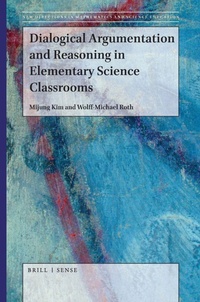
Dialogical Argumentation and Reasoning in Elementary Science Classrooms
Published on 25. October 2018
Book
Paperback/Softback
150 pages
978-90-04-39255-7 (ISBN)
Description
Science educators have come to recognize children's reasoning and problem solving skills as crucial ingredients of scientific literacy. As a consequence, there has been a concurrent, widespread emphasis on argumentation as a way of developing critical and creative minds. Argumentation has been of increasing interest in science education as a means of actively involving students in science and, thereby, as a means of promoting their learning, reasoning, and problem solving. Many approaches to teaching argumentation place primacy on teaching the structure of the argumentative genre prior to and at the beginning of participating in argumentation. Such an approach, however, is unlikely to succeed because to meaningfully learn the structure (grammar) of argumentation, one already needs to be competent in argumentation. This book offers a different approach to children's argumentation and reasoning based on dialogical relations, as the origin of internal dialogue (inner speech) and higher psychological functions. In this approach, argumentation first exists as dialogical relation, for participants who are in a dialogical relation with others, and who employ argumentation for the purpose of the dialogical relation. With the multimodality of dialogue, this approach expands argumentation into another level of physicality of thinking, reasoning, and problem solving in classrooms. By using empirical data from elementary classrooms, this book explains how argumentation emerges and develops in and from classroom interactions by focusing on thinking and reasoning through/in relations with others and the learning environment.
More details
Series
Language
English
Place of publication
Leiden
Netherlands
Target group
Professional and scholarly
Product notice
Paperback (trade)
Unsewn / adhesive bound
Dimensions
Height: 231 mm
Width: 152 mm
Thickness: 15 mm
Weight
227 gr
ISBN-13
978-90-04-39255-7 (9789004392557)
Copyright in bibliographic data and cover images is held by Nielsen Book Services Limited or by the publishers or by their respective licensors: all rights reserved.
Schweitzer Classification
Other editions
Additional editions
Mijung Kim | Wolff-Michael Roth
Dialogical Argumentation and Reasoning in Elementary Science Classrooms
Book
10/2018
Brill
€145.50
Shipment within 10-20 days
Persons
Mijung Kim is an associate professor of science education at the University of Alberta. She has published several journal articles and books on inquiry-based teaching, science curriculum and research, including Issues and Challenges in Science Education Research (Springer, 2012) and East-Asian Primary Science Curricula (Springer, 2017).
Wolff-Michael Roth is Lansdowne Professor of Applied Cognitive Science at the University of Victoria, Canada. He has published over 60 books and nearly 500 peer-reviewed journal articles. He was awarded many outstanding research awards and received an honorary doctorate (University of Ioannina, Greece).
Wolff-Michael Roth is Lansdowne Professor of Applied Cognitive Science at the University of Victoria, Canada. He has published over 60 books and nearly 500 peer-reviewed journal articles. He was awarded many outstanding research awards and received an honorary doctorate (University of Ioannina, Greece).
Content
Preface
List of Figures and Tables
1 Argumentation Research in Science Education
?Toulmin Argument Patterns
?Dialogue and Presumptive Argumentation
?Scientific Reasoning through Argumentation
?Overview
2 Vygotsky's Spinozist Perspectives on Language
?The Real Life of Language
?From Meaning to Sense
?The Sense-giving Contexture
?The Lived World Indicated by the Sign
?The System of Signs
?Sign-use as an Expressive Act
?Sign-use as a Communicative Act
?The Communicative Act as Soliciting a Behavior
?The In-order-to Motive and the Now, Here, and Thus of the Communicative Act
3 Children's Reasoning and Problem Solving
?The Complexity of Young Children's Reasoning
?What is Evidence?
?Evidence in Nested Sense-giving Contexture
4 Argumentation as Joint Action
?The Social Nature of the Word
?Argumentation and Emergence
?Laying the Garden Path in Walking
?Individualizing Collective Claims and Evidence
?Resolution of Contradictions and Emergence of New Trouble
?The Social Nature of Argumentation
5 The Role of Physical Objects in Science Lessons
?The Commonness and Difference of Physical Objects
?Abstraction: What is Happening in the Real Event?
?Physical Objects that Contribute to the Making of Sense
?Learning with Physical Objects
6 Argumentation and Inscriptions
?A Lesson Fragment
?From Explaining an Observation to Warranting a Claim
?Inscriptions in the Establishment of a Warrant
?Opportunities Arising from Working on the Chalkboard
7 Argumentation and the Thinking Body
?Position and Disposition
?Thinking and Speech
?Unity/Identity of Body and Mind
?On Overcoming the Psychophysical Problem
8 Teaching Argumentation in Elementary Science
?Attending to the Physicality of Argumentation
?Pointing and Formulating
?Being a Member of a Problem-Solving Community
Index
List of Figures and Tables
1 Argumentation Research in Science Education
?Toulmin Argument Patterns
?Dialogue and Presumptive Argumentation
?Scientific Reasoning through Argumentation
?Overview
2 Vygotsky's Spinozist Perspectives on Language
?The Real Life of Language
?From Meaning to Sense
?The Sense-giving Contexture
?The Lived World Indicated by the Sign
?The System of Signs
?Sign-use as an Expressive Act
?Sign-use as a Communicative Act
?The Communicative Act as Soliciting a Behavior
?The In-order-to Motive and the Now, Here, and Thus of the Communicative Act
3 Children's Reasoning and Problem Solving
?The Complexity of Young Children's Reasoning
?What is Evidence?
?Evidence in Nested Sense-giving Contexture
4 Argumentation as Joint Action
?The Social Nature of the Word
?Argumentation and Emergence
?Laying the Garden Path in Walking
?Individualizing Collective Claims and Evidence
?Resolution of Contradictions and Emergence of New Trouble
?The Social Nature of Argumentation
5 The Role of Physical Objects in Science Lessons
?The Commonness and Difference of Physical Objects
?Abstraction: What is Happening in the Real Event?
?Physical Objects that Contribute to the Making of Sense
?Learning with Physical Objects
6 Argumentation and Inscriptions
?A Lesson Fragment
?From Explaining an Observation to Warranting a Claim
?Inscriptions in the Establishment of a Warrant
?Opportunities Arising from Working on the Chalkboard
7 Argumentation and the Thinking Body
?Position and Disposition
?Thinking and Speech
?Unity/Identity of Body and Mind
?On Overcoming the Psychophysical Problem
8 Teaching Argumentation in Elementary Science
?Attending to the Physicality of Argumentation
?Pointing and Formulating
?Being a Member of a Problem-Solving Community
Index