

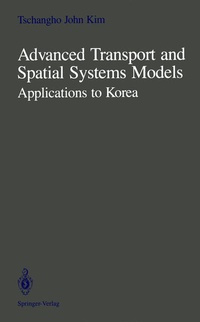
Advanced Transport and Spatial Systems Models
Applications to Korea
Published on 26. September 2011
Book
Paperback/Softback
XX, 255 pages
978-1-4612-8000-2 (ISBN)
Description
The usual view in a mixed economy is that some goods and services are produced privately and some, such as transportation, are produced publicly. Private institutions, such as households and entrepreneurs, produce and con sume goods and services in pursuing their parochial interests, while the pub lic sector attempts to broaden public interests. More precisely, the public sector constructs new transportation systems, improves their capaci ties, and regulates services and prices; and the private sector chooses locations of pro duction, modes of transportation, and routes of shipmellt. At the sallie' Lillte'. all forms of transportation influence our lives and cause us concern for Oll r environment, health, and safety. Thus, transportation is intimately woven into the daily life of individuals and organizations in our society. Because of its constant presence, transportation is easy to overlook until it fails in some way. Few would contend that private firms could or should construct an effi cient transportation system in a mixed economic system. Because the entire transportation system must be integrated and coordinated, firms with the power to construct such a system would have considerable monopoly control.
More details
Edition
Softcover reprint of the original 1st ed. 1990
Language
English
Place of publication
New York
United States
Target group
Professional and scholarly
Research
Illustrations
XX, 255 p.
Dimensions
Height: 235 mm
Width: 155 mm
Thickness: 16 mm
Weight
429 gr
ISBN-13
978-1-4612-8000-2 (9781461280002)
DOI
10.1007/978-1-4612-3410-4
Schweitzer Classification
Other editions
Additional editions
E-Book
12/2012
Springer
€96.29
Available for download
Book
06/1990
Springer
€96.29
Article exhausted; check different version
Persons
Content
I Introduction.- 1 National Development Plans and Planning Issues in Korea.- 2 The Transportation Systems in Korea.- II Linear Programming Models and Applications.- 3 A National Transportation Development Planning Model.- 4 Implementation of the Linear Programming Model: Experience from a Korean Application.- III Nonlinear Programming Models and Applications.- 5 Combined Input-Output and Commodity Flow Model: A Nonlinear Programming Formulation.- 6 Model Applications: Formulating Highway Investment Strategies.- IV Bilevel Programming Models and Applications.- 7 Bilevel Programming.- 8 Bilevel Transportation Network Design Models and Solution Algorithms.- 9 Model Application I: Measurement of Congestion Functions for Korean Highways.- 10 Model Application II: Evaluating Alternative Highway Investment Strategies.- V Advanced Transport and Spatial Planning Models: Future Prospects.- 11 Integrated National Transport Planning Model for Mixed Economic Systems: A Bilevel Programming Approach.- 12 Future Research Agenda.- Appendix A Optimality Conditions.- Appendix B Standardization of Units from the 1978 Survey.- Author Index.