

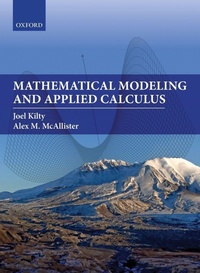
Mathematical Modeling and Applied Calculus
Published on 4. October 2018
Book
Hardback
812 pages
978-0-19-882472-5 (ISBN)
Description
This textbook is rich with real-life data sets, uses RStudio to streamline computations, builds "big picture" conceptual understandings, and applies them in diverse settings. Mathematical Modeling and Applied Calculus will develop the insights and skills needed to describe and model many different aspects of our world. This textbook provides an excellent introduction to the process of mathematical modeling, the method of least squares, and both differential and integral calculus, perfectly meeting the needs of today's students.
Mathematical Modeling and Applied Calculus provides a modern outline of the ideas of Calculus and is aimed at those who do not intend to enter the traditional calculus sequence. Topics that are not traditionally taught in a one-semester Calculus course, such as dimensional analysis and the method of least squares, are woven together with the ideas of mathematical modeling and the ideas of calculus to provide a rich experience and a large toolbox of mathematical techniques for future studies. Additionally, multivariable functions are interspersed throughout the text, presented alongside their single-variable counterparts. This text provides a fresh take on these ideas that is ideal for the modern student.
Mathematical Modeling and Applied Calculus provides a modern outline of the ideas of Calculus and is aimed at those who do not intend to enter the traditional calculus sequence. Topics that are not traditionally taught in a one-semester Calculus course, such as dimensional analysis and the method of least squares, are woven together with the ideas of mathematical modeling and the ideas of calculus to provide a rich experience and a large toolbox of mathematical techniques for future studies. Additionally, multivariable functions are interspersed throughout the text, presented alongside their single-variable counterparts. This text provides a fresh take on these ideas that is ideal for the modern student.
Reviews / Votes
There is an excellent balance of theory and application. Furthermore, most of the theoretical concepts covered in the textbook are essential for gaining facility in basic mathematical modelling. The book contains a high number of practice exercises. These extensive exercise sets give diverse opportunities to practice and deepen comprehension. The reviewer warmly recommends this book for consideration as a textbook for a course on calculus and/or mathematical modeling. * Teodora-Liliana Radulescu, Zentralblatt MATH * The two standout features of Mathematical Modelling and Applied Calculus are its synthesized approach to mathematical modelling and calculus and its use of real-world data ... There is an excellent balance of theory and application. Furthermore, most of the theoretical concepts covered in the textbook are those that are essential for gaining facility in basic mathematical modelling ... I definitely recommend this book for consideration as a textbook for a course on calculus and/or mathematical modelling for students majoring in life or social science disciplines. * 04/02/2019 *More details
Language
English
Place of publication
Oxford
United Kingdom
Target group
Adult education
Illustrations
approximately 680
Dimensions
Height: 252 mm
Width: 194 mm
Thickness: 48 mm
Weight
1741 gr
ISBN-13
978-0-19-882472-5 (9780198824725)
Copyright in bibliographic data and cover images is held by Nielsen Book Services Limited or by the publishers or by their respective licensors: all rights reserved.
Schweitzer Classification
Other editions
Additional editions
Joel Kilty | Alex McAllister
Mathematical Modeling and Applied Calculus
Book
10/2018
Oxford University Press
€66.85
Shipment within 15-20 days
Joel Kilty | Alex McAllister
Mathematical Modeling and Applied Calculus
E-Book
09/2018
1st Edition
OUP eBook
€49.99
Available for download
Persons
Joel M. Kilty joined the faculty of Centre College, a US News Top 50 Liberal Arts College, as an Assistant Professor of Mathematics in 2009, receiving tenure and promotion to the rank of Associate Professor in 2015. In 2017 he was named the Elizabeth Molloy Dowling Associate Professor of Mathematics. He received his Ph.D. and M.A. degrees in mathematics from the University of Kentucky in 2009 and 2006 respectively, and his B.A. degree in mathematics from Asbury College in 2004. He has published several research articles in the field of differential equations is an active member of the Mathematical Association of America.
Alex M. McAllister joined the Centre College faculty in 1999, and he has taught mathematics to undergraduates at the University of Notre Dame, Dartmouth College, and Centre College. He was awarded the H.W. Stodghill Jr. and Adele H. Stodghill Professorship in Mathematics in 2015 and the Mathematical Association of America's Kentucky Section Teaching Award in 2015. His scholarly interests include mathematical logic and foundations, computability theory, and the history of mathematics. McAllister earned a B.S. from Virginia Polytechnic Institute and State University, and a Ph.D. from the University of Notre Dame.
Alex M. McAllister joined the Centre College faculty in 1999, and he has taught mathematics to undergraduates at the University of Notre Dame, Dartmouth College, and Centre College. He was awarded the H.W. Stodghill Jr. and Adele H. Stodghill Professorship in Mathematics in 2015 and the Mathematical Association of America's Kentucky Section Teaching Award in 2015. His scholarly interests include mathematical logic and foundations, computability theory, and the history of mathematics. McAllister earned a B.S. from Virginia Polytechnic Institute and State University, and a Ph.D. from the University of Notre Dame.
Content
1: Functions for Modeling Data
1.1: Functions
1.2: Multivariable Functions
1.3: Linear Functions
1.4: Exponential Functions
1.5: Inverse Functions
1.6: Logarithmic Functions
1.7: Trigonometric Functions
2: Mathematical Modeling
2.1: Modeling with Linear Functions
2.2: Modeling with Exponential Functions
2.3: Modeling with Power Functions
2.4: Modeling with Sine Functions
2.5: Modeling with Sigmoidal Functions
2.6: Single Variable Modeling
2.7: Dimensional Analysis
3: The Method of Least Squares
3.1: Vectors and Vector Operations
3.2: Linear Combinations of Vectors
3.3: Existence of Linear Combinations
3.4: Vector Projection
3.5: The Method of Least Squares
4: Derivatives
4.1: Rates of Change
4.2: The Derivative as a Function
4.3: Derivatives of Modeling Functions
4.4: Product and Quotient Rules
4.5: The Chain Rule
4.6: Partial Derivatives
4.7: Limits and the Derivative
5: Optimization
5.1: Global Extreme Values
5.2: Local Extreme Values
5.3: Concavity and Extreme Values
5.4: Newton's Method and Optimization
5.5: Multivariable Optimization
5.6: Constrained Optimization
6: Accumulation and Integration
6.1: Accumulation
6.2: The Definite Integral
6.3: First Fundamental Theorem
6.4: Second Fundamental Theorem
6.5: The Method of Substitution
6.6: Integration by Parts
1.1: Functions
1.2: Multivariable Functions
1.3: Linear Functions
1.4: Exponential Functions
1.5: Inverse Functions
1.6: Logarithmic Functions
1.7: Trigonometric Functions
2: Mathematical Modeling
2.1: Modeling with Linear Functions
2.2: Modeling with Exponential Functions
2.3: Modeling with Power Functions
2.4: Modeling with Sine Functions
2.5: Modeling with Sigmoidal Functions
2.6: Single Variable Modeling
2.7: Dimensional Analysis
3: The Method of Least Squares
3.1: Vectors and Vector Operations
3.2: Linear Combinations of Vectors
3.3: Existence of Linear Combinations
3.4: Vector Projection
3.5: The Method of Least Squares
4: Derivatives
4.1: Rates of Change
4.2: The Derivative as a Function
4.3: Derivatives of Modeling Functions
4.4: Product and Quotient Rules
4.5: The Chain Rule
4.6: Partial Derivatives
4.7: Limits and the Derivative
5: Optimization
5.1: Global Extreme Values
5.2: Local Extreme Values
5.3: Concavity and Extreme Values
5.4: Newton's Method and Optimization
5.5: Multivariable Optimization
5.6: Constrained Optimization
6: Accumulation and Integration
6.1: Accumulation
6.2: The Definite Integral
6.3: First Fundamental Theorem
6.4: Second Fundamental Theorem
6.5: The Method of Substitution
6.6: Integration by Parts