

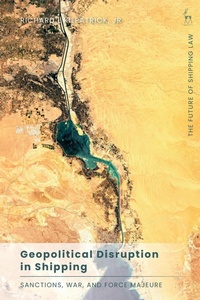
Geopolitical Disruption in Shipping
Sanctions, War, and Force Majeure
Published on 28. May 2026
Book
Hardback
280 pages
978-1-5099-8321-6 (ISBN)
Description
This book examines how the shipping industry is responding to the commercial challenges caused by geopolitical risk.
Geopolitical volatility in the modern world is generating physical and economic obstacles that are disrupting shipping activities and causing disputes that raise fundamental questions of commercial law. Studying this phenomenon by exploring common themes among varied dimensions of business disruption, the book first surveys physical disruption to shipping activities across the categories of war, unrest and piracy. It then turns to the purely economic disruption caused by sanctions and alternative forms of statecraft deployed in' 'trade wars'.
The book examines each of these categories by highlighting geopolitical and regulatory context, assessing industry adaptations, and analysing cross-jurisdictional case law to gather insight into the contractual rights and responsibilities impacted by these scenarios. Assessing solutions - including the development of bespoke contract clauses and the application of broader principles of illegality, impossibility, frustration, and force majeure - the book demonstrates that this rapidly evolving area of international commercial law demands a readiness to borrow analytical approaches across categories of business disruption.
With industry participants, courts, arbitrators and scholars in mind, the book provides a contemporary perspective on the geopolitical challenges affecting shipping through a distinctive commercial law lens.
Geopolitical volatility in the modern world is generating physical and economic obstacles that are disrupting shipping activities and causing disputes that raise fundamental questions of commercial law. Studying this phenomenon by exploring common themes among varied dimensions of business disruption, the book first surveys physical disruption to shipping activities across the categories of war, unrest and piracy. It then turns to the purely economic disruption caused by sanctions and alternative forms of statecraft deployed in' 'trade wars'.
The book examines each of these categories by highlighting geopolitical and regulatory context, assessing industry adaptations, and analysing cross-jurisdictional case law to gather insight into the contractual rights and responsibilities impacted by these scenarios. Assessing solutions - including the development of bespoke contract clauses and the application of broader principles of illegality, impossibility, frustration, and force majeure - the book demonstrates that this rapidly evolving area of international commercial law demands a readiness to borrow analytical approaches across categories of business disruption.
With industry participants, courts, arbitrators and scholars in mind, the book provides a contemporary perspective on the geopolitical challenges affecting shipping through a distinctive commercial law lens.
More details
Series
Language
English
Place of publication
Oxford
United Kingdom
Publishing group
Bloomsbury Publishing PLC
Target group
Professional and scholarly
College/higher education
Dimensions
Height: 240 mm
Width: 161 mm
Thickness: 19 mm
Weight
578 gr
ISBN-13
978-1-5099-8321-6 (9781509983216)
Copyright in bibliographic data and cover images is held by Nielsen Book Services Limited or by the publishers or by their respective licensors: all rights reserved.
Schweitzer Classification
Other editions
Additional editions
E-Book
05/2026
1st Edition
Hart Publishing
€100.99
Available for download
E-Book
05/2026
1st Edition
Hart Publishing
€100.99
Available for download
Person
Richard L Kilpatrick, Jr is Visiting Professor of Law at the William H. Bowen School of Law, University of Arkansas at Little Rock, USA, and Academic Fellow at the Centre for Maritime Law, National University of Singapore.
Content
1. Introduction
2. War
3. Unrest
4. Piracy
5. Sanctions
6. Statecraft
7. Conclusion
2. War
3. Unrest
4. Piracy
5. Sanctions
6. Statecraft
7. Conclusion