

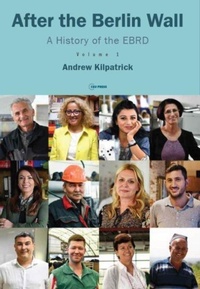
After the Berlin Wall
A History of the EBRD, Volume 1
Published on 1. September 2020
Book
Hardback
420 pages
978-963-386-394-7 (ISBN)
Description
After the Berlin Wall tells the inside story of an international financial institution, the European Bank for Reconstruction and Development (EBRD), created in the aftermath of communism to help the countries of central and eastern Europe transition towards open market-oriented democratic economies.
The first volume of a history in two parts, After the Berlin Wall charts the EBRD's life from a fledgling high-risk start-up investing in former socialist countries from 1991 to become an established member of the international financial community, which (as of April 2020) operates in almost 40 countries across three continents.
This volume describes the multilateral negotiations that created this cosmopolitan institution with a 'European character' and the emergence of the EBRD's unique business model: a focus on the private sector and a mission to deliver development impact with sustainable financial returns. The author recounts the challenges that 'transition' countries faced in moving from a defunct to a functioning economic system and maps the EBRD's response to critical events, from the dissolution of the Soviet Union, to the safe confinement of the Chernobyl disaster site, the debt default in Russia and the onset of the global financial crisis in 2008.
The first volume of a history in two parts, After the Berlin Wall charts the EBRD's life from a fledgling high-risk start-up investing in former socialist countries from 1991 to become an established member of the international financial community, which (as of April 2020) operates in almost 40 countries across three continents.
This volume describes the multilateral negotiations that created this cosmopolitan institution with a 'European character' and the emergence of the EBRD's unique business model: a focus on the private sector and a mission to deliver development impact with sustainable financial returns. The author recounts the challenges that 'transition' countries faced in moving from a defunct to a functioning economic system and maps the EBRD's response to critical events, from the dissolution of the Soviet Union, to the safe confinement of the Chernobyl disaster site, the debt default in Russia and the onset of the global financial crisis in 2008.
More details
Language
English
Place of publication
Amsterdam
Hungary
Target group
Professional and scholarly
Product notice
sewn/stitched
Cloth over boards
ISBN-13
978-963-386-394-7 (9789633863947)
Copyright in bibliographic data and cover images is held by Nielsen Book Services Limited or by the publishers or by their respective licensors: all rights reserved.
Schweitzer Classification
Other editions
Additional editions

Book
12/2020
Central European University Press
€81.50
Available (delivery time upon request)
Person
Andrew Kilpatrick is a consultant to the European Bank for Reconstruction and Development (EBRD) and World Bank Group. Until 2018, he was executive counsellor to the Chief Economist at the EBRD and Director for Project and Sector Assessment in the Economics and Policy Group from 2008.
Content
List of Abbreviations
Acknowledgments
Personal Foreword by Suma Chakrabarti
Preface
PART I Post-Cold War Pioneer
Chapter 1 A New International Development Institution
Chapter 2 Creating the EBRD's DNA
Chapter 3 Difficult Early Years
Chapter 4 Restoring Credibility
PART II Transition Mode
Chapter 5 Scaling Up through Financial Institutions
Chapter 6 Supporting Privatisation and Restructuring
Chapter 7 Developing Local Services
Chapter 8 Environment Matters
Chapter 9 Nuclear Safety
Chapter 10 Embedding Impact in the Business Model
PART III Holding Course
Chapter 11 Russian Crisis
Chapter 12 Recovery, Growth and Graduation
Appendix
Index
Acknowledgments
Personal Foreword by Suma Chakrabarti
Preface
PART I Post-Cold War Pioneer
Chapter 1 A New International Development Institution
Chapter 2 Creating the EBRD's DNA
Chapter 3 Difficult Early Years
Chapter 4 Restoring Credibility
PART II Transition Mode
Chapter 5 Scaling Up through Financial Institutions
Chapter 6 Supporting Privatisation and Restructuring
Chapter 7 Developing Local Services
Chapter 8 Environment Matters
Chapter 9 Nuclear Safety
Chapter 10 Embedding Impact in the Business Model
PART III Holding Course
Chapter 11 Russian Crisis
Chapter 12 Recovery, Growth and Graduation
Appendix
Index