

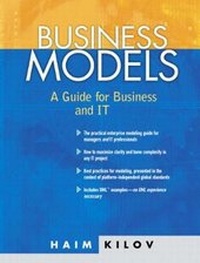
Business Models
A Guide for Business and IT
Published on 4. July 2002
Book
Paperback/Softback
256 pages
978-0-13-062135-1 (ISBN)
Description
To build software systems that meet business objectives, IT and business professionals must work together closely to define specifications and build models that accurately describe those objectives. This book gives them the shared language they need to accomplish this. Haim Kilov illuminates every key concept underlying today's most important approaches to specifications and modeling, giving business professionals practical insight for decision-making, and giving IT specialists the tools they need to evaluate IT artifacts in the context of business goals.KEY TOPICS:Drawing on his extraordinarily rich real-world experience in modeling systems for finance, telecommunications, document management, and other industries, Haim Kilov describes every factor that impacts business models, systems and specifications. He presents today's most effective modeling techniques in the context of international standards that are independent of any technology, methodology or tool, and will work in any enterprise environment. Along the way, he presents many examples, and shows how key modeling concepts can be used within the framework of today's most popular tools, notably UML.MARKET:For all IT architects, system designers, business analysts, consultants, and managers who are planning, modeling, and constructing complex enterprise software systems.
More details
Persons
HAIM KILOV is Chief Consulting Architect, Business Modeling and a member of the Strategic Enterprise Solutions (SES) group at IONA Technologies. Widely known as an authority on the capture and modeling of business and systems requirements for large-scale information systems, Kilov is a major contributor to OMG and ISO standards in these areas. He is author of Business Specifications: The Key to Successful Software Engineering (Prentice Hall PTR).
Content
Introduction.
Acknowledgments.
1. The Purpose of Modeling.
Success and Failure of Projects and Strategies. Core Competencies. Education. The Need for Understanding: Abstraction, Precision, Explicitness. Abstraction: The Way to Put Management in Control. Basic Structuring Constructs. Business Rules: Precision vs Handwaving. Tacit Assumptions and "Evident Truths". Specifying Problems and Solutions. Where to Start and Why: Business Domains.
2. The Basics of Modeling.
A Few Concepts and Structuring Rules. The Basic Stuff: Things, Relationships, and Actions. How Not to Get Lost: Abstraction Viewpoints and Levels. The Structure of a Composition. The Structure of Subtyping: How to Recognize, Treat and Structure Similarities. Templates. How to Treat Stable Properties: Invariants. How to Treat Changes: Epochs. How to Treat Environments. Contracts and Their Contexts. Trading. How to Treat Names. How to Treat "Exceptional" Situations. Various Viewpoints and the Five Basic Viewpoints. Synergy between Business and IT Specifications. The Business of the Business, the Business of the IT System, and the Business of the Traceability. How to Test Systems.
3. Putting It All Together.
Business Patterns: From Basic to Specific. Reuse: Pattern Matching in Context. Metaphors and Notations. Experience. Conclusion: Debuzzwordification. On Thinking.
Appendix A: The UML Subset Used for Representation.
On Tools and Specifications. What to Include in UML Diagrams? Simplification. A Simple Example (a Contract) and Lessons Learned. Relationship Invariants Are About Property Determination. Relationships Between Actions. Reading and Writing Large(r) Business Specifications. Separation of Concerns: Problem vs Solution. Additional Practical Hints. Where Do These Ideas Come From?
Appendix B: Generic Relationships.
A Generic Relationship: Generic Properties. Generic Relationships: The Taxonomy.
References.
Index.
Acknowledgments.
1. The Purpose of Modeling.
Success and Failure of Projects and Strategies. Core Competencies. Education. The Need for Understanding: Abstraction, Precision, Explicitness. Abstraction: The Way to Put Management in Control. Basic Structuring Constructs. Business Rules: Precision vs Handwaving. Tacit Assumptions and "Evident Truths". Specifying Problems and Solutions. Where to Start and Why: Business Domains.
2. The Basics of Modeling.
A Few Concepts and Structuring Rules. The Basic Stuff: Things, Relationships, and Actions. How Not to Get Lost: Abstraction Viewpoints and Levels. The Structure of a Composition. The Structure of Subtyping: How to Recognize, Treat and Structure Similarities. Templates. How to Treat Stable Properties: Invariants. How to Treat Changes: Epochs. How to Treat Environments. Contracts and Their Contexts. Trading. How to Treat Names. How to Treat "Exceptional" Situations. Various Viewpoints and the Five Basic Viewpoints. Synergy between Business and IT Specifications. The Business of the Business, the Business of the IT System, and the Business of the Traceability. How to Test Systems.
3. Putting It All Together.
Business Patterns: From Basic to Specific. Reuse: Pattern Matching in Context. Metaphors and Notations. Experience. Conclusion: Debuzzwordification. On Thinking.
Appendix A: The UML Subset Used for Representation.
On Tools and Specifications. What to Include in UML Diagrams? Simplification. A Simple Example (a Contract) and Lessons Learned. Relationship Invariants Are About Property Determination. Relationships Between Actions. Reading and Writing Large(r) Business Specifications. Separation of Concerns: Problem vs Solution. Additional Practical Hints. Where Do These Ideas Come From?
Appendix B: Generic Relationships.
A Generic Relationship: Generic Properties. Generic Relationships: The Taxonomy.
References.
Index.