

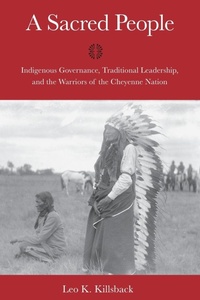
A Sacred People
Indigenous Governance, Traditional Leadership, and the Warriors of the Cheyenne Nation
Published on 30. October 2019
Book
Hardback
320 pages
978-1-68283-035-2 (ISBN)
Description
Selected for the 2021 Donald L. Fixico Award for Best Book on American Indian and Canadian First Nations HistoryBefore an indigenous people can decolonize, Leo Killsback explains, they must first understand what the world was like before colonization. Such understanding allows indigenous people to generate realistic goals and achieve positive change, reinventing themselves into people and nations who can honor original ways without corrupting or disgracing them.
In two volumes, A Sacred People and A Sovereign People, Killsback, a citizen of the Northern Cheyenne Nation, reconstructs and rekindles an ancient Cheyenne world--ways of living and thinking that became casualties of colonization and forced assimilation. Spanning more than a millennium of antiquity and recovering stories and ideas interpreted from a Cheyenne worldview, the works' joint purpose is rooted as much in a decolonization roadmap as it is in preservation of culture and identity for the next generations of Cheyenne people.
Dividing the story of the Cheyenne Nation into pre- and post-contact, A Sacred People and A Sovereign People lay out indigenously conceived possibilities for employing traditional worldviews to replace unhealthy and dysfunctional ones bred of territorial, cultural, and psychological colonization.
Together these volumes use an ancient past to confront long-standing challenges and to speak to the future. Comprising teachings that go to the true identities of the old ones, they reveal a way of thinking that today very few people know and even fewer live. Within such revelations about past leaders and events, Killsback demonstrates, lie the foundations for rebuilding and healing the Cheyenne Nation.
In two volumes, A Sacred People and A Sovereign People, Killsback, a citizen of the Northern Cheyenne Nation, reconstructs and rekindles an ancient Cheyenne world--ways of living and thinking that became casualties of colonization and forced assimilation. Spanning more than a millennium of antiquity and recovering stories and ideas interpreted from a Cheyenne worldview, the works' joint purpose is rooted as much in a decolonization roadmap as it is in preservation of culture and identity for the next generations of Cheyenne people.
Dividing the story of the Cheyenne Nation into pre- and post-contact, A Sacred People and A Sovereign People lay out indigenously conceived possibilities for employing traditional worldviews to replace unhealthy and dysfunctional ones bred of territorial, cultural, and psychological colonization.
Together these volumes use an ancient past to confront long-standing challenges and to speak to the future. Comprising teachings that go to the true identities of the old ones, they reveal a way of thinking that today very few people know and even fewer live. Within such revelations about past leaders and events, Killsback demonstrates, lie the foundations for rebuilding and healing the Cheyenne Nation.
More details
Series
Language
English
Place of publication
College Station
United States
Target group
Professional and scholarly
Dimensions
Height: 229 mm
Width: 152 mm
Thickness: 20 mm
Weight
547 gr
ISBN-13
978-1-68283-035-2 (9781682830352)
Copyright in bibliographic data and cover images is held by Nielsen Book Services Limited or by the publishers or by their respective licensors: all rights reserved.
Schweitzer Classification
Other editions
Additional editions
Leo K. Killsback
A Sacred People
Indigenous Governance, Traditional Leadership, and the Warriors of the Cheyenne Nation
E-Book
04/2020
Naval Institute Press
€9.49
Available for download
Person
Leo K. Killsback grew up on the Northern Cheyenne Indian Reservation and teaches American Indian Studies at Arizona State University. Devoted to the preservation and resurgence of Cheyenne language and culture, he sustains relationships within his nation by means of the collaborative methodologies that neither exploit nor marginalize.