

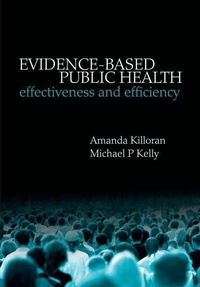
Evidence-based Public Health
Effectiveness and efficiency
Published on 26. November 2009
Book
Paperback/Softback
528 pages
978-0-19-956362-3 (ISBN)
Description
Evidence-based Public Health: Effectiveness and efficiency continues the themes raised in Public Health Evidence - tackling health inequalities. Written by the same author team, this book is a comprehensive reference to evidence-based approaches in public health. It covers the context and role of evidence-based public health in England; frameworks for evaluating the effectiveness and cost effectiveness of public health policies and interventions; diversity, vulnerability and risk as a focus for understanding the role of social context in influencing health-related behaviours; approaches and methods to generate and synthesize evidence of what works to improve health and tackle health inequalities; current best available evidence on the effectiveness of a diverse range of interventions; and the role of evidence-based guidance and standards in changing policy and practice.
This book will be essential reading for all those concerned with advancing an evidence-based approach to public health, and tackling health inequalities, including academics, researchers, policy makers, postgraduate students in public health, and anyone involved across different sectors of public health, including local government, health and education, Whilst based on work done in England by NICE, the book contains generic principles which are applicable internationally.
This book will be essential reading for all those concerned with advancing an evidence-based approach to public health, and tackling health inequalities, including academics, researchers, policy makers, postgraduate students in public health, and anyone involved across different sectors of public health, including local government, health and education, Whilst based on work done in England by NICE, the book contains generic principles which are applicable internationally.
Reviews / Votes
This may be the most comprehensive conceptual treatment of generating and appraising evidence for public health currently available. * Doody's Notes *More details
Language
English
Place of publication
Oxford
United Kingdom
Target group
College/higher education
Product notice
Paperback (trade)
Unsewn / adhesive bound
Illustrations
numerous figures
Dimensions
Height: 245 mm
Width: 172 mm
Thickness: 32 mm
Weight
892 gr
ISBN-13
978-0-19-956362-3 (9780199563623)
Copyright in bibliographic data and cover images is held by Nielsen Book Services Limited or by the publishers or by their respective licensors: all rights reserved.
Schweitzer Classification
Other editions
Additional editions
Mike P. Kelly Amanda Killoran
Evidence-based Public Health: Effectiveness and efficiency
Effectiveness and efficiency
E-Book
11/2009
1st Edition
OUP Oxford
€115.69
Available for download
Amanda Killoran | Mike P. Kelly
Evidence-based Public Health: Effectiveness and efficiency
Effectiveness and efficiency
E-Book
11/2009
1st Edition
OUP Oxford
€115.69
Available for download
Persons
Dr Amanda Killoran is a Public Health Analyst at the Centre for Public Health Excellence at the National Institute for Health and Clinical Excellence. Dr Killoran has worked at national level on public health policy, research and evaluation over many years (previously at the Health Development Agency, and Health Educational Authority). Currently Dr Killoran has technical responsibilities for the development of evidence-based public health guidance covering a wide range of areas (such as sexual health, emotional and social wellbeing of children, spatial planning, and mental wellbeing at work), and contributes to methodological developments relating to review of public health evidence. She is Fellow of the Faculty of Public Health and holds voluntary registration, and also has an honorary lectureship at the London School of Hygiene and Tropical Medicine. Dr Killoran also contributes to national evaluation programmes as a Visiting Fellow in Health Policy Analysis at the King's Fund.
Professor Mike Kelly is Director of the Centre of Public Health Excellence at NICE. He originally graduated in Social Science from the University of York, holds a Masters degree in Sociology from the University of Leicester, and undertook his PhD in the Department of Psychiatry in the University of Dundee. Before joining new NICE he was Director of Evidence and Guidance at the Health Development Agency. Professor Kelly has held posts at the Universities of Leicester, Dundee, Glasgow, Greenwich and Abertay. He now has an honorary chair in the Department of Public Health and Policy at the London School of Hygiene and Tropical Medicine, University of London and is a Fellow of the Faculty of Public Health. At NICE Professor Kelly has led the development of the public health portfolio since 2005. This has included the public health guidance on the prevention and management of obesity, behaviour change, maternal and child health, community engagement and physical activity and the environment.
Professor Mike Kelly is Director of the Centre of Public Health Excellence at NICE. He originally graduated in Social Science from the University of York, holds a Masters degree in Sociology from the University of Leicester, and undertook his PhD in the Department of Psychiatry in the University of Dundee. Before joining new NICE he was Director of Evidence and Guidance at the Health Development Agency. Professor Kelly has held posts at the Universities of Leicester, Dundee, Glasgow, Greenwich and Abertay. He now has an honorary chair in the Department of Public Health and Policy at the London School of Hygiene and Tropical Medicine, University of London and is a Fellow of the Faculty of Public Health. At NICE Professor Kelly has led the development of the public health portfolio since 2005. This has included the public health guidance on the prevention and management of obesity, behaviour change, maternal and child health, community engagement and physical activity and the environment.
Content
PART 1 - PUBLIC HEALTH CHALLENGES OF THE 21ST CENTURY ; 1. Trends and scenarios in public health in the UK ; 2. Policy and evidence-based public health ; 3. Ethics and evidence in health promotion ; PART 2 - EVIDENCE-BASED FRAMEWORKS ; 4. Theory-driven approach - 'programme theories' /'theory of change' concepts ; 5. Equity, risk and the life course: a framework for understanding and tackling health inequalities ; 6. Vulnerability, disadvantage and sexual health ; 7. Social context and youth health: understanding and mitigating exclusion ; 8. Use of economic methods to evaluate the cost effectiveness of public health interventions ; 9. Equity and efficiency: the contribution of health economics ; 10. Valuation of health in public health in economic evaluations ; 11. Ethics and public health: the ethics of intervention choices ; PART 3 - GENERATING EVIDENCE ; 12. Developing and evaluating complex interventions ; 13. Child health and wellbeing in the early years: the national evaluation of Sure Start ; 14. Smoking cessation ; 15. Diabetes-population based prevention programmes among South Asians ; 16. The Gatehouse project: a multi-level integrated approach to promoting wellbeing in schools ; 17. Workplace and mental wellbeing - Whitehall 2 Study ; 18. Area-based initiatives in deprived neighbourhoods ; 19. Built environment - 'walkability' of neighbourhoods ; 20. Fiscal policy and health-related behaviours ; PART 4 - SYNTHESISING EVIDENCE AND DEVELOPING GUIDANCE ; 21. Assessing evidence: study quality ; 22. Assessing evidence and prioritising clinical and public health guidance recommendations ; 23. Social values in developing public health guidance ; 24. Developing guidance on changing behaviour ; 25. What works in promoting the emotional and social well being of children in primary education? ; 26. What environmental measures are effective in promoting physical activity? ; 27. Developing evidence based guidance for health technologies: the NICE experience ; 28. Supporting implementation of public health guidance: NICE experience ; PART 5 - KNOWLEDGE, EVIDENCE AND POLICY ; 29. The individual and social level of public health ; 30. Informing public health policy with the best available evidence ; 31. Changing policy: reflections on the role of public health evidence