

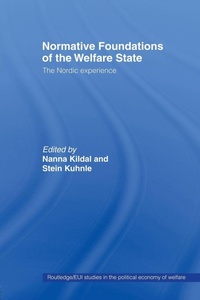
Normative Foundations of the Welfare State
The Nordic Experience
1st Edition
Published on 8. December 2006
Book
Paperback/Softback
274 pages
978-0-415-42976-4 (ISBN)
Description
This is a sharp analysis of the unique Nordic welfare system with urgent lessons for governments and societies across the globe.
Welfare programs and institutions tend to be analyzed as instrumental arrangements, overlooking the fact that welfare programs are essentially expressions of moral conceptions and values. This book recognises this distinction and offers analyses, perspectives and interpretations of the normative foundation of the 'Nordic welfare state model'.
These authors examine the main normative principles in this model, exploring their origins and the relationship between them. Paying particular attention to the principles of 'universalism', 'public responsibility for welfare', and 'work for all', they consider their significance for current welfare policy and question whether external economic and ideological pressures are threatening these principles. The book is divided into three clear parts:
*Part I considers the historical trajectories behind the Nordic welfare model
*Part II looks more specifically on normative tensions and dilemmas in current welfare policies with a focus on women friendly welfare, attitudes to basic income and alcohol and drug misuse
*Part III focuses on the possible change in the normative foundation of the Nordic welfare states
This book will be essential reading for researchers and students of the welfare state and also to those in the fields of social policy, comparative politics and political economy.
Welfare programs and institutions tend to be analyzed as instrumental arrangements, overlooking the fact that welfare programs are essentially expressions of moral conceptions and values. This book recognises this distinction and offers analyses, perspectives and interpretations of the normative foundation of the 'Nordic welfare state model'.
These authors examine the main normative principles in this model, exploring their origins and the relationship between them. Paying particular attention to the principles of 'universalism', 'public responsibility for welfare', and 'work for all', they consider their significance for current welfare policy and question whether external economic and ideological pressures are threatening these principles. The book is divided into three clear parts:
*Part I considers the historical trajectories behind the Nordic welfare model
*Part II looks more specifically on normative tensions and dilemmas in current welfare policies with a focus on women friendly welfare, attitudes to basic income and alcohol and drug misuse
*Part III focuses on the possible change in the normative foundation of the Nordic welfare states
This book will be essential reading for researchers and students of the welfare state and also to those in the fields of social policy, comparative politics and political economy.
Reviews / Votes
'This is an important book as a valuable resource for policy makers who want to study and maybe appropriate the Nordic welfare model. Its in-depth material transmits the message that such a transformation is not straightforward. But it does provide the information to assess such a process.' - Yitzhak Berman, European Centre for Social Welfare Policy and Research'The collection as a whole will be an invalueable resource for Scandinavianists and comparative welfare state researchers, especially the editors own introductory essay on The Nordic Welfare Model and the Idea of Universalism, which is quite simply the best chapter-length treatment of that topic I know. - Political Studies Review
More details
Series
Language
English
Place of publication
London
United Kingdom
Publishing group
Taylor & Francis Ltd
Target group
College/higher education
Professional and scholarly
Postgraduate and Professional
Dimensions
Height: 234 mm
Width: 156 mm
Thickness: 15 mm
Weight
424 gr
ISBN-13
978-0-415-42976-4 (9780415429764)
Copyright in bibliographic data and cover images is held by Nielsen Book Services Limited or by the publishers or by their respective licensors: all rights reserved.
Schweitzer Classification
Other editions
Additional editions
E-Book
05/2007
Routledge
€77.99
Available for download
E-Book
05/2007
Routledge
€77.99
Available for download
E-Book
05/2007
1st Edition
Routledge
€270.00
Available for download
Book
04/2005
1st Edition
Routledge
€215.77
Shipment within 15-20 days
Persons
Nanna Kildal is a Researcher at Stein Rokkan Centre for Social Studies, University of Bergen. Her current research interests are normative studies of welfare policies and studies of policy transfer. She has written a number of articles on the 1990s welfare reforms in Europe and USA.Stein Kuhnle is Professor of Comparative Politics at the University of Bergen. Among his recent publications in English are (ed.) Survival of the European Welfare State (Routledge, 2000); The Nordic welfare state in a European context: dealing with new economic and ideological challenges in the 1990s, European Review, Vol. 8, No. 3, 379-398 (2000); and Democracy and Productive Welfare: European and Korean Welfare Policy Development in Perspective, and The Journal of the Korean Economy, Vol. 3, No. 1, 59-83 (Spring 2002).
Content
Part One: Normative Foundations: Historical Perspectives 1. Nanna Kildal and Stein Kuhnle - The Principle of Universalism: Tracing a Key Idea in the Scandinavian Welfare Model 2. Bo Strath - The Normative Foundations of the Scandinavian Welfare States in Historical Perspective 3. Lars Bo Kaspersen - The Origin, Development, Consolidation and Transformation of the Danish Welfare State 4. Anders Nordlund - Nordic Social Politics in the Late 20th Century - an Analysis of the Political Reform Agenda Part Two: Normative Tensions 5. Birte Siim and Anette Borchorst - The Women-friendly Welfare State Revisited 6. Jan Otto Andersson and Olli Kangas - Universalism in the Age of Workfare: Attitudes to Basic Income in Sweden and Finland 7. Olavi Kaukonen and Kerstin Stenius - Comprehensiveness under Threat? From Administrative Coercion to Professional Subordination of Substance Misusers 8. Sven E. O. Hort - Three Normative Worlds in Three Welfare Projects during the 1990s - Decennium Horribilis? Part Three: Towards a Paradigm Shift? 9. Rune Ervik - Changing Normative Bases of the Nordic Welfare States? The Case of Pension Provision in Norway 10. Marcus Carson - Paradigm Shift to System Shift in the Swedish Welfare State 11. Stefan Olafsson - Welfare Regime Shift in Iceland? 12. Jorn Loftager - Which Democracy - Whose Welfare?