

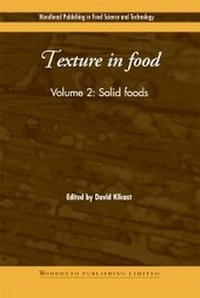
Texture in Food
Solid Foods
Published on 14. April 2004
Book
Hardback
560 pages
978-1-85573-724-2 (ISBN)
Description
Texture is one of the most important attributes used by consumers to assess food quality. With its distinguished editor and international team of contributors, this authoritative book summarises the wealth of recent research on what influences texture in solid foods and how it can be controlled to maximise product quality.
The first part of the book reviews research on understanding how consumers experience texture when they eat, and how they perceive and describe key textural qualities such as crispness. Part two considers the instrumental techniques used for analysing texture. It includes chapters on force/deformation and sound input techniques, near infrared spectroscopy (NIR), nuclear magnetic resonance (NMR) and magnetic resonance imaging (MRI). The final part examines how the texture of particular foods may be better understood and improved. A number of chapters review ways of controlling the texture of fruits and vegetables, including the role of plant structure and compounds, the handling of raw materials and technologies such as freezing and vacuum infusion. A final group of chapters discuss the texture of cereal foods, including bread, rice, pasta and fried food.
Texture in food Volume 2: Solid foods is a standard reference for the food industry. It is accompanied by a companion volume on the texture of semi-solid foods.
The first part of the book reviews research on understanding how consumers experience texture when they eat, and how they perceive and describe key textural qualities such as crispness. Part two considers the instrumental techniques used for analysing texture. It includes chapters on force/deformation and sound input techniques, near infrared spectroscopy (NIR), nuclear magnetic resonance (NMR) and magnetic resonance imaging (MRI). The final part examines how the texture of particular foods may be better understood and improved. A number of chapters review ways of controlling the texture of fruits and vegetables, including the role of plant structure and compounds, the handling of raw materials and technologies such as freezing and vacuum infusion. A final group of chapters discuss the texture of cereal foods, including bread, rice, pasta and fried food.
Texture in food Volume 2: Solid foods is a standard reference for the food industry. It is accompanied by a companion volume on the texture of semi-solid foods.
Reviews / Votes
"...a very useful guide for anybody in the field of food science who is or would like to be involved in texture related studies." --International Journal of Food Science and Technology"...this book is a timely and noteworthy presentation by many experts in the field of food texture studies. ...strongly recommend this book to anyone in academia or industry." --Institute of Chemical Engineers
"...distinguished editor and international team of contributors, Textute in food summarises the wealth of recent research on what influences texture in solid foods, and how in can be controlled to maximise product quality." --Chemistry and Industry
More details
Series
Language
English
Place of publication
Cambridge
United Kingdom
Publishing group
Elsevier Science & Technology
Target group
Professional and scholarly
Dimensions
Height: 234 mm
Width: 156 mm
Weight
980 gr
ISBN-13
978-1-85573-724-2 (9781855737242)
Copyright in bibliographic data and cover images is held by Nielsen Book Services Limited or by the publishers or by their respective licensors: all rights reserved.
Schweitzer Classification
Other editions
Additional editions
E-Book
04/2004
Woodhead Publishing
€240.00
Available for download
Person
Content
Part 1 Consumers, texture and food quality: Measuring consumer perceptions of texture: An overview; Consumers and texture: Understanding their perceptions and preferences; Texture and mastication; Understanding and measuring consumer perceptions of crispness. Part 2 Instrumental techniques for analysing texture: Force/deformation techniques for measuring texture; Sound input techniques for measuring texture; Near infrared (NIR) diffuse reflectance in texture measurement; Nuclear magnetic resonance (NMR) and magnetic resonance imaging (MRI) in texture measurement; Modelling food texture. Part 3 Understanding and improving the texture of particular foods: Plant structure, fruit and vegetable texture; Plant compounds and fruit texture: The case of pear; Controlling the texture of fruit and vegetables: The role of oxidising enzymes; Improving fruit and vegetable texture by genetic transformation; Raw material quality and the texture of processed vegetables; Improving the texture of processed vegetables by vacuum infusion; Improving the texture of frozen fruit: The case of berries; Improving the texture of processed fruit: The case of olives; Improving the texture of bread; Analysing and improving the texture of cooked rice; Improving the texture of pasta; Improving the texture of fried food.