

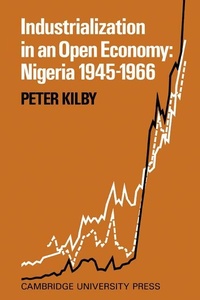
Industrialization in an Open Economy
Nigeria 1945-1966
Published on 14. October 2008
Book
Paperback/Softback
420 pages
978-0-521-08401-7 (ISBN)
Description
This book provides a detailed study of how manufacturing and processing industries have developed in the largest country of West Africa. Three chapters devoted to import substitution examine the interaction of growing consumer demand and the market strategy objectives of foreign merchant firms which produced the sudden spurt of industrialization in the late 1950s. It is shown that conventional government promotion policies played an insignificant role in triggering industrial development. Subsequent chapters present analyses of Nigeria's processing industries, applied industrial research, labour supply and productivity, technical education, industrial relations and indigenous entrepreneurial performance. The study goes beyond questions of efficiency in allocating resources, to underlying organizational and institutional factors. Professor Kilby concludes by isolating key problems in the industrialization process and by suggesting an optimum development strategy.
More details
Language
English
Place of publication
Cambridge
United Kingdom
Target group
Professional and scholarly
Product notice
Paperback (trade)
Illustrations
Worked examples or Exercises
Dimensions
Height: 229 mm
Width: 152 mm
Thickness: 25 mm
Weight
679 gr
ISBN-13
978-0-521-08401-7 (9780521084017)
Copyright in bibliographic data and cover images is held by Nielsen Book Services Limited or by the publishers or by their respective licensors: all rights reserved.
Schweitzer Classification
Other editions
Additional editions
Book
09/1969
Cambridge University Press
€11.77
Article exhausted; check for reprint
Previous edition
Book
09/1969
Cambridge University Press
€11.77
Article exhausted; check for reprint
Content
Introduction; Part I: 1. Growth of the Nigerian Economy 1900-1966; 2. The Market; Part II: 3. From Trade to Manufacture: The Mechanics of Import Substitution; 4. Import Substitution: Case Studies and Policy Implications; Part III: 5. Utilizing Domestic Resources: Processing for Export; 6. Utilizing Domestic Resources: Applied Industrial Research; Part IV: 7. The Supply of Labour; 8. Education and Skill Formation; 9. Industrial Relations and Wage Determination: Failure of the Anglo-Saxon Model; Part V: 10. Indigenous Enterprise; Part VI: 11. Conclusion: A Strategy for Industrialization.