

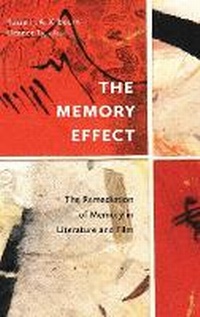
The Memory Effect
The Remediation of Memory in Literature and Film
Published on 25. September 2013
Book
Hardback
364 pages
978-1-55458-914-2 (ISBN)
Description
The Memory Effect is a collection of essays on the status of memory - individual and collective, cultural and transcultural - in contemporary literature, film, and other visual media. Contributors look at memory's representation, adaptation, translation, and appropriation, as well as its mediation and remediation. Memory's irreducibly constructed nature is explored, even as its status is reaffirmed as the basis of both individual and collective identity.
The book begins with an overview of the field, with an emphasis on the question of subjectivity. Under the section title Memory Studies: Theories, Changes, and Challenges, these chapters lay the theoretical groundwork for the volume. Section 2, Literature and the Power of Cultural Memory/Memorializing, focuses on the relation between literature and cultural memory. Section 3, Recuperating Lives: Memory and Life Writing, shifts the focus from literature to autobiography and life writing, especially those lives shaped by trauma and forgotten by history. Section 4, Cinematic Remediations: Memory and History, examines specific films in an effort to account for cinema's intimate and mutually constitutive relationship with memory and history. The final section, Multi-Media Interventions: Television, Video, and Collective Memory, considers individual and collective memory in the context of contemporary visual texts, at the crossroads of popular and avant-garde cultures.
The book begins with an overview of the field, with an emphasis on the question of subjectivity. Under the section title Memory Studies: Theories, Changes, and Challenges, these chapters lay the theoretical groundwork for the volume. Section 2, Literature and the Power of Cultural Memory/Memorializing, focuses on the relation between literature and cultural memory. Section 3, Recuperating Lives: Memory and Life Writing, shifts the focus from literature to autobiography and life writing, especially those lives shaped by trauma and forgotten by history. Section 4, Cinematic Remediations: Memory and History, examines specific films in an effort to account for cinema's intimate and mutually constitutive relationship with memory and history. The final section, Multi-Media Interventions: Television, Video, and Collective Memory, considers individual and collective memory in the context of contemporary visual texts, at the crossroads of popular and avant-garde cultures.
More details
Language
English
Place of publication
Waterloo, Ontario
Canada
Target group
College/higher education
Professional and scholarly
Product notice
sewn/stitched
Paper over boards
Dimensions
Height: 231 mm
Width: 155 mm
Thickness: 28 mm
Weight
640 gr
ISBN-13
978-1-55458-914-2 (9781554589142)
Copyright in bibliographic data and cover images is held by Nielsen Book Services Limited or by the publishers or by their respective licensors: all rights reserved.
Schweitzer Classification
Persons
Russell J. A. Kilbourn is an associate professor in the Department of English and Film Studies at Wilfrid Laurier University. He is the author of Cinema, Memory, Modernity: The Representation of Memory from the Art Film to Transnational Cinema (2010).
Eleanor Ty is a professor of English at Wilfrid Laurier University. She has published on contemporary ethnic texts, and on 18th-century British women writers. She is the author of Unfastened: Globality and Asian North American Narratives (2010) and co-editor, with Christl Verduyn, of Asian Canadian Writing Beyond Autoethnography (WLU Press, 2008).
Eleanor Ty is a professor of English at Wilfrid Laurier University. She has published on contemporary ethnic texts, and on 18th-century British women writers. She is the author of Unfastened: Globality and Asian North American Narratives (2010) and co-editor, with Christl Verduyn, of Asian Canadian Writing Beyond Autoethnography (WLU Press, 2008).
Content
The Memory Effect: The Remediation of Memory in Literature and Film, edited by Russell J.A. Kilbourn and Eleanor Ty
Part I Memory Studies: Theories, Changes, and Challenges
1. Developments in Memory Studies and Twentieth- and Twenty-First-Century Literature and Film Russell J.A. Kilbourn and Eleanor Ty
2. ""Joy in Repetition""; or, The Significance of Seriality in Processes of Memory and (Re-)Mediation Sabine Sielke
3. Hirsch, Sebald, and the Uses and Limits of Postmemory Kathy Behrendt
Part II Literature and the Power of Cultural Memory/Memorializing
4. British Propaganda and the Construction of Female Mourning in the First World War Sarah Henstra
5. ""Rhetorical Metatarsals"": Bone Memory in Dionne Brand's Ossuaries Tanis MacDonald
6. Mediation and Remediation in Carlos Fuentes's The Old Gringo John Dean
Part III Recuperating Lives: Memory and Life Writing
7. Resisting Holocaust Memory: Recuperating a Compromised Life Marlene Kadar
8. ""In Auschwitz There Is a Great House"": The Location of Memory and Identity in the Roma Porrajmos (Devouring) or Holocaust Sheelagh Russell-Brown
9. Autobiography and the Validation of Memory in Neil M. Gunns's The Atom of Delight K.J. Keir
Part IV Cinematic Remediations: Memory and History
10. La Jetee and 12 Monkeys: Memory and History at Odds Amresh Sinha
11. The Traces of ""A Half-Remembered Dream"": Christopher Nolan's Inception (2010), Wong Kar-wai's 2046 (2004), and the Memory Film Anders Bergstrom
12. ""You must remember this ..."": Watching Casablanca with Marc Auge Graeme Gilloch
13. The Cinema of Simulation: Hyper-Histories and (Un)Popular Memory in The Good German (2006) and Inglourious Basterds (2009) Stefan Sereda
Part V Multi-Media Interventions: Television, Video, and Collective Memory
14. The Heritage Minutes: Nostalgia, Nationalism, and Canadian Collective Memory Erin Peters
15. Disaster and Trauma in Rescue Me, Saving Grace, and Treme: Commercial Television's Contributions to Ideas about Memorials John McCullough
16. Creative Re-enactment in the Films and Videos of Omer Fast Kate Warren
Works Cited
About the Contributors
Index
Part I Memory Studies: Theories, Changes, and Challenges
1. Developments in Memory Studies and Twentieth- and Twenty-First-Century Literature and Film Russell J.A. Kilbourn and Eleanor Ty
2. ""Joy in Repetition""; or, The Significance of Seriality in Processes of Memory and (Re-)Mediation Sabine Sielke
3. Hirsch, Sebald, and the Uses and Limits of Postmemory Kathy Behrendt
Part II Literature and the Power of Cultural Memory/Memorializing
4. British Propaganda and the Construction of Female Mourning in the First World War Sarah Henstra
5. ""Rhetorical Metatarsals"": Bone Memory in Dionne Brand's Ossuaries Tanis MacDonald
6. Mediation and Remediation in Carlos Fuentes's The Old Gringo John Dean
Part III Recuperating Lives: Memory and Life Writing
7. Resisting Holocaust Memory: Recuperating a Compromised Life Marlene Kadar
8. ""In Auschwitz There Is a Great House"": The Location of Memory and Identity in the Roma Porrajmos (Devouring) or Holocaust Sheelagh Russell-Brown
9. Autobiography and the Validation of Memory in Neil M. Gunns's The Atom of Delight K.J. Keir
Part IV Cinematic Remediations: Memory and History
10. La Jetee and 12 Monkeys: Memory and History at Odds Amresh Sinha
11. The Traces of ""A Half-Remembered Dream"": Christopher Nolan's Inception (2010), Wong Kar-wai's 2046 (2004), and the Memory Film Anders Bergstrom
12. ""You must remember this ..."": Watching Casablanca with Marc Auge Graeme Gilloch
13. The Cinema of Simulation: Hyper-Histories and (Un)Popular Memory in The Good German (2006) and Inglourious Basterds (2009) Stefan Sereda
Part V Multi-Media Interventions: Television, Video, and Collective Memory
14. The Heritage Minutes: Nostalgia, Nationalism, and Canadian Collective Memory Erin Peters
15. Disaster and Trauma in Rescue Me, Saving Grace, and Treme: Commercial Television's Contributions to Ideas about Memorials John McCullough
16. Creative Re-enactment in the Films and Videos of Omer Fast Kate Warren
Works Cited
About the Contributors
Index