

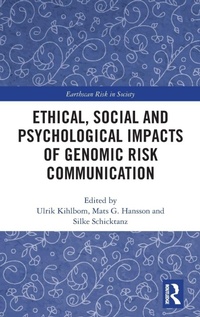
Ethical, Social and Psychological Impacts of Genomic Risk Communication
1st Edition
Published on 16. November 2020
Book
Hardback
178 pages
978-0-367-35669-9 (ISBN)
Description
This volume presents the ethical implications of risk information as related to genetics and other health data for policy decisions at clinical, research and societal levels.
Ethical, Social and Psychological Impacts of Genomic Risk Communication examines the introduction of new types of health risk information based on faster, cheaper and larger sets of genetic or genomic analysis. Synthesizing the results of a five-year interdisciplinary project, it explores the unsolved ethical and social questions around the sharing of this data, such as: What is best practice in risk communication? What are the normative presumptions and ethical consequences of an increased individual responsibility for ones' health? And how does one deal with the gap between the knowledge of risk and the lack of therapeutic options which often exist for complex diseases, such as dementia or some types of cancer? Drawing on contributions from over 20 experts in the field, this collection examines these questions from a liberal bioethics' perspective, advocating for contextual and cultural-sensitive ethical discussions.
This book will be of great interest to students and scholars of theoretical and clinical medical ethics, medical sociology, risk communication and ethics of risk, as well as professionals in clinical genetics.
Ethical, Social and Psychological Impacts of Genomic Risk Communication examines the introduction of new types of health risk information based on faster, cheaper and larger sets of genetic or genomic analysis. Synthesizing the results of a five-year interdisciplinary project, it explores the unsolved ethical and social questions around the sharing of this data, such as: What is best practice in risk communication? What are the normative presumptions and ethical consequences of an increased individual responsibility for ones' health? And how does one deal with the gap between the knowledge of risk and the lack of therapeutic options which often exist for complex diseases, such as dementia or some types of cancer? Drawing on contributions from over 20 experts in the field, this collection examines these questions from a liberal bioethics' perspective, advocating for contextual and cultural-sensitive ethical discussions.
This book will be of great interest to students and scholars of theoretical and clinical medical ethics, medical sociology, risk communication and ethics of risk, as well as professionals in clinical genetics.
More details
Series
Language
English
Place of publication
London
United Kingdom
Publishing group
Taylor & Francis Ltd
Target group
College/higher education
Illustrations
2 s/w Tabellen
2 Tables, black and white
Dimensions
Height: 240 mm
Width: 161 mm
Thickness: 15 mm
Weight
458 gr
ISBN-13
978-0-367-35669-9 (9780367356699)
Copyright in bibliographic data and cover images is held by Nielsen Book Services Limited or by the publishers or by their respective licensors: all rights reserved.
Schweitzer Classification
Other editions
Additional editions
Ulrik Kihlbom | Mats G. Hansson | Silke Schicktanz
Ethical, Social and Psychological Impacts of Genomic Risk Communication
Book
05/2022
1st Edition
Routledge
€64.90
Shipment within 15-20 days
Ulrik Kihlbom | Mats G. Hansson | Silke Schicktanz
Ethical, Social and Psychological Impacts of Genomic Risk Communication
E-Book
11/2020
1st Edition
Routledge
€59.49
Available for download
Ulrik Kihlbom | Mats G. Hansson | Silke Schicktanz
Ethical, Social and Psychological Impacts of Genomic Risk Communication
E-Book
11/2020
1st Edition
Routledge
€59.49
Available for download
Persons
Ulrik Kihlbom is Associate Professor in Medical Ethics at Uppsala University.
Mats G. Hansson is Senior Professor of Biomedical Ethics and Director of The Centre for Research Ethics & Bioethics (CRB) at Uppsala University.
Silke Schicktanz is Full Professor of Cultural and Ethical Studies of Biomedicine at University Medical Center Goettingen.
Mats G. Hansson is Senior Professor of Biomedical Ethics and Director of The Centre for Research Ethics & Bioethics (CRB) at Uppsala University.
Silke Schicktanz is Full Professor of Cultural and Ethical Studies of Biomedicine at University Medical Center Goettingen.
Content
1. Introduction Part 1: New Visions of Genetics and Genomics as Integrative Medicine 2. Genomic Medicine in 2025-2030 Part 2: Risk Empowerment 3. Genomic Risk Perception and Implications for Patient Outcomes from Genetic Counselling 4. Genomic and Biological Risk Profiling Part 3: Rethinking Professional Responsibility 5. On Patients' Difficulties in Understanding Medical Risks and the Aims of Clinical Risk Communication 6. Ethical Consideration about Health Risk Communication and Professional Responsibility 7. Uncertainty and Risk Perception in the Context of Personalized Medicine Part 4: Social and Policy Implications 8. Direct to Consumer Personal Genomic Testing and Trust 9. The Application of New Technologies to Improve Literacy among the General Public and to Promote Informed Decisions in Genomics 10. Algorithms as Emerging Policy Tools in Medicine 11. Epilogue