

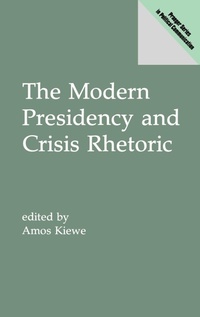
The Modern Presidency and Crisis Rhetoric
Published on 30. November 1993
Book
Hardback
288 pages
978-0-275-94176-5 (ISBN)
Description
This volume examines how presidents from Truman to Bush rhetorically approached and managed political, military, judicial, legislative, and economic crises during their presidencies. Editor Amos Kiewe assembles new essays by communications scholars who look at rhetoric initiated during national crises, and account for various rhetorical developments affected by crises, changes in presidential rhetoric, and rhetorical and situational crisis constraints. Their studies suggest similarities in rhetoric in different types of crises, and yield resources for postulating patterns of crisis rhetoric.
Each chapter's author presents a crisis rhetoric case study, analyzing initial strategies and tactics, shifts in rhetorical tactics, adjustments of discourse to particular phases in the crises, and unique rhetorical approaches designed to accommodate unexpected turns of events. The contributors discuss how presidents use rhetorical inventions, flip-flops, face-saving posturing, and even silence to diffuse crises. Specific topics include Eisenhower's response to the constitutional crisis in Little Rock, Kennedy and the Berlin Wall crisis, Johnson and the Kennedy assassination, Nixon and Watergate, and Bush and the Persian Gulf Crisis. Recommended for political scientists and communication theorists.
Each chapter's author presents a crisis rhetoric case study, analyzing initial strategies and tactics, shifts in rhetorical tactics, adjustments of discourse to particular phases in the crises, and unique rhetorical approaches designed to accommodate unexpected turns of events. The contributors discuss how presidents use rhetorical inventions, flip-flops, face-saving posturing, and even silence to diffuse crises. Specific topics include Eisenhower's response to the constitutional crisis in Little Rock, Kennedy and the Berlin Wall crisis, Johnson and the Kennedy assassination, Nixon and Watergate, and Bush and the Persian Gulf Crisis. Recommended for political scientists and communication theorists.
More details
Series
Language
English
Place of publication
United States
Publishing group
Bloomsbury Publishing Plc
Target group
College/higher education
Professional and scholarly
Interest Age: From 7 to 17 years
Dimensions
Height: 240 mm
Width: 161 mm
Thickness: 20 mm
Weight
599 gr
ISBN-13
978-0-275-94176-5 (9780275941765)
Copyright in bibliographic data and cover images is held by Nielsen Book Services Limited or by the publishers or by their respective licensors: all rights reserved.
Schweitzer Classification
Person
AMOS KIEWE is an Assistant Professor of Speech Communication at Syracuse University. He is the co-author, with Davis W. Houck, of two books, Shining City On a Hill: Ronald Reagan's Economic Rhetoric (Praeger, 1991), and Actor, Ideologue, Politican: The Public Speeches of Ronald Reagan (Greenwood Press, 1993).
Content
Series Foreword by Robert E. Denton, Jr.
Preface
Introduction by Amos Kiewe
Declaring a National Emergency: Truman's Rhetorical Crisis and the Great Debate of 1951 by Robert L. Ivie
Eisenhower, Little Rock, and the Rhetoric of Crisis by Martin J. Medhurst
Crisis as Pretext: John F. Kennedy and the Rhetorical Construction of the Berlin Crisis by Enrico Pucci, Jr.
Lyndon B. Johnson's Crisis Rhetoric after the Assassination of John F. Kennedy: Securing Legitimacy and Leadership by Kurt Ritter
Richard Nixon and the Personalization of Crisis by Carole Blair and Davis W. Houck
The Coalitional Crisis of the Ford Presidency: The Pardons Reconsidered by Craig Allen Smith and Kathy B. Smith
Narrative Character in Presidential Crisis Rhetoric: Jimmy Carter and the Iranian Hostage Crisis by Charles J.G. Griffin
Creating His Own Constraint: Ronald Reagan and the Iran-Contra Crisis by Greg Dickinson
From a Rhetorical Trap to Capitulation and Obviation: The Crisis Rhetoric of George Bush's "Read My Lips: No New Taxes" by Amos Kiewe
The Battle for the Past: George Bush and the Gulf Crisis by Mark A. Pollock
Bibliography
Index
Preface
Introduction by Amos Kiewe
Declaring a National Emergency: Truman's Rhetorical Crisis and the Great Debate of 1951 by Robert L. Ivie
Eisenhower, Little Rock, and the Rhetoric of Crisis by Martin J. Medhurst
Crisis as Pretext: John F. Kennedy and the Rhetorical Construction of the Berlin Crisis by Enrico Pucci, Jr.
Lyndon B. Johnson's Crisis Rhetoric after the Assassination of John F. Kennedy: Securing Legitimacy and Leadership by Kurt Ritter
Richard Nixon and the Personalization of Crisis by Carole Blair and Davis W. Houck
The Coalitional Crisis of the Ford Presidency: The Pardons Reconsidered by Craig Allen Smith and Kathy B. Smith
Narrative Character in Presidential Crisis Rhetoric: Jimmy Carter and the Iranian Hostage Crisis by Charles J.G. Griffin
Creating His Own Constraint: Ronald Reagan and the Iran-Contra Crisis by Greg Dickinson
From a Rhetorical Trap to Capitulation and Obviation: The Crisis Rhetoric of George Bush's "Read My Lips: No New Taxes" by Amos Kiewe
The Battle for the Past: George Bush and the Gulf Crisis by Mark A. Pollock
Bibliography
Index