

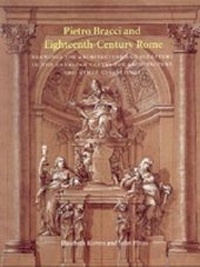
Pietro Bracci and Eighteenth-Century Rome
Drawings for Architecture and Sculpture in the Canadian Centre for Architecture and Other Collections
Published on 7. November 2001
Book
Hardback
392 pages
978-0-271-02008-2 (ISBN)
Description
Pietro Bracci was a leading sculptor of eighteenth-century Rome, but the dispersal of his drawings has hampered study of the interplay between his approach to design and his response to Rome's vast artistic heritage. Using a group of Bracci drawings acquired by the Canadian Centre for Architecture as their point d'appui, Elisabeth Kieven and John Pinto have prepared a long-overdue catalogue of Bracci's complete study collection, from preliminary sketches to finished presentation drawings. Kieven and Pinto discuss the origin and function of each drawing and offer a wealth of new insights into Bracci's remarkable skill at integrating sculpture into Rome's grand buildings and public spaces.
Bracci won some of the most sought-after commissions in eighteenth-century Rome, including monuments in Saint Peter's and the allegorical figures of the Trevi Fountain. Kieven's and Pinto's introductory essays situate these and other commissions in the history of Roman architecture and urbanism, survey Bracci's career, and explore the context of his drawing practices. Considered together, the Bracci drawings shed important new light on the collaborative relationship between architects and sculptors in the design of one of the art capitals of the world.
Kieven and Pinto's book concludes with a catalogue raisonne of the entire corpus of drawings ascribed to Bracci and his son Virginio. In addition, their book illustrates all of Bracci's drawings and provides transcriptions of key documents.
Bracci won some of the most sought-after commissions in eighteenth-century Rome, including monuments in Saint Peter's and the allegorical figures of the Trevi Fountain. Kieven's and Pinto's introductory essays situate these and other commissions in the history of Roman architecture and urbanism, survey Bracci's career, and explore the context of his drawing practices. Considered together, the Bracci drawings shed important new light on the collaborative relationship between architects and sculptors in the design of one of the art capitals of the world.
Kieven and Pinto's book concludes with a catalogue raisonne of the entire corpus of drawings ascribed to Bracci and his son Virginio. In addition, their book illustrates all of Bracci's drawings and provides transcriptions of key documents.
More details
Language
English
Place of publication
Pennsylvania
United States
Target group
College/higher education
Professional and scholarly
Product notice
sewn/stitched
Dimensions
Thickness: 34 mm
Weight
1420 gr
ISBN-13
978-0-271-02008-2 (9780271020082)
Copyright in bibliographic data and cover images is held by Nielsen Book Services Limited or by the publishers or by their respective licensors: all rights reserved.
Schweitzer Classification
Persons
Elisabeth Kieven is Professor of Art and Director of the Bibliotheca Hertziana (Max-Planck-Institut) in Rome.
John Pinto is a Professor in the Department of Art and Archaeology at Princeton University.
John Pinto is a Professor in the Department of Art and Archaeology at Princeton University.