

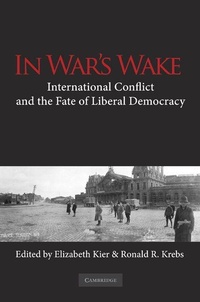
In War's Wake
International Conflict and the Fate of Liberal Democracy
Published on 30. June 2010
Book
Paperback/Softback
326 pages
978-0-521-15770-4 (ISBN)
Description
War has diverse and seemingly contradictory effects on liberal democratic institutions and processes. It has led democracies to abandon their principles, expanding executive authority and restricting civil liberties, but it has also prompted the development of representative parliamentary institutions. It has undercut socioeconomic reform, but it has also laid the basis for the modern welfare state. This landmark volume brings together distinguished political scientists, historians, and sociologists to explore the impact of war on liberal democracy - a subject far less studied than the causes of war but hardly less important. Three questions drive the analysis: How does war shape the transition to and durability of democracy? How does war influence democratic contestation? How does war transform democratic participation? Employing a wide range of methods, this volume assesses what follows in the wake of war.
Reviews / Votes
"War, Otto Hintze argued in a classic essay, builds strong autocratic states. Democracies, we are told by Harold Lasswell and others, have a hard time maintaining their open political systems during wartime. But this fascinating collection of essays suggests that the relationship between war and democracy is much more complex than these classic works propose. Depending upon the process of mobilization for war, democracy can either thrive or wither. This book revisits classic themes at a time when many of us worry about the future of American democracy in the face of the long-war on terror."- Michael C. Desch, University of Notre Dame "In War's Wake is an unusually lively edited volume: the multi-method, multi-disciplinary essays are thoughtful, well-grounded, provocative, and contentious. The authors pull no punches in their disagreements with each other, and in so doing, clearly lay out key questions for future research."
- Lynn Eden, Stanford University "This riveting collection by a cohort of leading scholars in social science and history does more than advance our understanding of the protean relationship of war and democracy. By tracing war's complex and variegated effects, this volume sets a standard for how analytical history can advance by showing how fundamental questions should be adduced, how rigorous investigation should proceed, and how vexing instances should be probed."
- Ira Katznelson, Columbia University "This important book begins and ends with a paradox: while democracies often compromise their principles during war, war's effects on democratic institutions are often positive. Following in the footsteps of Charles Tilly, Kier and Krebs and their contributors explore different dimensions of the war/democracy paradox, applying it to cases as diverse as World Wars I and II, the Yom Kippur War, and the War on Terror. This book will become a standard accompaniment to Tilly's Coercion, Capital and European States and to Lasswell's and Huntington's work on the military and politics."
- Sidney Tarrow, Cornell University
More details
Language
English
Place of publication
Cambridge
United Kingdom
Target group
Professional and scholarly
Product notice
Paperback (trade)
Illustrations
15 Tables, unspecified; 3 Line drawings, unspecified
Dimensions
Height: 234 mm
Width: 156 mm
Thickness: 18 mm
Weight
500 gr
ISBN-13
978-0-521-15770-4 (9780521157704)
Copyright in bibliographic data and cover images is held by Nielsen Book Services Limited or by the publishers or by their respective licensors: all rights reserved.
Schweitzer Classification
Other editions
Additional editions
Elizabeth Kier | Ronald R. Krebs
In War's Wake
International Conflict and the Fate of Liberal Democracy
E-Book
07/2010
1st Edition
Cambridge University Press
€26.49
Available for download
Elizabeth Kier | Ronald R. Krebs
In War's Wake
International Conflict and the Fate of Liberal Democracy
Book
06/2010
Cambridge University Press
€127.50
Article not available at the moment
Persons
Elizabeth Kier is Associate Professor of Political Science at the University of Washington. She is the author of Imagining War: French and British Military Doctrine between the Wars. Ronald R. Krebs is Associate Professor in the Department of Political Science at the University of Minnesota. His most recent book is Fighting for Rights: Military Service and the Politics of Citizenship.
Content
1. Introduction: war and democracy in comparative perspective Elizabeth Kier and Ronald Krebs; Part I. War and Democratic Transitions: New and Durable Democracies?: 2. Does war influence democratization? Edward Mansfield and Jack Snyder; 3. Dodging a bullet: democracy's gains in modern war Paul Starr; 4. Armed conflict and the durability of electoral democracy Nancy Bermeo; Part II. War and Democratic Publics: Reshaping Political Participation?: 5. The effects of war on civil society: cross-national evidence from World War II Rieko Kage; 6. Veterans, human rights, and the tranformation of European democracy Jay Winter; 7. War and reform: gaining labor's compliance on the homefront Elizabeth Kier; 8. Spinning Mars: democracy in Britain and the United States and the economic lessons of war Mark Wilson; Part III. War and Democratic States: Government by the People or over the People?: 9. International conflict and the constitutional balance: executive authority after war Ronald R. Krebs; 10. Claims and capacity: war, national policing institutions, and democracy Daniel Kryder; 11. War, recruitment systems, and democracy Deborah Avant; Concluding reflections: 12. What wars do Miguel Angel Centeno.