

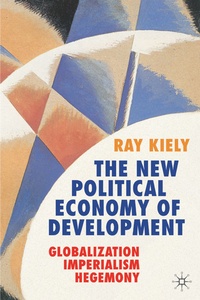
The New Political Economy of Development
Globalization, Imperialism, Hegemony
Published on 14. November 2006
Book
Paperback/Softback
VIII, 344 pages
978-1-4039-9997-9 (ISBN)
Description
This major new text analyses changes and continuities in the current international order and their implications for understanding international development in the 21st century. The author assesses the extent and impact of globalization and the emergence of a more aggressive stance by the U.S and the subsequent debates.
Reviews / Votes
'This invaluable text aims to restore to development the 'broad ambition of that once stimulating area of study' by re-setting it in the indispensable historical and political-economic context from which it has been progressively divorced in recent decades and engaging with the large and complex forces that actually determine the fate of the world's poor. To a truly admirable extent, it succeeds, in the process guiding the reader through a vast range of literature and making judicious assessments of all the key debates.' - Colin Leys, Emeritus Professor, Queen's University, Kingston, CanadaMore details
Edition
2006
Language
English
Place of publication
London
United Kingdom
Publishing group
Bloomsbury Publishing PLC
Target group
Professional and scholarly
College/higher education
Dimensions
Height: 234 mm
Width: 156 mm
Thickness: 19 mm
Weight
524 gr
ISBN-13
978-1-4039-9997-9 (9781403999979)
DOI
10.1057/9780230207608
Schweitzer Classification
Other editions
Additional editions
Book
11/2006
Red Globe Press
€193.40
Shipment within 10-20 days
Person
RAY KIELY is Professor of International Politics, Queen Mary and Westfield College, University of London, UK.
Content
Introduction.- Capitalist Expansion and Imperialism.- Pre-War Capitalism and Development.- The End of the Post-War Boom and Capitalist Restructuring.- Globalization and Contemporary Imperialism: Theoretical Debates.- Cosmopolitan Globalization and Global Governance.- Globalization, Poverty and the Contemporary World Economy.- Globalization, Neo-Liberal and the State.- Globalization, Regionalization and Hegemony.- Resisting Globalization: Islam, Post-Development and Global Justice.- Conclusion.