

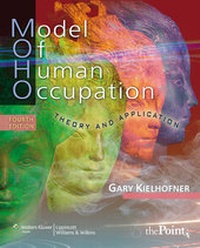
Model of Human Occupation
Theory and Application
4th Edition
Published on 4. September 2007
Book
Paperback/Softback
565 pages
978-0-7817-6996-9 (ISBN)
Description
Model of Human Occupation, Fourth Edition offers a complete and current presentation of the most widely used model in occupational therapy, and delivers the latest in MOHO theory, research, and application to practice. This authoritative text explores what motivates individuals, how they select occupations and establish everyday routines, how environment influences occupational behavior, and more.
NEW TO THIS EDITION:
Case Vignettes that illustrate key concepts that students need to know
Case Studies that help students apply the model to practice
Chapter on evidence based practice (ch. 25)
Chapter on World Health Organization and AOTA practice framework and language links the MOHO model to two widely used frameworks (ch. 27)
Photographs of real patients help bring the concepts and cases to life
Model of Human Occupation, Fourth Edition offers a complete and current presentation of the most widely used model in occupational therapy, and delivers the latest in MOHO theory, research, and application to practice. This authoritative text explores what motivates individuals, how they select occupations and establish everyday routines, how environment influences occupational behavior, and more.
NEW TO THIS EDITION:<ul><li>Case Vignettes that illustrate key concepts that students need to know</li><li>Case Studies that help students apply the model to practice</li><li>Chapter on evidence based practice (ch. 25)</li><li>Chapter on World Health Organization and AOTA practice framework and language links the MOHO model to two widely used frameworks (ch. 27)</li><li>Photographs of real patients help bring the concepts and cases to life</li></ul>
NEW TO THIS EDITION:
Case Vignettes that illustrate key concepts that students need to know
Case Studies that help students apply the model to practice
Chapter on evidence based practice (ch. 25)
Chapter on World Health Organization and AOTA practice framework and language links the MOHO model to two widely used frameworks (ch. 27)
Photographs of real patients help bring the concepts and cases to life
Model of Human Occupation, Fourth Edition offers a complete and current presentation of the most widely used model in occupational therapy, and delivers the latest in MOHO theory, research, and application to practice. This authoritative text explores what motivates individuals, how they select occupations and establish everyday routines, how environment influences occupational behavior, and more.
NEW TO THIS EDITION:<ul><li>Case Vignettes that illustrate key concepts that students need to know</li><li>Case Studies that help students apply the model to practice</li><li>Chapter on evidence based practice (ch. 25)</li><li>Chapter on World Health Organization and AOTA practice framework and language links the MOHO model to two widely used frameworks (ch. 27)</li><li>Photographs of real patients help bring the concepts and cases to life</li></ul>
More details
Edition
4th edition
Language
English
Place of publication
Philadelphia
United States
Target group
Professional and scholarly
Edition type
New edition
Product notice
Paperback (trade)
Dimensions
Height: 235 mm
Width: 187 mm
Weight
1066 gr
ISBN-13
978-0-7817-6996-9 (9780781769969)
Copyright in bibliographic data and cover images is held by Nielsen Book Services Limited or by the publishers or by their respective licensors: all rights reserved.
Schweitzer Classification
Other editions
New editions

Renee Taylor
Kielhofner's Model of Human Occupation
Book
07/2023
6th Edition
WOLTERS KLUWER HEALTH
€96.00
Available immediately
Book
04/2017
5th Edition
Lippincott Williams and Wilkins
€109.13
Article exhausted; check for reprint
Previous edition

Book
05/2002
3rd Edition
Lippincott Williams and Wilkins
€61.48
Article exhausted; check for reprint
Content
Chapter 1: Introduction to the Model of Human Occupation
<ul><li>Section 1: Explaining Human Occupation</li><li>Chapter 2: The Basic Concepts of Human Occupation</li><li>Chapter 3: The Dynamics of Human Occupation</li><li>Chapter 4: Volition</li><li>Chapter 5: Habituation: Patterns of Daily Occupation</li><li>Chapter 6: Performance capacity and lived body</li><li>Chapter 7: The Environment and Human Occupation</li><li>Chapter 8: Dimensions of Doing</li><li>Chapter 9: Crafting Occupational Life</li><li>Chapter 10: Doing and Becoming: Occupational Change and Development</li><li>
Section 2 Applying MOHO: The Therapy Process and Therapeutic Reasoning
</li><li>Chapter 11: Therapeutic Reasoning: Planning,Implementing and Evaluating the Outcomes of Therapy</li><li>Chapter 12:Assessment: Choosing and Using Structured and Unstructured Means of Gathering Information</li><li>Chapter 13:Occupation Engagement: How Clients Achieve Change</li><li>Chapter 14:Therapeutic Strategies for Enabling Clients</li><li>
Section 3: Assessments: Structured methods for Gathering Client Information
</li><li>Chapter 15: Observational Assessments</li><li>Chapter 16:Self-Reports: Eliciting Client's Perspectives</li><li>Chapter 17: Talking With Clients: Assessments That Collect Information</li><li>Chapter 18:Assessments Combining Methods of Information Gathering</li><li>
Section 4: Case Illustrations
</li><li>Chapter 19:Recrafting Occupation Narratives</li><li>Chapter 20:Applying MOHO to Clients Who Are Cognitively Impaired</li><li></li><li>Chapter 22:Enabling Clients to Reconstruct Their Occupational Lives in Long-Term Settings</li><li>
Section 5: Resources for Applying and Developing MOHO
</li><li>Chapter 23:Communication and Documentation</li><li>Chapter 24:Program Development</li><li>Chapter 25:Evidence for Practice from the Model of Human Occupation</li><li>Chapter 26:Research: Investigating MOHO</li><li>Chapter 27:The Model of Human Occupation, the ICF, and the Occupational Therapy Practice Framework: Connections to Support Best Practice Around the World .</li><li>Appendix A: Bibliography</li><li>Appendix B: Introduction to the MOHO Clearinghouse and Web Site </li></ul>
<ul><li>Section 1: Explaining Human Occupation</li><li>Chapter 2: The Basic Concepts of Human Occupation</li><li>Chapter 3: The Dynamics of Human Occupation</li><li>Chapter 4: Volition</li><li>Chapter 5: Habituation: Patterns of Daily Occupation</li><li>Chapter 6: Performance capacity and lived body</li><li>Chapter 7: The Environment and Human Occupation</li><li>Chapter 8: Dimensions of Doing</li><li>Chapter 9: Crafting Occupational Life</li><li>Chapter 10: Doing and Becoming: Occupational Change and Development</li><li>
Section 2 Applying MOHO: The Therapy Process and Therapeutic Reasoning
</li><li>Chapter 11: Therapeutic Reasoning: Planning,Implementing and Evaluating the Outcomes of Therapy</li><li>Chapter 12:Assessment: Choosing and Using Structured and Unstructured Means of Gathering Information</li><li>Chapter 13:Occupation Engagement: How Clients Achieve Change</li><li>Chapter 14:Therapeutic Strategies for Enabling Clients</li><li>
Section 3: Assessments: Structured methods for Gathering Client Information
</li><li>Chapter 15: Observational Assessments</li><li>Chapter 16:Self-Reports: Eliciting Client's Perspectives</li><li>Chapter 17: Talking With Clients: Assessments That Collect Information</li><li>Chapter 18:Assessments Combining Methods of Information Gathering</li><li>
Section 4: Case Illustrations
</li><li>Chapter 19:Recrafting Occupation Narratives</li><li>Chapter 20:Applying MOHO to Clients Who Are Cognitively Impaired</li><li></li><li>Chapter 22:Enabling Clients to Reconstruct Their Occupational Lives in Long-Term Settings</li><li>
Section 5: Resources for Applying and Developing MOHO
</li><li>Chapter 23:Communication and Documentation</li><li>Chapter 24:Program Development</li><li>Chapter 25:Evidence for Practice from the Model of Human Occupation</li><li>Chapter 26:Research: Investigating MOHO</li><li>Chapter 27:The Model of Human Occupation, the ICF, and the Occupational Therapy Practice Framework: Connections to Support Best Practice Around the World .</li><li>Appendix A: Bibliography</li><li>Appendix B: Introduction to the MOHO Clearinghouse and Web Site </li></ul>