

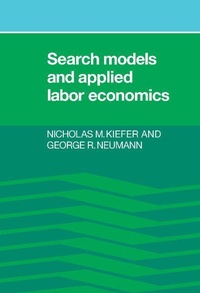
Search Models and Applied Labor Economics
Published on 24. February 1989
Book
Hardback
308 pages
978-0-521-36053-1 (ISBN)
Description
This 1989 collection of papers marks the development of empirical application of the search approach to labor economics - an approach which arose as a theoretical development of the 1960s and led to numerous insights in the 1970s. The search approach naturally incorporates uncertainty in the economic model, making up some of the early work in what is now called 'the economics of information'. Included are econometric issues such as estimation and specification of search models for wages and unemployment duration, continuous time models of turnover, and identification of structural parameters. Applications to policy questions including Unemployment Insurance and wage subsidy programs are given, and data collection issues are discussed within the search framework.
More details
Language
English
Place of publication
Cambridge
United Kingdom
Target group
College/higher education
Professional and scholarly
Dimensions
Height: 235 mm
Width: 157 mm
Thickness: 21 mm
Weight
599 gr
ISBN-13
978-0-521-36053-1 (9780521360531)
Copyright in bibliographic data and cover images is held by Nielsen Book Services Limited or by the publishers or by their respective licensors: all rights reserved.
Schweitzer Classification
Other editions
Additional editions
Nicholas M. Kiefer | George R. Neumann
Search Models and Applied Labor Economics
Book
03/2006
Cambridge University Press
€49.30
Shipment within 15-20 days
Persons
Content
1. Introduction; Part I. Wages, Reservation Wages and Duration: 2. Estimation of wage offer distributions and reservation wages; 3. An empirical job-search model, with a test of the constant reservation-wage hypothesis; 4. Individual effects in a nonlinear model: explicit treatment of heterogeneity in the empirical job-search model; Part II. Continuous-time Models of Duration: 5. Earnings, unemployment, and the allocation of time over time; 6. Choice or chance? A structural interpretation of individual labor market histories; 7. Layoffs and duration dependence in a model of turnover; Part III. Applications: 8. Structural and reduced form approaches to analyzing unemployment durations; 9. Wages and the structure of unemployment rates; 10. How long is a spell of unemployment? Illusions and biases in the use of CPS data; Part IV. Mobility and Contracting: 11. Employment risk and labor market diversification; 12. A proposition and an example in the theory of job search with hours constraints; 13. Interfirm mobility and earnings; 14. Methods for analyzing employment contracts and other agreements; Index.