

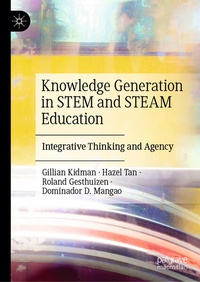
Knowledge Generation in STEM and STEAM Education
Description
This book examines how integrative practices are conceived, described, and taught within the context of STE A+ M education. STE A+ M education is far more than a disciplinary expansion of STEM education; it is a paradigmatic shift in educational purpose and practice, offering a framework for rethinking how knowledge is produced, whose voices are legitimised, and what purposes education serves. The authors argue that teachers must not only understand the knowledge and skills of a specialist discipline but also understand how to integrate and synthesise knowledge in a cross-disciplinary fashion between several disciplines simultaneously. For teachers to effectively integrate multiple educational domains, they must engage students in integrative STE A+ M thinking practices such as inquiry-based learning, student agency, and neo-twenty-first century skills. This must occur not only within, but also across, disciplines in an integrated manner, whether this involves multi-, inter-, or trans-disciplinary approaches. This skill is defined as integrative inquiry literacy.
More details
Other editions
Additional editions
Persons
Gillian Kidman is from Monash University, Australia. She specialises in science, mathematics, geography education, and integrative STEM/STEAM education.
Hazel Tan is from Monash University, Australia. She specialises in secondary mathematics and integrative STEM/STEAM education.
Roland Gesthuizen is a senior teacher with the Department of Education Victoria, Australia. He specialises in digital pedagogy and computational thinking.
Dominador Dizon Mangao is from the Philippine Normal University, Philippines. He is a specialist in science education.
Content
Part A: Foundations of Integrative Thinking in STEA+M Education.- Chapter 1 Neuroeducation in STEM: Bridging Cognitive Science and Pedagogy for Effective Learning.- Chapter 2 Disciplinary Thinking in STEM: Balancing Epistemologies for Integrated Education.- Chapter 3 The Plexus Model of STEA+M Education: Fostering Agency, Innovation, and Societal Engagement.- Chapter 4 Interdisciplinary Thinking in STEA+M: Cognitive Integration, Makerspaces, and Knowledge Creation.- Part B: Expanding the Boundaries of STEA+M Education.- Chapter 5 21st Century Skills and STEM Education: A Review of Literature.- Chapter 6 STEA+M Thinking Systems as Neo-21st Century Skills.- Chapter 7 STEA+M Education and Hidden Curriculum Contexts.- Part C: Implementing Integrative STEA+M Pedagogies and Professional Development.- Chapter 8 Integrating Design Thinking in STEA+M Education: The PaDL Framework for Planning and Learning.- Chapter 9 Interdisciplinary STEM Curriculum Integration: Exploring Teacher-Developed Curriculum Goals .- Chapter 10 Interdisciplinary Integration for Future-Making Education in STEAM.