

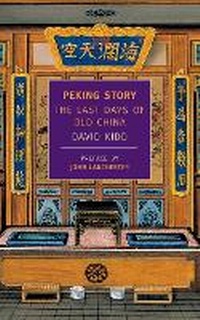
Peking Story
The Last Days of Old China
Published on 31. July 2003
Book
Paperback/Softback
208 pages
978-1-59017-040-3 (ISBN)
Description
For two years before and after the 1948 Communist Revolution, David Kidd lived in Peking, where he married the daughter of an aristocratic Chinese family. "I used to hope," he writes, "that some bright young scholar on a research grant would write about us and our Chinese friends before it was too late and we were all dead and gone, folding into the darkness the wonder that had been our lives." Here Kidd himself brings that wonder to life.
More details
Language
English
Place of publication
New York
United States
Publishing group
New York Review Books
Product notice
Paperback (trade)
Unsewn / adhesive bound
Dimensions
Height: 204 mm
Width: 128 mm
Thickness: 13 mm
Weight
213 gr
ISBN-13
978-1-59017-040-3 (9781590170403)
Copyright in bibliographic data and cover images is held by Nielsen Book Services Limited or by the publishers or by their respective licensors: all rights reserved.
Schweitzer Classification
Other editions
Additional editions
E-Book
04/2011
NYRB Classics
€17.49
Available for download
Persons
David Kidd (1926–1996) was born in Corbin, Kentucky to a coal-mining community. He later grew up in Detroit, where his father became an executive in the automotive industry. In 1946, at age nineteen, Kidd made his first trip to Peking as a University of Michigan exchange student with one idea in mind: to get as far away from home as possible. He spent the next four years teaching English in the Peking suburbs. During this time, he married the daughter of a former Chief Justice of the Supreme Court, moving into her family’s 101-room palace, where he had a uniquely intimate view of the Communist takeover. His account of his experiences was serialized in The New Yorker and published in book-form as All the Emperor’s Horses in 1960, later retitled Peking Story: The Last Days of Old China. He returned to the US in 1950 and taught at the Asia Institute until 1956, when he moved to Japan. There he continued to work as a lecturer, became a devoted collector of Chinese and Japanese art and antiquities, and, in 1976, founded the Oomoto School of Traditional Japanese Arts in Kyoto. He lived in Kyoto until his death of cancer at age sixty-nine.