

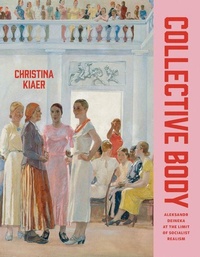
Collective Body
Aleksandr Deineka at the Limit of Socialist Realism
Will be published approx. on 19. March 2024
Book
Hardback
360 pages
978-0-226-82716-2 (ISBN)
Description
A study of the Socialist Realist aesthetic focusing on the artist Aleksandr Deineka.
Dislodging the avant-garde from its central position in the narrative of Soviet art, Collective Body presents painter Aleksandr Deineka's haptic and corporeal version of Socialist Realist figuration as an alternate experimental aesthetic that, at its best, activates and organizes affective forces for collective ends. Christina Kiaer traces Deineka's path from his avant-garde origins as the inventor of the proletarian body in illustrations for mass magazines after the revolution through his success as a state-sponsored painter of monumental, lyrical canvases during the Terror and beyond. In so doing, she demonstrates that Socialist Realism is best understood not as a totalitarian style but as a fiercely collective art system that organized art outside the market and formed part of the legacy of the revolutionary modernisms of the 1920s. Collective Body accounts for the way the art of the October Revolution continues to capture viewers' imaginations by evoking the elation of collectivity, making viewers not just comprehend but truly feel socialism, and retaining the potential to inform our own art-into-life experiments within contemporary political art. Deineka figures in this study not as a singular master, in the spirit of a traditional monograph, but as a limit case of the system he inhabited and helped to create.
Dislodging the avant-garde from its central position in the narrative of Soviet art, Collective Body presents painter Aleksandr Deineka's haptic and corporeal version of Socialist Realist figuration as an alternate experimental aesthetic that, at its best, activates and organizes affective forces for collective ends. Christina Kiaer traces Deineka's path from his avant-garde origins as the inventor of the proletarian body in illustrations for mass magazines after the revolution through his success as a state-sponsored painter of monumental, lyrical canvases during the Terror and beyond. In so doing, she demonstrates that Socialist Realism is best understood not as a totalitarian style but as a fiercely collective art system that organized art outside the market and formed part of the legacy of the revolutionary modernisms of the 1920s. Collective Body accounts for the way the art of the October Revolution continues to capture viewers' imaginations by evoking the elation of collectivity, making viewers not just comprehend but truly feel socialism, and retaining the potential to inform our own art-into-life experiments within contemporary political art. Deineka figures in this study not as a singular master, in the spirit of a traditional monograph, but as a limit case of the system he inhabited and helped to create.
Reviews / Votes
"Kiaer's Collective Body is promising to become a seminal publication on Deineka for years to come. The book is beautifully designed and features a broad array of rare illustrations, many of which are no longer accessible to Western scholarship. . . . the book effectively challenges pervasive stereotypes about Soviet art. With its wide range of themes, methods, and historical materials, Collective Body is not only a highly anticipated monograph on Deineka but also an excellent and intellectually stimulating study of Soviet art's formative period. Most importantly, it promotes a complex and nuanced approach to researching this legacy-an approach especially vital to preserve during a time of a violent political and cultural war."* H-Net * "Collective Body is a tour de force: at once a history of a single artist, of Soviet art practice in the 1930s-and of Soviet culture more broadly. Kiaer writes with ease and sophistication, using brilliant close readings of artworks to illuminate her social and historical context in new ways. This is scholarship of a very high order." -- Emma Widdis, University of Cambridge "Aleksandr Deineka's depiction of sensual bodies was labeled by Russian critics 'lyrical socialist realism.' Traversing three decades of artistic debates and realignments, Kiaer elucidates this paradoxical stylistic label and gives us a new reading of the complexities of a Soviet and Stalinist world that remains as fascinating as it is disturbing. This highly original study puts the revolutionary avant-garde and its aftermath in a new perspective." -- Romy Golan, City University of New York
More details
Language
English
Place of publication
Chicago
United States
Publishing group
The University of Chicago Press
Target group
Professional and scholarly
Illustrations
84 color plates, 71 halftones
Dimensions
Height: 288 mm
Width: 222 mm
Thickness: 31 mm
Weight
1750 gr
ISBN-13
978-0-226-82716-2 (9780226827162)
Copyright in bibliographic data and cover images is held by Nielsen Book Services Limited or by the publishers or by their respective licensors: all rights reserved.
Schweitzer Classification
Other editions
Additional editions
E-Book
03/2024
1st Edition
University of Chicago Press
€67.99
Available for download
Person
Christina Kiaer is the Arthur Andersen Teaching and Research Professor of art history at Northwestern University. She is the author of Imagine No Possessions: The Socialist Objects of Russian Constructivism, coauthor with Robert Bird and Zachary Cahill of Revolution Every Day: A Calendar, and coeditor with Eric Naiman of Everyday Life in Early Soviet Russia: Taking the Revolution Inside.
Content
Preface
Introduction
1. The Proletarian Body
2. The Grand Style of Socialist Painting
3. The Lateral Aesthetics of Cultural Revolution
4. Lyrical Socialist Realism
5. American Pictures
6. Primal Scenes of Socialist Realism
7. Afterword: The Soviet Picasso
Appendix: "The Art of Our Days"
Acknowledgments
Notes
Bibliography
Index
Introduction
1. The Proletarian Body
2. The Grand Style of Socialist Painting
3. The Lateral Aesthetics of Cultural Revolution
4. Lyrical Socialist Realism
5. American Pictures
6. Primal Scenes of Socialist Realism
7. Afterword: The Soviet Picasso
Appendix: "The Art of Our Days"
Acknowledgments
Notes
Bibliography
Index