

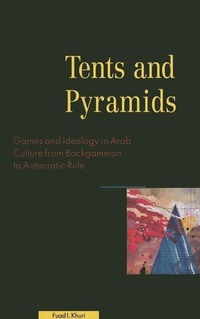
Tents and Pyramids
Games and Ideology in Arab Culture from Backgammon to Autocratic Rule
Published on 14. February 2001
Book
Hardback
168 pages
978-0-86356-334-8 (ISBN)
Description
This study deals with an unusual and absorbing topic: how the Arabs see and deal with reality and the implications this has for the nature of power in the Arab world. "Tents" and "pyramids" are, metaphorically, opposed mental images; the first signifies the absence of hierarchy and graded authority, the second the presence of both, Khuri argues that the Arabs perceive both social and physical reality as a series of discrete, non-pyramidal structures that are inherently equal in value - much like a Bedouin encampment composed of tents scattered haphazardly on a flat desert surface with no visible hierarchy. Authority is not built into a hierarchial arrangement where roles are subordinated to one another in a graded system (as in the West); it is, rather, derived from the use of sheer physical power, with one person dominating the others - a first among "equals". Strategy, manoeuvrability and tactics take precedence over office and structure. The strategy is to act in groups - the isolated are vunerable. There are striking parallels between these mental constructs and the behavioural patterns in Arab society, in situations ranging from backgammon to autocratic rule.
The book examines the mechanisms involved in sports and card games, poetry and prose, charting genealogies and the laws of inheritance. Since there are no "pyramids", there are no standardized rules of succession to high office. Government belongs to the powerful, the conquerors. Power rests in the control of solidarities, or endogamous groups, which militates aginst the rules of a "public" that holds the ruler accountable for his actions. There is no public and therefore no republic. Whether "president", "king", "sultan", "imam" or "emie", the governor always rules autocratically.
The book examines the mechanisms involved in sports and card games, poetry and prose, charting genealogies and the laws of inheritance. Since there are no "pyramids", there are no standardized rules of succession to high office. Government belongs to the powerful, the conquerors. Power rests in the control of solidarities, or endogamous groups, which militates aginst the rules of a "public" that holds the ruler accountable for his actions. There is no public and therefore no republic. Whether "president", "king", "sultan", "imam" or "emie", the governor always rules autocratically.
More details
Language
English
Place of publication
London
United Kingdom
Target group
College/higher education
Professional and scholarly
Product notice
sewn/stitched
Paper over boards
With dust jacket
Dimensions
Height: 206 mm
Width: 139 mm
Thickness: 17 mm
Weight
286 gr
ISBN-13
978-0-86356-334-8 (9780863563348)
Copyright in bibliographic data and cover images is held by Nielsen Book Services Limited or by the publishers or by their respective licensors: all rights reserved.
Schweitzer Classification
Person
Fuad I. Khuri is a leading anthropologist of the Middle East. He has written extensively in English and Arabic on various aspects of Arab culture and society. His works include Tribe and State in Bahrain; Imams and Emirs: State, Religion and Sects in Islam. The last title has also been published by Saqi Books.