

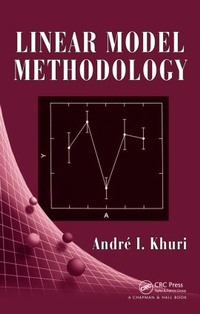
Linear Model Methodology
1st Edition
Published on 21. October 2009
Book
Hardback
562 pages
978-1-58488-481-1 (ISBN)
Description
Given the importance of linear models in statistical theory and experimental research, a good understanding of their fundamental principles and theory is essential. Supported by a large number of examples, Linear Model Methodology provides a strong foundation in the theory of linear models and explores the latest developments in data analysis.
After presenting the historical evolution of certain methods and techniques used in linear models, the book reviews vector spaces and linear transformations and discusses the basic concepts and results of matrix algebra that are relevant to the study of linear models. Although mainly focused on classical linear models, the next several chapters also explore recent techniques for solving well-known problems that pertain to the distribution and independence of quadratic forms, the analysis of estimable linear functions and contrasts, and the general treatment of balanced random and mixed-effects models. The author then covers more contemporary topics in linear models, including the adequacy of Satterthwaite's approximation, unbalanced fixed- and mixed-effects models, heteroscedastic linear models, response surface models with random effects, and linear multiresponse models. The final chapter introduces generalized linear models, which represent an extension of classical linear models.
Linear models provide the groundwork for analysis of variance, regression analysis, response surface methodology, variance components analysis, and more, making it necessary to understand the theory behind linear modeling. Reflecting advances made in the last thirty years, this book offers a rigorous development of the theory underlying linear models.
After presenting the historical evolution of certain methods and techniques used in linear models, the book reviews vector spaces and linear transformations and discusses the basic concepts and results of matrix algebra that are relevant to the study of linear models. Although mainly focused on classical linear models, the next several chapters also explore recent techniques for solving well-known problems that pertain to the distribution and independence of quadratic forms, the analysis of estimable linear functions and contrasts, and the general treatment of balanced random and mixed-effects models. The author then covers more contemporary topics in linear models, including the adequacy of Satterthwaite's approximation, unbalanced fixed- and mixed-effects models, heteroscedastic linear models, response surface models with random effects, and linear multiresponse models. The final chapter introduces generalized linear models, which represent an extension of classical linear models.
Linear models provide the groundwork for analysis of variance, regression analysis, response surface methodology, variance components analysis, and more, making it necessary to understand the theory behind linear modeling. Reflecting advances made in the last thirty years, this book offers a rigorous development of the theory underlying linear models.
Reviews / Votes
This is a comprehensive and up-to-date textbook on the theory of linear models. ... Every chapter besides the first historical one contains many exercises ... . There is also a huge bibliography. The textbook represents an important source for all researchers and lectures in linear models.-Hilmar Drygas, Zentralblatt MATH, 2012
The outstanding book, written by a prominent researcher and author, presents a wealth of materials on linear models in Chapters 1 though 12 and includes materials on generalized linear models in the last chapter. The material on linear models is an amazing collection of important topics that would benefit researchers, teachers, students, and practitioners and has added value to the book. Many illustrative examples are presented with SAS codes. The examples are practically important and thoughtfully chosen. Exercises at the end of Chapters 2-13 are excellent, and some are valuable resources for the researchers in this area. ... The author has to be commended for his success in executing this so elegantly.
-Subir Ghosh, Journal of Quality Technology, Vol. 44, January 2012
This book provides a very well-written and rigorous account of the theory of linear models. ... In sum, this is a carefully written and reliable book that reflects the experience of the author in teaching graduate level courses on linear models. I will certainly add it to the list of reference textbooks for the graduate one-quarter course on linear model theory taught at UC Santa Cruz.
-Raquel Prado, Journal of the American Statistical Association, September 2011, Vol. 106
This text is a possible choice for a second course in linear model theory.
-David J. Olive, Technometrics, May 2011
The material is well chosen and well organized, and includes many results that are not found in other textbooks. ... Throughout the book, the presentation is very clear and well organized, with a focus on mathematical developments. Most results are stated with proofs, some material is based on the author's own contributions to the field. Generally, many important special cases are treated in detail, which will make the book also highly useful as a reference. There are also many worked-out examples from different subject areas to illustrate the methods. Later chapters also include some instructions on how to use the methods in SAS. Furthermore, there are lots of exercises at the end of each chapter. ... The book is very accessible and encompassing ... the book will be an excellent choice both as a text and as a reference book.
-T. Mildenberger, Statistical Papers, April 2011
The material on which this book is based has been taught in a couple of courses at the University of Florida for about 20 years and the author's skills and experience in doing this are superbly represented in this fine text. ... there are numerous exercises that reinforce both the theoretical and the practical aspects of regression... This is an excellent, reliable, and comprehensive text.
-International Statistical Review (2010), 78
This book provides a thorough overview which is similar to other available texts but in a very different way. The choice of topics covered, their organization and presentation are the unique features that distinguish this book. ... This book is well structured as a textbook as well as a reference with every chapter explaining the definitions, principles and methods of the subject matter illustrated by data-based examples with the details on use of SAS software, wherever possible. ... the topics that are covered in Chapters 7-12 are not generally found in a single book. ... The book would make an excellent textbook for a course on linear models at masters and graduate levels. Moreover, some parts of the book can also be a part of a course on analysis of variance. Overall, the book is a valuable reference for those involved in research and teaching in this area.
-Journal of the Royal Statistical Society, Series A, 2010
More details
Language
English
Place of publication
Oxford
United States
Publishing group
Taylor & Francis Inc
Target group
Professional and scholarly
Professional
Product notice
Paper over boards
Illustrations
13 s/w Abbildungen
13 Illustrations, black and white
Dimensions
Height: 234 mm
Width: 156 mm
Weight
1200 gr
ISBN-13
978-1-58488-481-1 (9781584884811)
Copyright in bibliographic data and cover images is held by Nielsen Book Services Limited or by the publishers or by their respective licensors: all rights reserved.
Schweitzer Classification
Other editions
Additional editions
Andre I. Khuri
Linear Model Methodology
E-Book
10/2009
1st Edition
Chapman & Hall/CRC
€225.99
Available for download
Person
Andre I. Khuri is a Professor Emeritus in the Department of Statistics at the University of Florida in Gainesville.
Content
Linear Models: Some Historical Perspectives. Basic Elements of Linear Algebra. Basic Concepts in Matrix Algebra. The Multivariate Normal Distribution. Quadratic Forms in Normal Variables. Full-Rank Linear Models. Less-Than-Full-Rank Linear Models. Balanced Linear Models. The Adequacy of Satterthwaite's Approximation. Unbalanced Fixed-Effects Models. Unbalanced Random and Mixed Models. Additional Topics in Linear Models. Generalized Linear Models. Bibliography. Index.