

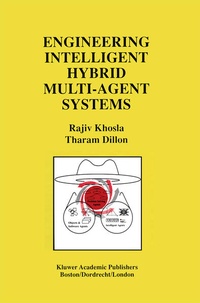
Engineering Intelligent Hybrid Multi-Agent Systems
Published on 26. November 2012
Book
Paperback/Softback
XXI, 410 pages
978-1-4613-7854-9 (ISBN)
Description
Engineering Intelligent Hybrid Multi-Agent Systems
is about building intelligent hybrid systems. Included is coverage of applications and design concepts related to fusion systems, transformation systems and combination systems. These applications are in areas involving hybrid configurations of knowledge-based systems, case-based reasoning, fuzzy systems, artificial neural networks, genetic algorithms, and in knowledge discovery and data mining. Through examples and applications a synergy of these subjects is demonstrated.
The authors introduce a multi-agent architectural theory for engineering intelligent associative hybrid systems. The architectural theory is described at both the task structure level and the computational level. This problem-solving architecture is relevant for developing knowledge agents and information agents.
An enterprise-wide system modeling framework is outlined to facilitate forward and backward integration of systems developed in the knowledge, information, and data engineering layers of an organization. In the modeling process, software engineering aspects like agent oriented analysis, design and reuse are developed and described.
Engineering Intelligent Hybrid Multi-Agent Systems is the first book in the field to provide details of a multi-agent architecture for building intelligent hybrid systems.
The authors introduce a multi-agent architectural theory for engineering intelligent associative hybrid systems. The architectural theory is described at both the task structure level and the computational level. This problem-solving architecture is relevant for developing knowledge agents and information agents.
An enterprise-wide system modeling framework is outlined to facilitate forward and backward integration of systems developed in the knowledge, information, and data engineering layers of an organization. In the modeling process, software engineering aspects like agent oriented analysis, design and reuse are developed and described.
Engineering Intelligent Hybrid Multi-Agent Systems is the first book in the field to provide details of a multi-agent architecture for building intelligent hybrid systems.
More details
Edition
Softcover reprint of the original 1st ed. 1997
Language
English
Place of publication
New York
United States
Target group
Professional and scholarly
Research
Illustrations
XXI, 410 p.
Dimensions
Height: 235 mm
Width: 155 mm
Thickness: 24 mm
Weight
657 gr
ISBN-13
978-1-4613-7854-9 (9781461378549)
DOI
10.1007/978-1-4615-6223-8
Schweitzer Classification
Other editions
Additional editions
Rajiv Khosla
Engineering Intelligent Hybrid Multi-Agent Systems
E-Book
12/2012
Springer
€149.79
Available for download
Rajiv Khosla
Engineering Intelligent Hybrid Multi-Agent Systems
Book
09/1997
Kluwer Academic Publishers
€160.49
Shipment within 15-20 days
Content
1. Why Intelligent Hybrid Systems.- 2. Methodologies.- 3. Intelligent Fusion and Transformation Systems.- 4. Intelligent Combination Systems.- 5. Knowledge Discovery, Data Mining and Hybrid Systems.- 6. Association Systems - Task Structure Level Associative Hybrid Architecture.- 7. Intelligent Multi-Agent Hybrid Computational Architecture - Part I.- 8. Intelligent Multi-Agent Hybrid Computational Architecture - Part II.- 9. Alarm Processing - An Application of IMAHDA.- 10. Agent Oriented Analysis and Design of the RTAPS - Part I.- 11. Agent Oriented Analysis and Design of the RTAPS - Part II.- 12. RTAPS.- 13. From Data Repositories to Knowledge Repositories.- 14. IMAHDA Revisited.- Appendices.- A-Input Features of the Animal Domain.- B-Classes in the Animal Domain.- C-TTS Power Network.- D-TTS Substation Power Network.- E-Real Time Alarm Data.