

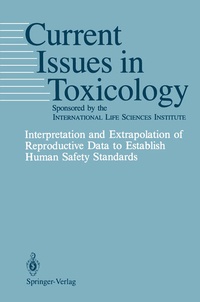
Interpretation and Extrapolation of Reproductive Data to Establish Human Safety Standards
Published on 10. June 1998
Book
Paperback/Softback
XII, 133 pages
978-0-387-96962-6 (ISBN)
Description
The International Life Sciences Institute (!LSI) is a scientific foundation that addresses critical health and safety issues of national and international con cern. ILSI promotes international cooperation by providing the mechanism for scientists from government, industry, and universities to work together on cooperative programs to generate and disseminate scientific data. The mem bers and trustees of the institute believe that questions regarding health and safety are best resolved when scientists can examine and discuss issues as an independent body separate from the political pressures of individual countries and the economic concerns of individual companies. Frequently, meaningful assessment of the risk of a test substance is hindered by the inherent inconsistencies in the system. The development and refine ment of methods and systems to evaluate the safety of chemicals have evolved in a rapid and largely unplanned fashion. Attempts to improve the system have mainly been directed toward broad general concerns, with little attention being given to specific problems or issues. A failure to resolve these problems has frequently resulted in increased testing costs and complications in the assessment and extrapolation of the results to humans. Publicity surrounding toxicologic issues makes it difficult for governments to deal effectively with these problems. In response to these difficulties, ILSI has assembled highly qualified and renowned scientists from research institutes, universities, government, and industry with relevant scientific knowledge and expertise regarding the issues that complicate risk assessment procedures.
More details
Series
Edition
Softcover reprint of the original 1st ed. 1989
Language
English
Place of publication
New York
United States
Target group
Professional and scholarly
Research
Illustrations
XII, 133 p.
Dimensions
Height: 235 mm
Width: 155 mm
Thickness: 9 mm
Weight
236 gr
ISBN-13
978-0-387-96962-6 (9780387969626)
DOI
10.1007/978-1-4684-6379-8
Schweitzer Classification
Other editions
Additional editions
K.S. Khera | H.C. Grice | D.J. Clegg
Interpretation and Extrapolation of Reproductive Data to Establish Human Safety Standards
E-Book
12/2012
Springer
€96.29
Available for download
Content
I. Introduction.- II. Terminology and Definitions.- References.- III. Teratogenicity (Embryotoxicity) Studies: Design, Conduct, and Evaluation.- 3.1. Introduction.- 3.2. Protocol.- 3.3. Conduct of the Study.- 3.4. Evaluation of Animal Data.- References.- IV. Multigeneration Studies.- 4.1. Introduction.- 4.2. Test Protocols.- 4.3. Test Material.- 4.4. Test Species.- 4.5. Route of Administration.- 4.6. Method of Administration.- 4.7. Dose Levels.- 4.8. Performance of Multigeneration Studies.- 4.9. Evaluation of Animal Data.- References.- V. Behavioral-Functional Teratology.- 5.1. Introduction.- 5.2. Review Articles.- 5.3. Methods Currently in Use or Under Development.- 5.4. Current Status of Testing Procedures and Use.- 5.4.3.1. Food and Drug Administration.- 5.4.3.2. Environmental Protection Agency.- 5.5. Discussion.- References.- VI. In Vitro Developmental Toxicity Assays.- 6.1. Introduction.- 6.2. Assay Systems Using Submammalian Species.- 6.3. Assay Systems Using Mammalian Species.- 6.4. Role of In Vitro Assays for Teratogenicity.- References.- VII. Statistical Methods for Developmental Toxicity Studies.- 7.1. Introduction.- 7.2. Comparison Between Exposed and Unexposed Groups.- 7.3. Dose-Response Models.- 7 4 Summary and Conclusions.- References.- VIII. Epidemiology.- 8.1. Introduction.- 8.2. The Conduct of Epidemiologic Studies on Human Reproduction.- 8.3. Descriptive Studies.- 8.4. Etiologic Studies.- 8.5. Characteristics of an Acceptable Human Reproduction Study.- References.- IX. Extrapolation of Reproductive Risks from Animal and Human Data.- 9.1. Introduction.- 9.2. Classification of Chemicals for In Utero Effects.- 9.3. Methods of Risk Extrapolation.- References.- X. Guidelines for Reproductive Toxicity Tests in Different Countries With a Proposal for International Harmonization.- 10.1. Introduction.- 10.2. Current Guidelines for Reproductive Toxicity Testing.- 10.3. Harmonization of Guidelines.- 10.4. Steps Toward Harmonization.- 10.5. Conclusions.- References.