

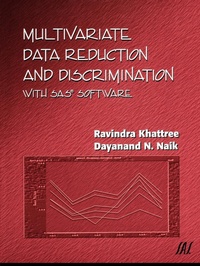
Multivariate Data Reduction and Discrimination with SAS Software
Published on 31. July 2000
Book
Paperback/Softback
584 pages
978-0-471-32300-6 (ISBN)
Description
Easy to read and comprehensive, this book presents descriptive multivariate (DMV) statistical methods using real-world problems and data sets. It offers a unique approach to integrating statistical methods, various kinds of advanced data analyses, and applications of the popular SAS software aids. Emphasis is placed on the correct interpretation of output to draw meaningful conclusions in a variety of disciplines and industries.
Reviews / Votes
"...a core or supplementary text for graduate or senior undergraduate students, and a reference for researchers and practitioners." (SciTech Book News, Vol. 24, No. 4, December 2000)More details
Language
English
Place of publication
New York
United States
Target group
College/higher education
Professional and scholarly
Product notice
Paperback (trade)
Unsewn / adhesive bound
Dimensions
Height: 280 mm
Width: 210 mm
Thickness: 31 mm
Weight
1408 gr
ISBN-13
978-0-471-32300-6 (9780471323006)
Copyright in bibliographic data and cover images is held by Nielsen Book Services Limited or by the publishers or by their respective licensors: all rights reserved.
Schweitzer Classification
Persons
Ravindra Khattree is an Indian-American statistician and professor of statistics at Oakland University. His contribution to the Fountain-Khattree-Peddada Theorem in Pitman measure of closeness is one of the important results of his work. Khattree is the coauthor of two books and has coedited two volumes. Dayanand N. Naik is the author of Multivariate Data Reduction and Discrimination with SAS Software, published by Wiley.
Content
Basic Concepts for Multivariate Statistics.
Principal Component Analysis.
Canonical Correlation Analysis.
Factor Analysis.
Discriminant Analysis.
Cluster Analysis.
Correspondence Analysis.
Appendix.
References.
Index.
Principal Component Analysis.
Canonical Correlation Analysis.
Factor Analysis.
Discriminant Analysis.
Cluster Analysis.
Correspondence Analysis.
Appendix.
References.
Index.