

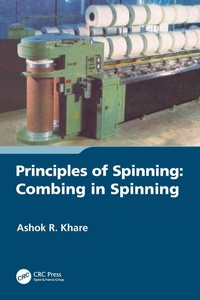
Principles of Spinning
Combing in Spinning
1st Edition
Published on 30. January 2025
Book
Paperback/Softback
218 pages
978-1-032-53490-9 (ISBN)
Description
Principally focussed on the combing process, the initial chapters of this book explain the basic functioning of the conventional comber, which is not very different from modern combing. Various associated motions with reference to certain timings along with importance are illustrated in detail. Characteristics that set the modern comber apart are also discussed including speed and control of features such as vibrations and fatigue. The role of modern electronics in mechanism control, including related calculations and solved examples, is described.
Features:
Exclusive title focussing on various elements of combing in spinning.
Includes detailed functioning of conventional and modern combers.
Explains various motions in combing pertaining to different timings.
Discusses the role of modern electronics in controlling the mechanisms and offering online controls.
Features solved examples at the end to tackle problems at the shop-floor level.
This book is aimed at senior undergraduate/graduate students, textile process engineers and related manufacturing technologists, quality assurance professionals in textile engineering, staple fibre processing, spinning of staple fibres, textile marketing/design, textile technology, yarn manufacturing, spinning machines and design of yarns.
Features:
Exclusive title focussing on various elements of combing in spinning.
Includes detailed functioning of conventional and modern combers.
Explains various motions in combing pertaining to different timings.
Discusses the role of modern electronics in controlling the mechanisms and offering online controls.
Features solved examples at the end to tackle problems at the shop-floor level.
This book is aimed at senior undergraduate/graduate students, textile process engineers and related manufacturing technologists, quality assurance professionals in textile engineering, staple fibre processing, spinning of staple fibres, textile marketing/design, textile technology, yarn manufacturing, spinning machines and design of yarns.
More details
Series
Language
English
Place of publication
London
United Kingdom
Publishing group
Taylor & Francis Ltd
Target group
College/higher education
Professional and scholarly
Postgraduate and Professional Practice & Development
Illustrations
165 s/w Abbildungen, 4 s/w Photographien bzw. Rasterbilder, 161 s/w Zeichnungen, 16 s/w Tabellen
16 Tables, black and white; 161 Line drawings, black and white; 4 Halftones, black and white; 165 Illustrations, black and white
Dimensions
Height: 234 mm
Width: 156 mm
Thickness: 13 mm
Weight
365 gr
ISBN-13
978-1-032-53490-9 (9781032534909)
Copyright in bibliographic data and cover images is held by Nielsen Book Services Limited or by the publishers or by their respective licensors: all rights reserved.
Schweitzer Classification
Other editions
Additional editions
Book
09/2023
1st Edition
CRC Press
€186.10
Shipment within 10-20 days
E-Book
09/2023
1st Edition
CRC Press
€52.49
Available for download
E-Book
09/2023
1st Edition
CRC Press
€52.49
Available for download
Person
Ashok R. Khare is a graduate, post-graduate and doctorate from a well-known technological institute - Veermata Jijabai Technological Institute, Mumbai (formerly known as Victoria Jubilee Technical Institute). He graduated from this Institute in 1970 and went to serve a well-known textile group of Mafatlal mills. After serving for nearly 5 years in the textile mills, he returned back to his Alma mater in 1975 as a lecturer in textile technology. In the due course, he was promoted to Assistant Professor and Professor.
In the last phase of his service in V.J.T.I., Mumbai, he took over as the Head of the Textile Manufacture's Department. Almost during the same tenure, he held a position of Deputy Director in the same Institute. He has written several articles on card cleaning efficiency, role of uni-comb, extended research work on influence of doubling parameters on properties of blended doubles yarns.
In the last phase of his service in V.J.T.I., Mumbai, he took over as the Head of the Textile Manufacture's Department. Almost during the same tenure, he held a position of Deputy Director in the same Institute. He has written several articles on card cleaning efficiency, role of uni-comb, extended research work on influence of doubling parameters on properties of blended doubles yarns.
Content
1. Combing Preparation. 2. Preparation for combing. 3. Comber. 4. Important Comber Settings. 5. Cylinder & Top Comb Needling Arrangement. 6. Other Aspects. 7. Faults in Comber. 8. Features of Modern Comber. 9. Comber Calculations