

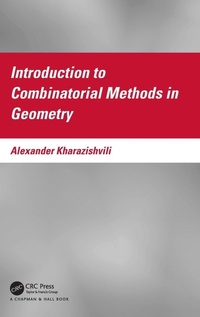
Introduction to Combinatorial Methods in Geometry
1st Edition
Published on 7. May 2024
Book
Hardback
376 pages
978-1-032-59470-5 (ISBN)
Description
This book offers an introduction to some combinatorial (also, set-theoretical) approaches and methods in geometry of the Euclidean space Rm. The topics discussed in the manuscript are due to the field of combinatorial and convex geometry.
The author's primary intention is to discuss those themes of Euclidean geometry which might be of interest to a sufficiently wide audience of potential readers. Accordingly, the material is explained in a simple and elementary form completely accessible to the college and university students. At the same time, the author reveals profound interactions between various facts and statements from different areas of mathematics: the theory of convex sets, finite and infinite combinatorics, graph theory, measure theory, classical number theory, etc.
All chapters (and also the five Appendices) end with a number of exercises. These provide the reader with some additional information about topics considered in the main text of this book. Naturally, the exercises vary in their difficulty. Among them there are almost trivial, standard, nontrivial, rather difficult, and difficult. As a rule, more difficult exercises are marked by asterisks and are provided with necessary hints.
The material presented is based on the lecture course given by the author. The choice of material serves to demonstrate the unity of mathematics and variety of unexpected interrelations between distinct mathematical branches.
The author's primary intention is to discuss those themes of Euclidean geometry which might be of interest to a sufficiently wide audience of potential readers. Accordingly, the material is explained in a simple and elementary form completely accessible to the college and university students. At the same time, the author reveals profound interactions between various facts and statements from different areas of mathematics: the theory of convex sets, finite and infinite combinatorics, graph theory, measure theory, classical number theory, etc.
All chapters (and also the five Appendices) end with a number of exercises. These provide the reader with some additional information about topics considered in the main text of this book. Naturally, the exercises vary in their difficulty. Among them there are almost trivial, standard, nontrivial, rather difficult, and difficult. As a rule, more difficult exercises are marked by asterisks and are provided with necessary hints.
The material presented is based on the lecture course given by the author. The choice of material serves to demonstrate the unity of mathematics and variety of unexpected interrelations between distinct mathematical branches.
More details
Language
English
Place of publication
Boca Raton
United Kingdom
Publishing group
Taylor & Francis Ltd
Target group
College/higher education
Professional and scholarly
Academic and Postgraduate
Dimensions
Height: 240 mm
Width: 161 mm
Thickness: 26 mm
Weight
760 gr
ISBN-13
978-1-032-59470-5 (9781032594705)
Copyright in bibliographic data and cover images is held by Nielsen Book Services Limited or by the publishers or by their respective licensors: all rights reserved.
Schweitzer Classification
Other editions
Additional editions
Alexander Kharazishvili
Introduction to Combinatorial Methods in Geometry
E-Book
05/2024
1st Edition
Chapman and Hall
€73.99
Available for download
Alexander Kharazishvili
Introduction to Combinatorial Methods in Geometry
E-Book
05/2024
1st Edition
Chapman and Hall
€73.99
Available for download
Person
Alexander Kharazishvili is Head of the Department of Discrete Mathematics at I. Vekua Institute of Applied Mathematics.
Content
1. The index of an isometric embedding. 2. Maximal ot-subsets of the Euclidean plane. 3. The cardinalities of at-sets in a real Hilbert space. 4. Isosceles triangles and it-sets in Euclidean space. 5. Some geometric consequences of Ramsey's combinatorial theorem. 6. Convexly independent subsets of infinite sets of points. 7. Homogeneous coverings of the Euclidean plane. 8. Three-colorings of the Euclidean plane and associated triangles of a prescribed type. 9. Chromatic numbers of graphs associated with point systems in Euclidean space. 10. The Szemeredi-Trotter theorem. 11. Minkowski's theorem, number theory, and nonmeasurable sets. 12. Tarski's plank problem. 13. Borsuk's conjecture. 14. Piecewise affine approximations of continuous functions of several variables and Caratheodory-Gale polyhedral. 15. Dissecting a square into triangles of equal areas. 16. Geometric realizations of finite and infinite families of sets. 17. A geometric form of the Axiom of Choice.