

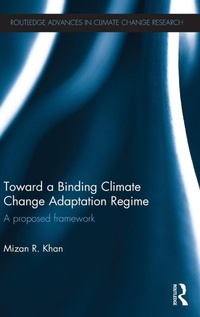
Toward a Binding Climate Change Adaptation Regime
A Proposed Framework
1st Edition
Published on 29. October 2013
Book
Hardback
280 pages
978-0-415-66155-3 (ISBN)
Description
The impact of climate change is global both in its cause and its effect. Thus there is a global responsibility for international cooperation to tackle the causes through mitigation strategies such as those agreed at the Durban Platform of December 2011. This climate regime aims to define responsibilities, mechanisms, funding and compliance in order to achieve a clear objective regarding the reduction of greenhouse gas emissions. Although tackling the causes of climate change through mitigation is necessary, it is also essential to examine the effect of climate change and what international cooperation can take place to ensure global adaptation measures. This pioneering book deals exclusively with the politics of why adaptation as a global responsibility continues to be ignored.
Scientific consensus is that the impacts of climate change are increasing, as evident from the greater frequency, intensity and magnitude of climate disasters in recent years. This book asks why anticipatory and planned measures for reducing vulnerability to the impacts of climate change should not be regarded as a global responsibility in the same way as mitigation. This discrimination is likely to continue unless the framing and legal basis of adaptation can be strengthened. It is with this aim in place that Professor Khan utilises his experience in academia and as a negotiator to analyse the politics surrounding this important issue. In this book the author sets out a framework for establishing a legally-binding adaptation regime under the United Nations Framework Convention on Climate Change, with the view to reducing the gap between the strategic focus on mitigation and adaptation. This is invaluable research for students researching climate change from a variety of disciplinary perspectives, including the politics, law and economics of the issue.
Scientific consensus is that the impacts of climate change are increasing, as evident from the greater frequency, intensity and magnitude of climate disasters in recent years. This book asks why anticipatory and planned measures for reducing vulnerability to the impacts of climate change should not be regarded as a global responsibility in the same way as mitigation. This discrimination is likely to continue unless the framing and legal basis of adaptation can be strengthened. It is with this aim in place that Professor Khan utilises his experience in academia and as a negotiator to analyse the politics surrounding this important issue. In this book the author sets out a framework for establishing a legally-binding adaptation regime under the United Nations Framework Convention on Climate Change, with the view to reducing the gap between the strategic focus on mitigation and adaptation. This is invaluable research for students researching climate change from a variety of disciplinary perspectives, including the politics, law and economics of the issue.
More details
Series
Language
English
Place of publication
London
United Kingdom
Publishing group
Taylor & Francis Ltd
Target group
College/higher education
Illustrations
8 s/w Tabellen
8 Tables, black and white
Dimensions
Height: 240 mm
Width: 161 mm
Thickness: 20 mm
Weight
590 gr
ISBN-13
978-0-415-66155-3 (9780415661553)
Copyright in bibliographic data and cover images is held by Nielsen Book Services Limited or by the publishers or by their respective licensors: all rights reserved.
Schweitzer Classification
Other editions
Additional editions
Book
08/2015
1st Edition
Routledge
€71.60
Shipment within 10-20 days
E-Book
10/2013
1st Edition
Routledge
€64.49
Available for download
E-Book
10/2013
1st Edition
Routledge
€64.49
Available for download
Person
Mizan R. Khan is Professor at the Department of Environmental Science and Management at North South University, Bangladesh, and currently a visiting scholar at Brown University, USA.
Content
Part One Chapter 1: Introduction - The Context and Niche of the Book Chapter 2: Climate Change Regime, Adaptation and Politics Chapter 3: Climate Finance: Supply, Demand and Governance Chapter 4: Reframing of Adaptation Framework Part Two Chapter 5: The Lens of Double Exposure: Climate Change and Uneven Chapter 6 The Lens of human and global security Chapter 7:Climate change, justice and human rights - A Logical Marriage Part Three Chapter 8: Polluter pays principle Chapter 9: Liability and compensation under Loss and Damage Chapter 10: Conclusion - Toward the proposed framework