

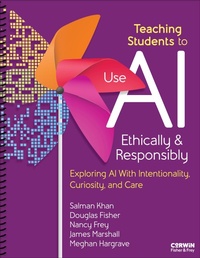
Teaching Students to Use AI Ethically & Responsibly
Exploring AI With Intentionality, Curiosity, and Care
1st Edition
Published on 10. November 2025
Book
Paperback/Softback
176 pages
979-8-3488-3222-3 (ISBN)
Description
Artificial intelligence is no longer a distant concept in education. It's a present-day force reshaping how students learn, and teachers teach. But in the rapidly evolving world of AI, educators need more than just quick fixes or flashy tools. With the guidance of expert educators Salman Khan, Douglas Fisher, Nancy Frey, James Marshall, and Meghan Hargrave, Teaching Students to Use AI Ethically & Responsibly will prepare you not only how to teach with AI-but how to teach for a world transformed by it.
Grounded in the latest research and enriched by years of classroom experience, this book takes you from understanding what AI is and how it operates, to helping students become confident, ethical thinkers in an AI-powered world. Organized into three sections, it covers how to teach AI's foundational concepts, how to develop student inquiry and critical thinking, and how to teach student AI usage through authentic, curiosity-driven learning quests. It includes:
Clear definitions, classroom examples, and teacher/student practices for each of the 30 core topics across AI theory, skills, and application
Step-by-step guides for nine unique AI-powered learning quests, each designed to drive curiosity, collaboration, and deep understanding
Practical strategies for addressing ethical considerations, bias, privacy, and responsible use of AI in learning environments
Skill progressions for different grade bands, including skills to master, prompt-crafting tips, and online examples to help both educators and students integrate and evaluate AI tools with confidence
Whether you're new to AI or already exploring its integration, this comprehensive resource sheds light on hidden aspects of AI, equips you to foster essential student skills, and provides actionable strategies for hands-on collaboration with AI in your daily teaching practice.
Grounded in the latest research and enriched by years of classroom experience, this book takes you from understanding what AI is and how it operates, to helping students become confident, ethical thinkers in an AI-powered world. Organized into three sections, it covers how to teach AI's foundational concepts, how to develop student inquiry and critical thinking, and how to teach student AI usage through authentic, curiosity-driven learning quests. It includes:
Clear definitions, classroom examples, and teacher/student practices for each of the 30 core topics across AI theory, skills, and application
Step-by-step guides for nine unique AI-powered learning quests, each designed to drive curiosity, collaboration, and deep understanding
Practical strategies for addressing ethical considerations, bias, privacy, and responsible use of AI in learning environments
Skill progressions for different grade bands, including skills to master, prompt-crafting tips, and online examples to help both educators and students integrate and evaluate AI tools with confidence
Whether you're new to AI or already exploring its integration, this comprehensive resource sheds light on hidden aspects of AI, equips you to foster essential student skills, and provides actionable strategies for hands-on collaboration with AI in your daily teaching practice.
More details
Language
English
Place of publication
Thousand Oaks
United States
Target group
Professional and scholarly
Dimensions
Height: 221 mm
Width: 279 mm
Thickness: 15 mm
Weight
512 gr
ISBN-13
979-8-3488-3222-3 (9798348832223)
Copyright in bibliographic data and cover images is held by Nielsen Book Services Limited or by the publishers or by their respective licensors: all rights reserved.
Schweitzer Classification
Persons
Salman Khan is the founder and CEO of the education nonprofit Khan Academy which has the mission of "providing free, world-class education for anyone, anywhere." It has 180 million registered users in over 50 languages. Salman is also the author of Brave New Words, a book about the future of AI in education and The One World Schoolhouse.
Douglas Fisher is professor and chair of educational leadership at San Diego State University and a teacher leader at Health Sciences High and Middle College. Previously, Doug was an early intervention teacher and elementary school educator. He is a credentialed English teacher and administrator in California. In 2022, he was inducted into the Reading Hall of Fame by the Literacy Research Association. He has published numerous articles on reading and literacy, leadership, and curriculum design, as well as books such as The Teacher Clarity Playbook (2nd ed.), Your Introduction to PLC+, The Illustrated Guide to Teacher Credibility, Instructional Strategies to Move Learning Forward: 50+ Tools That Support Gradual Release of Responsibility, and Welcome to Teaching!
Nancy Frey is a professor in educational leadership at San Diego State University and a teacher leader at Health Sciences High and Middle College. She is a credentialed special educator, reading specialist, and administrator in California. She is a member of the International Literacy Association's Literacy Research Panel. Her published titles include 50 Strategies for Activating Your PLC+, The Illustrated Guide to Visible Learning, Welcome to Teaching Multilingual Learners, Teaching Foundational Skills to Adolescent Readers, and RIGOR Unveiled: A Video-Enhanced Flipbook to Promote Teacher Expertise in Relationship Building, Instruction, Goals, Organization, and Relevance.
James Marshall is a professor of educational leadership at San Diego State University, where he also leads the Doctorate in Educational Leadership program. A credentialed teacher, he began his career as an informal science educator at the San Diego Zoo. Jim's passion centers on the design of learning programs that yield predictable results. He has written broadly on needs assessment, learning initiative design, implementation, and program evaluation. His published books include Right From the Start: The Essential Guide to Implementing School Initiatives, Fixing Education Initiatives in Crisis: 24 Go-To Strategies, and RIGOR Unveiled: A Video-Enhanced Flipbook to Promote Teacher Expertise in Relationship Building, Instruction, Goals, Organization, and Relevance. Meghan Hargrave is an experienced educator, with 20 years in the field. After being a teacher leader in the classroom, she moved into education coaching and consulting where she supports hundreds of K-12 schools and districts worldwide. Her work has always focused on important instructional shifts in education and practical ways the educators she supports can embrace these shifts effectively, which has included the integration of Artificial Intelligence tools in the classroom. She is ChatGPT, GoogleAI, and AI for Education certified in addition to working closely with thousands of educators on how to implement these tools in the classroom. She is the coauthor of The Artificial Intelligence Playbook (now in its second edition) and Teaching Students to Use AI Ethically and Responsibly, two books that help schools prepare students for an AI-powered future. Meghan is an international presenter, has taught preservice teachers at Columbia University's Teachers College, regularly contributes to popular educational publications, and is known for sharing innovative and effective classroom strategies via social media @letmeknowhowitgoes.
Douglas Fisher is professor and chair of educational leadership at San Diego State University and a teacher leader at Health Sciences High and Middle College. Previously, Doug was an early intervention teacher and elementary school educator. He is a credentialed English teacher and administrator in California. In 2022, he was inducted into the Reading Hall of Fame by the Literacy Research Association. He has published numerous articles on reading and literacy, leadership, and curriculum design, as well as books such as The Teacher Clarity Playbook (2nd ed.), Your Introduction to PLC+, The Illustrated Guide to Teacher Credibility, Instructional Strategies to Move Learning Forward: 50+ Tools That Support Gradual Release of Responsibility, and Welcome to Teaching!
Nancy Frey is a professor in educational leadership at San Diego State University and a teacher leader at Health Sciences High and Middle College. She is a credentialed special educator, reading specialist, and administrator in California. She is a member of the International Literacy Association's Literacy Research Panel. Her published titles include 50 Strategies for Activating Your PLC+, The Illustrated Guide to Visible Learning, Welcome to Teaching Multilingual Learners, Teaching Foundational Skills to Adolescent Readers, and RIGOR Unveiled: A Video-Enhanced Flipbook to Promote Teacher Expertise in Relationship Building, Instruction, Goals, Organization, and Relevance.
James Marshall is a professor of educational leadership at San Diego State University, where he also leads the Doctorate in Educational Leadership program. A credentialed teacher, he began his career as an informal science educator at the San Diego Zoo. Jim's passion centers on the design of learning programs that yield predictable results. He has written broadly on needs assessment, learning initiative design, implementation, and program evaluation. His published books include Right From the Start: The Essential Guide to Implementing School Initiatives, Fixing Education Initiatives in Crisis: 24 Go-To Strategies, and RIGOR Unveiled: A Video-Enhanced Flipbook to Promote Teacher Expertise in Relationship Building, Instruction, Goals, Organization, and Relevance. Meghan Hargrave is an experienced educator, with 20 years in the field. After being a teacher leader in the classroom, she moved into education coaching and consulting where she supports hundreds of K-12 schools and districts worldwide. Her work has always focused on important instructional shifts in education and practical ways the educators she supports can embrace these shifts effectively, which has included the integration of Artificial Intelligence tools in the classroom. She is ChatGPT, GoogleAI, and AI for Education certified in addition to working closely with thousands of educators on how to implement these tools in the classroom. She is the coauthor of The Artificial Intelligence Playbook (now in its second edition) and Teaching Students to Use AI Ethically and Responsibly, two books that help schools prepare students for an AI-powered future. Meghan is an international presenter, has taught preservice teachers at Columbia University's Teachers College, regularly contributes to popular educational publications, and is known for sharing innovative and effective classroom strategies via social media @letmeknowhowitgoes.
Content
About the Authors
SECTION 1. TEACHING ABOUT AI: "UNDER THE HOOD" CONCEPTS TO SUPPORT GOOD, ETHICAL, EFFECTIVE USE OF AI FOR LEARNING
Overview
GENERATIVE MODELS
PERSONALIZED MASTERY-BASED LEARNING
HUMAN-IN-THE-LOOP EXPERIENCES
COLLECTIVE INTELLIGENCE
ADAPTIVE PLATFORMS
AI, DATA, AND YOU
AI LIMITATIONS
AI AND SOCIETY
SECTION 2. TEACHING FOR AI: DEVELOPING HUMAN INTELLIGENCE SKILLS IN STUDENTS
Overview
INFORMATION LITERACY
DATA LITERACY
QUESTIONING
PROMPT ENGINEERING
DIALOGUE
VERIFICATION
CRITICAL INTERPRETATION
CURIOSITY
METACOGNITION
COGNITIVE FLEXIBILITY
ETHICAL REASONING
SELF-REGULATION
TEACHER DECISION-MAKING: WHEN STUDENTS CAN USE AI (AND WHEN THEY CANNOT)
SECTION 3. TEACHING WITH AI: LEARNING QUESTS THAT IGNITE CURIOSITY AND DEEPEN UNDERSTANDING
Overview
ANCHOR QUEST
CLARITY QUEST
COMPARE QUEST
CRITIQUE QUEST
GROWTH QUEST
LEVEL-UP QUEST
MISSION QUEST
PERSPECTIVE QUEST
REVERSE QUEST
RIGHT-SIZING QUEST
Conclusion
References
Index
SECTION 1. TEACHING ABOUT AI: "UNDER THE HOOD" CONCEPTS TO SUPPORT GOOD, ETHICAL, EFFECTIVE USE OF AI FOR LEARNING
Overview
GENERATIVE MODELS
PERSONALIZED MASTERY-BASED LEARNING
HUMAN-IN-THE-LOOP EXPERIENCES
COLLECTIVE INTELLIGENCE
ADAPTIVE PLATFORMS
AI, DATA, AND YOU
AI LIMITATIONS
AI AND SOCIETY
SECTION 2. TEACHING FOR AI: DEVELOPING HUMAN INTELLIGENCE SKILLS IN STUDENTS
Overview
INFORMATION LITERACY
DATA LITERACY
QUESTIONING
PROMPT ENGINEERING
DIALOGUE
VERIFICATION
CRITICAL INTERPRETATION
CURIOSITY
METACOGNITION
COGNITIVE FLEXIBILITY
ETHICAL REASONING
SELF-REGULATION
TEACHER DECISION-MAKING: WHEN STUDENTS CAN USE AI (AND WHEN THEY CANNOT)
SECTION 3. TEACHING WITH AI: LEARNING QUESTS THAT IGNITE CURIOSITY AND DEEPEN UNDERSTANDING
Overview
ANCHOR QUEST
CLARITY QUEST
COMPARE QUEST
CRITIQUE QUEST
GROWTH QUEST
LEVEL-UP QUEST
MISSION QUEST
PERSPECTIVE QUEST
REVERSE QUEST
RIGHT-SIZING QUEST
Conclusion
References
Index