

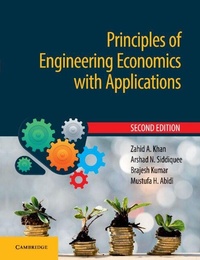
Principles of Engineering Economics with Applications
2nd Edition
Published on 18. October 2018
Book
Paperback/Softback
540 pages
978-1-108-45885-6 (ISBN)
Description
Covering detailed discussion of fundamental concepts of economics, the textbook commences with comprehensive explanation of theory of consumer behavior, utility maximization and optimal choice, profit function, cost minimization and cost function. The textbook covers methods including present worth method, future worth method, annual worth method, internal rate of return method, explicit re-investment rate of return method and payout method useful for studying economic studies. A chapter on value engineering discusses important topics such as function analysis systems techniques, the value index, value measurement techniques, innovative phase and constraints analysis in depth. It facilitates the understanding of the concepts through illustrations and solved problems. This text is the ideal resource for Indian undergraduate engineering students in the fields of mechanical engineering, computer science and engineering and electronics engineering for a course on engineering economics/engineering economy.
More details
Edition
2nd Revised edition
Language
English
Place of publication
Cambridge
United Kingdom
Target group
College/higher education
Edition type
Revised edition
Product notice
Paperback (trade)
Illustrations
Worked examples or Exercises
Dimensions
Height: 246 mm
Width: 189 mm
Thickness: 29 mm
Weight
1039 gr
ISBN-13
978-1-108-45885-6 (9781108458856)
Copyright in bibliographic data and cover images is held by Nielsen Book Services Limited or by the publishers or by their respective licensors: all rights reserved.
Schweitzer Classification
Other editions
Additional editions
Zahid A. Khan | Arshad N. Siddiquee | Brajesh Kumar
Principles of Engineering Economics with Applications
E-Book
09/2018
2nd Edition
Cambridge University Press
€79.99
Available for download
Persons
Zahid A. Khan is Professor, Department of Mechanical Engineering, Jamia Millia Islamia University, New Delhi, India. He received his Ph.D. in 2001 from Jamia Millia Islamia University. His research interest includes optimization of design and manufacturing processes parameters, Artificial Neural Network (ANN) and fuzzy modeling and environmental ergonomics. He has published more than 90 articles in journals of national and international repute. Arshad Noor Siddiquee is Professor, Department of Mechanical Engineering, Jamia Millia Islamia University, New Delhi. He received his Ph.D. from the Indian Institute of Technology, Delhi. His research areas are materials structure property correlation, welding engineering, machining and optimization of design and process parameters using fuzzy modeling. He has published more than 75 articles in national and international journals. He served as Assistant Director of All India Council of Technical Education (AICTE) from 2005-07. Brajesh Kumar is currently serving as an Associate Professor at the National Institute of Financial Management (NIFM), Faridabad. He has more than 17 years of teaching, training consultancy and research experience. His areas of interest include mathematical economics, business economics, managerial economics, computer applications in economics, research methodology and econometrics. He has published several papers in journals of national and international repute. Mustufa H. Abidi is a researcher, Industrial Engineering Department, King Saud University. His areas of research include application of virtual reality techniques for sustainable product development, Flexible Manufacturing Systems, Micro-Manufacturing, Human-Computer Interaction, additive manufacturing, and Reverse engineering. He has been teaching courses on Design of Experiments, Simulation modeling, Product Design and Development at King Saud University.
Content
Preface; Acknowledgement; Dedication; 1. Engineering economy: a prologue; 2. Fundamentals of mathematics and engineering economics; 3. Elementary economic analysis; 4. Interest formulas and their applications; 5. Methods for making economy studies; 6. Selection among alternatives; 7. Replacement and retention decisions; 8. Depreciation; 9. Economic evaluation of public sector projects; 10. Economy study with inflation considered; 11. Make or buy decision; 12. Cost estimation and its methods; 13. Project management; 14. Value engineering; 15. Forecasting; Reference; Index.