

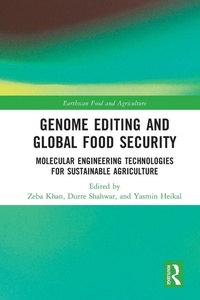
Genome Editing and Global Food Security
Molecular Engineering Technologies for Sustainable Agriculture
1st Edition
Published on 18. December 2024
Book
Paperback/Softback
318 pages
978-1-032-46526-5 (ISBN)
Description
With the rapid increase in the global population and changing climatic impacts on agriculture, this book demonstrates how genome editing will be an indispensable technique to overcome ongoing and prospective agricultural challenges.
This book examines the role of genome editing in improving crop yields and contributing to global food security. It summarizes a range of genome editing techniques and discusses the roles they can play in producing a new generation of high-yielding, climate-ready crops. This includes site-specific nucleases, precision genome engineering, clustered regularly interspaced short palindromic repeats, and bioinformatics. It showcases how these gene editing techniques can tailor plants to not only increase yield-related traits but to also make them better suited to their environment and to be resistant to pests and extreme climatic events, such as droughts. The book also examines genome editing regulations and policies, the commercialization of genome-edited crops, and biosafety and biosecurity concerns. Overall, this book reveals and showcases how genome editing can improve crop resilience and production to address current and future agricultural challenges and alleviation of global food security concerns.
This book will be of great interest to students and scholars of agricultural science, crop and plant science, genome editing, sustainable agriculture, biotechnology, and food security.
This book examines the role of genome editing in improving crop yields and contributing to global food security. It summarizes a range of genome editing techniques and discusses the roles they can play in producing a new generation of high-yielding, climate-ready crops. This includes site-specific nucleases, precision genome engineering, clustered regularly interspaced short palindromic repeats, and bioinformatics. It showcases how these gene editing techniques can tailor plants to not only increase yield-related traits but to also make them better suited to their environment and to be resistant to pests and extreme climatic events, such as droughts. The book also examines genome editing regulations and policies, the commercialization of genome-edited crops, and biosafety and biosecurity concerns. Overall, this book reveals and showcases how genome editing can improve crop resilience and production to address current and future agricultural challenges and alleviation of global food security concerns.
This book will be of great interest to students and scholars of agricultural science, crop and plant science, genome editing, sustainable agriculture, biotechnology, and food security.
More details
Series
Language
English
Place of publication
London
United Kingdom
Publishing group
Taylor & Francis Ltd
Target group
College/higher education
Professional and scholarly
Academic, Postgraduate, and Undergraduate Advanced
Illustrations
39 s/w Abbildungen, 28 s/w Photographien bzw. Rasterbilder, 11 s/w Zeichnungen, 14 s/w Tabellen
14 Tables, black and white; 11 Line drawings, black and white; 28 Halftones, black and white; 39 Illustrations, black and white
Dimensions
Height: 234 mm
Width: 156 mm
Thickness: 18 mm
Weight
509 gr
ISBN-13
978-1-032-46526-5 (9781032465265)
Copyright in bibliographic data and cover images is held by Nielsen Book Services Limited or by the publishers or by their respective licensors: all rights reserved.
Schweitzer Classification
Other editions
Additional editions
Zeba Khan | Durre Shahwar | Yasmin Heikal
Genome Editing and Global Food Security
Molecular Engineering Technologies for Sustainable Agriculture
E-Book
09/2023
1st Edition
Routledge
€55.49
Available for download
Zeba Khan | Durre Shahwar | Yasmin Heikal
Genome Editing and Global Food Security
Molecular Engineering Technologies for Sustainable Agriculture
Book
09/2023
1st Edition
Routledge
€196.90
Shipment within 10-20 days
Zeba Khan | Durre Shahwar | Yasmin Heikal
Genome Editing and Global Food Security
Molecular Engineering Technologies for Sustainable Agriculture
E-Book
09/2023
1st Edition
Routledge
€55.49
Available for download
Persons
Zeba Khan is a faculty member at the Center for Agricultural Education, Department of Agricultural Sciences at the Aligarh Muslim University, India. She holds a PhD from Aligarh Muslim University.
Durre Shahwar is a post-doctoral fellow at the Department of horticultural biosciences, Pusan National University, South Korea. She holds a PhD from the Aligarh Muslim University, India.
Yasmin Heikal is an assistant professor in the Department of Botany at Mansoura University, Egypt. She holds a PhD in genetic diversity from Mansoura University.
Durre Shahwar is a post-doctoral fellow at the Department of horticultural biosciences, Pusan National University, South Korea. She holds a PhD from the Aligarh Muslim University, India.
Yasmin Heikal is an assistant professor in the Department of Botany at Mansoura University, Egypt. She holds a PhD in genetic diversity from Mansoura University.
Content
Chapter 1 Genome editing in plants via CRISPR/Cas9: A genomic scissor borrowed from bacterial immune system.
Chapter 2 Genome Editing by Site-Directed Nucleases (SDNs) and its Applications Producing Climate Change Resilient Crop Plants
Chapter 3 Genome editing by different Site-Specific Nucleases (SSNs) and their applications in improving horticultural crops
Chapter 4 Precision genome engineering and designer nucleases for crop improvement
Chapter 5 CRISPR genome editing to address food security and climate changes: challenges and opportunities
Chapter 6 Abiotic and biotic stress tolerance in plants via genome editing tools
Chapter 7 Recent advances in Genome Editing towards Sustainable Agriculture
Chapter 8 Potential of commercialization of genome edited crops
Chapter 9 Crop Genome Editing - Regulations and Policies
Chapter 10 Biosafety and biosecurity concerns associated with plant genome editing
Chapter 11 Role of Bioinformatics Databases in Functional Genomics and Metabolic engineeringResearches
Chapter 2 Genome Editing by Site-Directed Nucleases (SDNs) and its Applications Producing Climate Change Resilient Crop Plants
Chapter 3 Genome editing by different Site-Specific Nucleases (SSNs) and their applications in improving horticultural crops
Chapter 4 Precision genome engineering and designer nucleases for crop improvement
Chapter 5 CRISPR genome editing to address food security and climate changes: challenges and opportunities
Chapter 6 Abiotic and biotic stress tolerance in plants via genome editing tools
Chapter 7 Recent advances in Genome Editing towards Sustainable Agriculture
Chapter 8 Potential of commercialization of genome edited crops
Chapter 9 Crop Genome Editing - Regulations and Policies
Chapter 10 Biosafety and biosecurity concerns associated with plant genome editing
Chapter 11 Role of Bioinformatics Databases in Functional Genomics and Metabolic engineeringResearches