

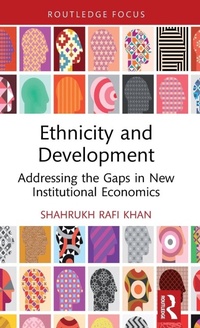
Ethnicity and Development
Addressing the Gaps in New Institutional Economics
1st Edition
Published on 3. November 2023
Book
Hardback
78 pages
978-1-032-63082-3 (ISBN)
Description
Ethnicity and Development explores the impact of ethnic fragmentation on the success or failure of nations and uses case studies of Bangladesh and Pakistan to illustrate this. It analyzes the role of institutions in engendering economic and social progress and challenges the New Institutional Economics (NIE) narrative.
The book argues that the NIE narrative has some gaps, particularly that it is blind to ethnic fragmentation and therefore does not account for the construction of institutions that can build national cohesion in low- and low-middleincome countries (L/LMICs). It shows that L/LMICs have a different cultural context and that they need to first build national cohesion on a foundation of horizontal - across ethnic groups - and vertical - across classes - equity. The author's analysis also examines other novel issues, such as the boost that is provided by nations acquiring the right of self-determination. Other novelties are the distinction between prime causes (triggers) for economic development and approaches for economic development. More important for this book is the distinction between natural and constructed nations and the conceptual framework presented to analyze their performance. Finally, the study examines the creation of national cohesion in ethnically diverse nations.
Addressing a gap in the literature, this book will be of interest to researchers in development economics, political science and sociology and specialists in comparative politics/political theory with a focus on Area Studies.
The book argues that the NIE narrative has some gaps, particularly that it is blind to ethnic fragmentation and therefore does not account for the construction of institutions that can build national cohesion in low- and low-middleincome countries (L/LMICs). It shows that L/LMICs have a different cultural context and that they need to first build national cohesion on a foundation of horizontal - across ethnic groups - and vertical - across classes - equity. The author's analysis also examines other novel issues, such as the boost that is provided by nations acquiring the right of self-determination. Other novelties are the distinction between prime causes (triggers) for economic development and approaches for economic development. More important for this book is the distinction between natural and constructed nations and the conceptual framework presented to analyze their performance. Finally, the study examines the creation of national cohesion in ethnically diverse nations.
Addressing a gap in the literature, this book will be of interest to researchers in development economics, political science and sociology and specialists in comparative politics/political theory with a focus on Area Studies.
More details
Series
Language
English
Place of publication
London
United Kingdom
Publishing group
Taylor & Francis Ltd
Target group
College/higher education
Postgraduate
Illustrations
11 s/w Tabellen
11 Tables, black and white
Dimensions
Height: 222 mm
Width: 145 mm
Thickness: 9 mm
Weight
261 gr
ISBN-13
978-1-032-63082-3 (9781032630823)
Copyright in bibliographic data and cover images is held by Nielsen Book Services Limited or by the publishers or by their respective licensors: all rights reserved.
Schweitzer Classification
Other editions
Additional editions
Book
04/2025
1st Edition
Routledge
€35.50
Shipment within 10-20 days
E-Book
11/2023
1st Edition
Taylor & Francis
€31.49
Available for download
E-Book
11/2023
1st Edition
Taylor & Francis
€31.49
Available for download
Person
Shahrukh Rafi Khan is currently a research associate at Mount Holyoke College, South Hadley, Massachusetts. He has published extensively in refereed journals and authored and edited numerous books. His recent books include Economic Successes in South Asia: A Story of Partnerships (Routledge, 2022); Spontaneous and Induced Collective Action in Pakistani Rural Development (with Shaheen Rafi Khan, Palgrave Macmillan, 2021); Development Economics: A Critical Introduction (Routledge, 2020); A Microcredit Alternative in South Asia (with Natasha Ansari, Routledge, 2018); Routledge History of Development Economics Thought (Routledge, 2014); and Market as Means Not Master: Towards New Developmentalism (Routledge, 2010).
Content
List of tables viii
Preface ix
1 New institutional economics and economic development 1
2 Nations, conceptual framework and method 15
3 Ethnicity and development 24
4 Independence, ethnicity and development: case studies 37
5 Forging national cohesion in constructed nations 51
6 Summary and conclusion 72
Index 75
Preface ix
1 New institutional economics and economic development 1
2 Nations, conceptual framework and method 15
3 Ethnicity and development 24
4 Independence, ethnicity and development: case studies 37
5 Forging national cohesion in constructed nations 51
6 Summary and conclusion 72
Index 75