

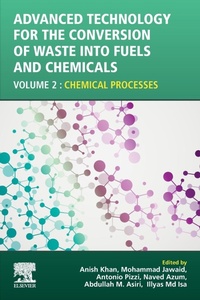
Advanced Technology for the Conversion of Waste into Fuels and Chemicals
Volume 2: Chemical Processes
Published on 29. July 2021
Book
Paperback/Softback
406 pages
978-0-323-90150-5 (ISBN)
Description
Advanced Technology for the Conversion of Waste into Fuels and Chemicals: Volume 2: Chemical Processes is the second of two volumes by the editors (the first volume is Advanced Technology for the Conversion of Waste into Fuels and Chemicals: Biological Processes). This volume presents advanced techniques and combined techniques used to convert energy to waste, including combustion, gasification, paralysis, anaerobic digestion and fermentation. The title focuses on solid waste conversion to fuel and energy, presenting advances in the design, manufacture and application of conversion technologies. Contributors from physics, chemistry, metallurgy, engineering and manufacturing present a truly trans-disciplinary picture of waste to energy conversion.
Huge volumes of solid waste are produced globally while, at the same time, huge amounts of energy are produced from fossil fuels. Waste to energy (WTE) technologies are developing rapidly, holding out the potential to make clean, sustainable power from waste material. These WTE procedures incorporate various methods and blended approaches, and present an enormous opportunity for clean, sustainable energy.
Huge volumes of solid waste are produced globally while, at the same time, huge amounts of energy are produced from fossil fuels. Waste to energy (WTE) technologies are developing rapidly, holding out the potential to make clean, sustainable power from waste material. These WTE procedures incorporate various methods and blended approaches, and present an enormous opportunity for clean, sustainable energy.
More details
Language
English
Place of publication
United States
Publishing group
Elsevier Science Publishing Co Inc
Target group
Professional and scholarly
Product notice
Paperback (trade)
Illustrations
100 illustrations (50 in full color); Illustrations
Dimensions
Height: 229 mm
Width: 152 mm
Thickness: 21 mm
Weight
545 gr
ISBN-13
978-0-323-90150-5 (9780323901505)
Copyright in bibliographic data and cover images is held by Nielsen Book Services Limited or by the publishers or by their respective licensors: all rights reserved.
Schweitzer Classification
Other editions
Additional editions
Anish Khan | Mohammad Jawaid | Antonio Pizzi
Advanced Technology for the Conversion of Waste into Fuels and Chemicals
Volume 2: Chemical Processes
E-Book
07/2021
Woodhead Publishing
€220.00
Available for download
Persons
Dr. Anish Khan is currently working as Assistant Professor in Chemistry Department, Centre of Excellence for Advanced Materials Research (CEAMR), Faculty of Science, King Abdulaziz University, Jeddah, Saudi Arabia. Completed Ph.D. from Aligarh Muslim University, India in 2010. Completed Postdoctoral from School of Chemical Sciences, University Sains Malaysia (USM) in Electroanalytical chemistry in 2010. Working in the field of synthetic biosensor, polymer composites, organic-inorganic electrically conducting nanocomposites. More than 200 research articles, 70 book chapters 30 books published in referred international publisher and more than 20 international conferences/ workshop. More than 30 research projects completed. Editorial board member of more than 11 international journals. Member of American Nano Society.
Prof. Dr. Mohammad Jawaid is currently working as Distinguished Professor at Chemical and Petroleum Engineering Department, United Arab Emirates University, UAE. He has more than 25 years of experience in teaching, research, and industries. His area of research interests includes hybrid composites, lignocellulosic reinforced/filled polymer composites, advance materials: graphene/nanoclay/fire retardant, modification and treatment of lignocellulosic fibers and solid wood, biopolymers and biopolymers for packaging applications, nanocomposites and nanocellulose fibers, and polymer blends. So far, he has published 100 books, more than 100 book chapters, more than 500 peer-reviewed international journal papers, and several published review papers under top 25 hot articles in science direct during 2013-2020. He also obtained 6 Patents and 6 Copyrights/Industrial design. H-index and citation in Scopus are 101 and 43525 and in Google scholar, and H-index and citation are 120 and 58132. 40 Ph.D. and 17 Master's students graduated under his supervision in 2014-2024 in the fields of hybrid composites, green composites, nanocomposites, natural fiber-reinforced composites, nanocellulose, etc. He secured various research grants at university, national, and international levels on polymer composites of around USD 3 Million. He also delivered plenary and invited talks in international conferences related to composites in India, Turkey, Malaysia, Thailand, United Kingdom, France, Saudi Arabia, Egypt, China, Germany, Indonesia, Spain, UAE, Portagal, etc. Besides that, he is also a member of technical committees of several national and international conferences on composites and material science. He is founding Series Editor of Springer Three Book Series. He worked as guest editor of special issues of Several Peer reviewed Journals. Besides that, he is also reviewer of several high-impact international peer-reviewed journals of Elsevier, Springer, Wiley, Saga, ACS, RSC, Frontiers, etc. Dr. Mohammad Jawaid also received Several Award at National and International Level. He is also Winner of Newton-Ungku Omar Coordination Fund: UK-Malaysia Research and Innovation Bridges Competition 2015. He is also Professional membership of ACS, SPE, APA, MySET, etc. He is Fellow and Chartered Scientist of The Institute of Materials, Minerals & Mining (IOM3), UK. He is also Clarivate 1% Highly cited Researcher-2023.
Antonio Pizzi works in LERMAB at the University of Lorraine, Epinal, France. Naved Azum works in the Centre of Excellence for Advanced Materials Research, Chemistry Department, Faculty of Science at King Abdulaziz University, Jeddah, Saudi Arabia Prof. Abdullah M. Asiri is the Head of the Chemistry Department at King Abdulaziz University since October 2009 and he is the founder and the Director of the Center of Excellence for Advanced Materials Research (CEAMR) since 2010 till date. He is the Professor of Organic Photochemistry. His research interest covers color chemistry, synthesis of novel photochromic and thermochromic systems, synthesis of novel coloring matters and dyeing of textiles, materials chemistry, nanochemistry and nanotechnology, polymers and plastics. A major achievement of Prof. Asiri is the discovery of tribochromic compounds, a class of compounds which change from slightly or colorless to deep colored when subjected to small pressure or when grind. This discovery was introduced to the scientific community as a new terminology published by IUPAC in 2000. This discovery was awarded a patent from European Patent office and from UK patent. He is also a member of the Editorial Board of various journals of international repute. He is the Vice- President of Saudi Chemical Society (Western Province Branch). He holds four USA patents, more than 800 Publications in international journals, seven book chapters, and ten books Illyas M.D. Isa works in the Chemistry Department at Universiti Pendidikan Sultan Idris (UPSI, Kuala Lumpur, Malaysia
Prof. Dr. Mohammad Jawaid is currently working as Distinguished Professor at Chemical and Petroleum Engineering Department, United Arab Emirates University, UAE. He has more than 25 years of experience in teaching, research, and industries. His area of research interests includes hybrid composites, lignocellulosic reinforced/filled polymer composites, advance materials: graphene/nanoclay/fire retardant, modification and treatment of lignocellulosic fibers and solid wood, biopolymers and biopolymers for packaging applications, nanocomposites and nanocellulose fibers, and polymer blends. So far, he has published 100 books, more than 100 book chapters, more than 500 peer-reviewed international journal papers, and several published review papers under top 25 hot articles in science direct during 2013-2020. He also obtained 6 Patents and 6 Copyrights/Industrial design. H-index and citation in Scopus are 101 and 43525 and in Google scholar, and H-index and citation are 120 and 58132. 40 Ph.D. and 17 Master's students graduated under his supervision in 2014-2024 in the fields of hybrid composites, green composites, nanocomposites, natural fiber-reinforced composites, nanocellulose, etc. He secured various research grants at university, national, and international levels on polymer composites of around USD 3 Million. He also delivered plenary and invited talks in international conferences related to composites in India, Turkey, Malaysia, Thailand, United Kingdom, France, Saudi Arabia, Egypt, China, Germany, Indonesia, Spain, UAE, Portagal, etc. Besides that, he is also a member of technical committees of several national and international conferences on composites and material science. He is founding Series Editor of Springer Three Book Series. He worked as guest editor of special issues of Several Peer reviewed Journals. Besides that, he is also reviewer of several high-impact international peer-reviewed journals of Elsevier, Springer, Wiley, Saga, ACS, RSC, Frontiers, etc. Dr. Mohammad Jawaid also received Several Award at National and International Level. He is also Winner of Newton-Ungku Omar Coordination Fund: UK-Malaysia Research and Innovation Bridges Competition 2015. He is also Professional membership of ACS, SPE, APA, MySET, etc. He is Fellow and Chartered Scientist of The Institute of Materials, Minerals & Mining (IOM3), UK. He is also Clarivate 1% Highly cited Researcher-2023.
Antonio Pizzi works in LERMAB at the University of Lorraine, Epinal, France. Naved Azum works in the Centre of Excellence for Advanced Materials Research, Chemistry Department, Faculty of Science at King Abdulaziz University, Jeddah, Saudi Arabia Prof. Abdullah M. Asiri is the Head of the Chemistry Department at King Abdulaziz University since October 2009 and he is the founder and the Director of the Center of Excellence for Advanced Materials Research (CEAMR) since 2010 till date. He is the Professor of Organic Photochemistry. His research interest covers color chemistry, synthesis of novel photochromic and thermochromic systems, synthesis of novel coloring matters and dyeing of textiles, materials chemistry, nanochemistry and nanotechnology, polymers and plastics. A major achievement of Prof. Asiri is the discovery of tribochromic compounds, a class of compounds which change from slightly or colorless to deep colored when subjected to small pressure or when grind. This discovery was introduced to the scientific community as a new terminology published by IUPAC in 2000. This discovery was awarded a patent from European Patent office and from UK patent. He is also a member of the Editorial Board of various journals of international repute. He is the Vice- President of Saudi Chemical Society (Western Province Branch). He holds four USA patents, more than 800 Publications in international journals, seven book chapters, and ten books Illyas M.D. Isa works in the Chemistry Department at Universiti Pendidikan Sultan Idris (UPSI, Kuala Lumpur, Malaysia
Editor
Assistant Professor in Chemistry Department, Center of Excellence for Advanced Materials Research, King Abdulaziz University, Jeddah 21589, Saudi Arabia
Department of Chemical and Petroleum Engineering, College of Engineering, United Arab Emirates University, Al Ain, United Arab Emirates
LERMAB, University of Lorraine, Epinal, France
Centre of Excellence for Advanced Materials Research, Chemistry Department, Faculty of Science, King Abdulaziz University, Jeddah, Saudi Arabia
Chemistry Department, Center of Excellence for Advanced Materials Research, King Abdulaziz University,
Jeddah, Saudi Arabia
Jeddah, Saudi Arabia
Chemistry Department, Universiti Pendidikan Sultan Idris (UPSI, Kuala Lumpur, Malaysia
Content
1. Nanomaterials for the conversion of carbon dioxide into renewable fuels
2. Influence of fuel injection pressure for diesel-waste cooking oil cofuel in a research engine
3. Waste to liquid fuels: potency, progress and challenges
4. Diesel engine performance and emissions with fuels derived from waste tyres
5. Solid oxide fuel cell technology for sustainable development
6. Valorisation of waste tires into fuel and energy
7. Sustainable energy production from food waste: Advanced production strategies and management in the anaerobic digestion process
8. Production of biofuels, bioactive compounds, and fertilizers from fishery waste and wastewater
9. Perspectives and state of the art in producing solar fuels and chemicals from CO2
10. Assessment of the energy recovery potential of waste photovoltaic (PV) modules
11. Advanced vehicle systems and technologies: economic and environmental implications
12. Selective production of light olefins and hydrogen from waste plastics by pyrolysis and in-line transformation
13. Sustainable management of municipal solid waste to fuel: an overview for a better tomorrow
14. Sampling composition for the low heat value evaluation of municipal solid wastes in Brazil
15. Role of polyoxometalates in converting plastic waste into fuel oil
16. Biopolymer-based waste for biomaterials thin film in piezoelectric application
2. Influence of fuel injection pressure for diesel-waste cooking oil cofuel in a research engine
3. Waste to liquid fuels: potency, progress and challenges
4. Diesel engine performance and emissions with fuels derived from waste tyres
5. Solid oxide fuel cell technology for sustainable development
6. Valorisation of waste tires into fuel and energy
7. Sustainable energy production from food waste: Advanced production strategies and management in the anaerobic digestion process
8. Production of biofuels, bioactive compounds, and fertilizers from fishery waste and wastewater
9. Perspectives and state of the art in producing solar fuels and chemicals from CO2
10. Assessment of the energy recovery potential of waste photovoltaic (PV) modules
11. Advanced vehicle systems and technologies: economic and environmental implications
12. Selective production of light olefins and hydrogen from waste plastics by pyrolysis and in-line transformation
13. Sustainable management of municipal solid waste to fuel: an overview for a better tomorrow
14. Sampling composition for the low heat value evaluation of municipal solid wastes in Brazil
15. Role of polyoxometalates in converting plastic waste into fuel oil
16. Biopolymer-based waste for biomaterials thin film in piezoelectric application