

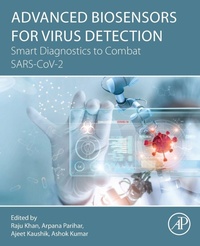
Advanced Biosensors for Virus Detection
Smart Diagnostics to Combat SARS-CoV-2
Published on 9. March 2022
Book
Paperback/Softback
476 pages
978-0-12-824494-4 (ISBN)
Description
Advanced Biosensors for Virus Detection: Smart Diagnostics to Combat Against the SARS-CoV2 Pandemic covers the development of biosensor-based approaches for the diagnosis and prognosis of viral infections, specifically coronaviruses. The book discusses wide-ranging topics of available biosensor-based technologies and their application for early viral detection. Sections cover the emergence of SARS-CoV, MERS-CoV and SARS-CoV2, the global health response, the impact on affected populations, state-of-the art biomarkers, and risk factors. Specific focus is given to COVID-19, with coverage of genomic profiling, strain variation and the pathogenesis of SARS-CoV2.
In addition, current therapeutics, nano-abled advancements and challenges in the detection of SARS-CoV2 and COVID-19 management are discussed, along with the role of nanomaterials in the development of biosensors and how biosensors can be scaled up for clinical applications and commercialization.
In addition, current therapeutics, nano-abled advancements and challenges in the detection of SARS-CoV2 and COVID-19 management are discussed, along with the role of nanomaterials in the development of biosensors and how biosensors can be scaled up for clinical applications and commercialization.
More details
Language
English
Place of publication
San Diego
United States
Publishing group
Elsevier Science Publishing Co Inc
Target group
Professional and scholarly
virologists, clinicians, biomedical engineers, pathologists, molecular biologists, medical practitioners, analytical chemists and academics
Product notice
Paperback (trade)
Illustrations
Approx. 100 illustrations; Illustrations
Dimensions
Height: 235 mm
Width: 191 mm
Thickness: 24 mm
Weight
816 gr
ISBN-13
978-0-12-824494-4 (9780128244944)
Copyright in bibliographic data and cover images is held by Nielsen Book Services Limited or by the publishers or by their respective licensors: all rights reserved.
Schweitzer Classification
Other editions
Additional editions

Frsc Khan | MSc Parihar BSc | MSc Kaushik
Advanced Biosensors for Virus Detection
Smart Diagnostics to Combat SARS-CoV-2
E-Book
03/2022
Academic Press
€155.00
Available for download
Persons
Raju Khan is a Senior Principal Scientist and Professor, at CSIR-Advanced Materials and Processes Research Institute, Bhopal. He did his PhD in Chemistry in 2005 from Jamia Millia Islamia, Central University, New Delhi, and Postdoctoral researcher at the "Sensor Research Laboratory? University of the Western Cape, Cape Town. His current research involved synthesizing novel materials to fabricate electrochemical and fluorescence-based biosensors integrated with microfluidics to detect target disease risk biomarkers for health care monitoring. He has published over 150 papers in SCI journal, which attracted over 5500 citations as per Google Scholar, published 45 book chapters in the reputed book Elsevier and Taylor Francis, editing of 28 books from Elsevier and Taylor Francis, and his research has been highlighted in Nature India. He has supervised 5 PhD and 30 undergraduate/postgraduate theses and has supervised 4 numbers of postdoctoral fellows under the scheme of N-PDF, CSIR-Nehru Fellowship, and DST-Women Scientist Projects.
Arpana Parihar is a DST Scientist B at CSIR-Advanced Materials and Processes Research Institute (AMPRI), Bhopal, India. She has 8 years of research and teaching experience and her current research interests include fabrication (Micro/Nano-fabrication) of Bio-devices/bio-medical POCT Devices for early diagnosis of cancer and infectious disease. She has gained significant expertise in the field of 3D cell culture, drug designing, tissue engineering, photodynamic therapy, molecular dynamic simulations, and immunoinformatics. Dr. Ajeet Kaushik is an Associate Professor of Chemistry at the Department of Chemistry, at Florida Polytechnic University, Florida, United States, as well as an ICS Fellow and Fulbright Specialist. Currently he is exploring nano-enabled technologies for health and environmental monitoring. He has authored or co-authored over 350 publications, published 14 edited books, and has 4 patents, as well as various other editorial roles and international collaborations. Dr. Kaushik's research interests include green chemistry, catalysis, drug delivery systems, electrochemistry, sensors, and point-of-care sensing for sustainable health and the environment.
Dr. Ashok Kumar is currently working as an Associate Professor in the Department of Biochemistry of All India Institute of Medical Sciences Bhopal. His current research interest is understanding the role of non-coding RNAs and sphingosine-1-phosphate signaling in Head and Neck Cancer. He received his PhD degree from Sanjay Gandhi Postgraduate Institute of Medical Sciences (SGPGIMS) Lucknow, India. Then, he received postdoctoral training from UCSFBenioff's Children's Hospital Oakland & Research Centre, Oakland, CA, USA. Dr. Ashok Kumar's major area of research work are Cell & Molecular Biology, Cancer Biology, Immunology & Sphingolipid signaling. He has more than 15 years of research experience. He has published more than 50 research articles and 10 book chapters and he has edited two books. He is a member of several international professional societies including American Association of Cancer Research and Fellow of Royal Society of Biology
Arpana Parihar is a DST Scientist B at CSIR-Advanced Materials and Processes Research Institute (AMPRI), Bhopal, India. She has 8 years of research and teaching experience and her current research interests include fabrication (Micro/Nano-fabrication) of Bio-devices/bio-medical POCT Devices for early diagnosis of cancer and infectious disease. She has gained significant expertise in the field of 3D cell culture, drug designing, tissue engineering, photodynamic therapy, molecular dynamic simulations, and immunoinformatics. Dr. Ajeet Kaushik is an Associate Professor of Chemistry at the Department of Chemistry, at Florida Polytechnic University, Florida, United States, as well as an ICS Fellow and Fulbright Specialist. Currently he is exploring nano-enabled technologies for health and environmental monitoring. He has authored or co-authored over 350 publications, published 14 edited books, and has 4 patents, as well as various other editorial roles and international collaborations. Dr. Kaushik's research interests include green chemistry, catalysis, drug delivery systems, electrochemistry, sensors, and point-of-care sensing for sustainable health and the environment.
Dr. Ashok Kumar is currently working as an Associate Professor in the Department of Biochemistry of All India Institute of Medical Sciences Bhopal. His current research interest is understanding the role of non-coding RNAs and sphingosine-1-phosphate signaling in Head and Neck Cancer. He received his PhD degree from Sanjay Gandhi Postgraduate Institute of Medical Sciences (SGPGIMS) Lucknow, India. Then, he received postdoctoral training from UCSFBenioff's Children's Hospital Oakland & Research Centre, Oakland, CA, USA. Dr. Ashok Kumar's major area of research work are Cell & Molecular Biology, Cancer Biology, Immunology & Sphingolipid signaling. He has more than 15 years of research experience. He has published more than 50 research articles and 10 book chapters and he has edited two books. He is a member of several international professional societies including American Association of Cancer Research and Fellow of Royal Society of Biology
Editor
Senior Principal Scientist and Professor, CSIR-Advanced Materials & Processes Research Institute, Bhopal, Madhya Pradesh, India
Industrial Waste Utilization, Nano and Biomaterials, CSIR-Advanced, Materials and Processes, Research Institute (AMPRI), Bhopal, Madhya, Pradesh, India
Department of Chemistry, Florida Polytechnic University, Florida, United States
Associate Professor, Department of Biochemistry, All India Institute of Medical Sciences (AIIMS), Bhopal, MP, India
Content
1. Emergence of coronavirus epidemic and pandemic
2. Emergence of novel coronavirus (SARS-COV-2) and global public health response
3. Lessons learned from coronavirus (SARS-CoV, MERS-CoV and SARS-CoV2) and Socio-economic impact of (SARS-COV-2) pandemic
4. Current therapeutics for COVID-19 management
5. Exploring SARS-COV-2 genomic profiling and strain variation
6. Profiling and pathogenesis of SARS-CoV2
7. Nano-enabled advancements in COVID-19 management
8. Challenges in SARS-CoV2 detection needed to management COVID-19 pandemic
9. State-of-the-art diagnostic to manage coronavirus epidemic and pandemic
10. Biomarkers and risk factors associated with coronavirus infection
11. Protein Biomarkers
12. Genomic Biomarkers
13. Patients fluid as antibody
14. Biological/Synthetic Receptors used for Biosensors development for coronavirus detection
(a) Antibody based
(b) Enzyme based
(c) Aptamer based
15. Electrochemical biosensors for viral infection diagnostics
16. Optical Biosensors for viral infection diagnostics
17. Calorimetric Biosensors for viral infection diagnostics
18. Role of Magnetic nanoparticles in development of Biosensors for viral infection diagnostics
19. Advances in nanomaterials for biosensor development for virus detection
20. Multiplexed biosensors for virus detection
21. Acoustic/electrical biosensors for diagnostic approaches
22. Role of mechanical biosensors in diagnostic approaches
23. Fluorescence Based Biosensors for coronavirus infection diagnostics
24. Raman based biosensors for coronavirus infection diagnostics
25. Miniaturized analytical system for Point-of-care coronavirus infection diagnostics
26. Microfluidic Device with Integrated Biosensors for coronavirus infection diagnostics
27. Currently available Biosensor based approaches for SARS-CoV-2 detection
28. Biosensors based approaches for other viral infection detection
29. Lab-on-chip devices for coronavirus infection diagnostics
30. Scaling up of biosensors for clinical applications and commercialization
31. Future aspects of biosensor-based devices in disease detection
2. Emergence of novel coronavirus (SARS-COV-2) and global public health response
3. Lessons learned from coronavirus (SARS-CoV, MERS-CoV and SARS-CoV2) and Socio-economic impact of (SARS-COV-2) pandemic
4. Current therapeutics for COVID-19 management
5. Exploring SARS-COV-2 genomic profiling and strain variation
6. Profiling and pathogenesis of SARS-CoV2
7. Nano-enabled advancements in COVID-19 management
8. Challenges in SARS-CoV2 detection needed to management COVID-19 pandemic
9. State-of-the-art diagnostic to manage coronavirus epidemic and pandemic
10. Biomarkers and risk factors associated with coronavirus infection
11. Protein Biomarkers
12. Genomic Biomarkers
13. Patients fluid as antibody
14. Biological/Synthetic Receptors used for Biosensors development for coronavirus detection
(a) Antibody based
(b) Enzyme based
(c) Aptamer based
15. Electrochemical biosensors for viral infection diagnostics
16. Optical Biosensors for viral infection diagnostics
17. Calorimetric Biosensors for viral infection diagnostics
18. Role of Magnetic nanoparticles in development of Biosensors for viral infection diagnostics
19. Advances in nanomaterials for biosensor development for virus detection
20. Multiplexed biosensors for virus detection
21. Acoustic/electrical biosensors for diagnostic approaches
22. Role of mechanical biosensors in diagnostic approaches
23. Fluorescence Based Biosensors for coronavirus infection diagnostics
24. Raman based biosensors for coronavirus infection diagnostics
25. Miniaturized analytical system for Point-of-care coronavirus infection diagnostics
26. Microfluidic Device with Integrated Biosensors for coronavirus infection diagnostics
27. Currently available Biosensor based approaches for SARS-CoV-2 detection
28. Biosensors based approaches for other viral infection detection
29. Lab-on-chip devices for coronavirus infection diagnostics
30. Scaling up of biosensors for clinical applications and commercialization
31. Future aspects of biosensor-based devices in disease detection