

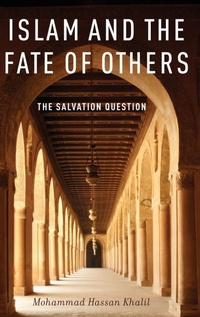
Islam and the Fate of Others
The Salvation Question
1st Edition
Published on 24. May 2012
Book
Hardback
272 pages
978-0-19-979666-3 (ISBN)
Description
Can non-Muslims be saved? And can those who are damned to hell ever be redeemed? Mohammad Hassan Khalil examines the writings of influential medieval and modern Muslim scholars on the controversial question of non-Muslim salvation.
Islam and the Fate of Others is an illuminating study of four of the most prominent figures in the history of Islam: al-Ghazali, Ibn 'Arabi, Ibn Taymiyya, and Rashid Rida, as well as a wide variety of other writers, including Ibn Qayyim al-Jawziyya, Mulla Sadra, Shah Wali Allah of Delhi, Muhammad 'Ali of Lahore, Sayyid Qutb, Yusuf al-Qaradawi, and Farid Esack. Khalil demonstrates that though these theologians tended to shun a purely pluralistic concept of salvation, most envisioned a Paradise populated with Muslims and non-Muslims alike, and many believed in a just and merciful God. Khalil reveals that these writers' interpretations of the Qur'an and hadith corpus-from optimistic depictions of Judgment Day to notions of a temporal Hell and salvation for all-challenge widespread assumptions about Islamic scripture and thought.
Islam and the Fate of Others is an illuminating study of four of the most prominent figures in the history of Islam: al-Ghazali, Ibn 'Arabi, Ibn Taymiyya, and Rashid Rida, as well as a wide variety of other writers, including Ibn Qayyim al-Jawziyya, Mulla Sadra, Shah Wali Allah of Delhi, Muhammad 'Ali of Lahore, Sayyid Qutb, Yusuf al-Qaradawi, and Farid Esack. Khalil demonstrates that though these theologians tended to shun a purely pluralistic concept of salvation, most envisioned a Paradise populated with Muslims and non-Muslims alike, and many believed in a just and merciful God. Khalil reveals that these writers' interpretations of the Qur'an and hadith corpus-from optimistic depictions of Judgment Day to notions of a temporal Hell and salvation for all-challenge widespread assumptions about Islamic scripture and thought.
Reviews / Votes
Khalil's fine work is perhaps best understood as primarily a work which studies historical theology rather than a work of contemporary theology. Indeed, through sober and meticulous analysis and copious annotation, Khalil does a good job of hiding his own theological tendencies and views on Islamic soteriology. * Amir Dastmalchian, Journal of Shi'a Islamic Studies. * Khalil's volumes encourage us to perceive inter-religious dialogue on a deeper level than that of superficial do-gooders unable to understand the real difficulties of religious confrontation. * Marginalia *More details
Language
English
Place of publication
New York
United States
Target group
College/higher education
Scholars and students of Islam, religious studies, theology, Middle Eastern studies, history
Dimensions
Height: 240 mm
Width: 161 mm
Thickness: 21 mm
Weight
625 gr
ISBN-13
978-0-19-979666-3 (9780199796663)
Copyright in bibliographic data and cover images is held by Nielsen Book Services Limited or by the publishers or by their respective licensors: all rights reserved.
Schweitzer Classification
Other editions
Additional editions
E-Book
05/2012
1st Edition
OUP eBook
€42.49
Available for download
E-Book
10/2011
1st Edition
OUP eBook
€60.99
Available for download
Person
Mohammad Hassan Khalil is Professor of Religious Studies, Adjunct Professor of Law, and Director of the Muslim Studies Program at Michigan State University. He is the author of Islam and the Fate of Others: The Salvation Question (2012) and editor of Between Heaven and Hell: Islam, Salvation, and the Fate of Others (2013) and Muslims and US Politics Today: A Defining Moment (2019). In 2015 he received the Michigan State University Teacher-Scholar Award.
Content
Acknowledgments ; Conventions ; Introduction: Rethinking Our Assumptions ; Chapter 1: Damnation as the Exception-The Case of Ghazali ; Chapter 2: All Paths Lead to God-The Case of Ibn 'Arabi ; Chapter 3: The Redemption of Humanity-The Case of Ibn Taymiyya ; Chapter 4: The Modern Scene-Rashid Rida and Beyond ; Glossary ; Notes ; Bibliography