

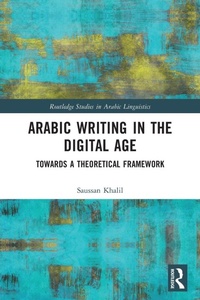
Arabic Writing in the Digital Age
Towards a Theoretical Framework
1st Edition
Published on 29. January 2024
Book
Paperback/Softback
178 pages
978-0-367-49070-6 (ISBN)
Description
The written and spoken forms of Arabic have been traditionally viewed as separate forms of the language that rarely overlap in writing, but this book will examine the recently emerged concept of 'mixed' writing that combines both written and spoken forms.
This book takes a close look at different examples of mixed Arabic writing in modern (twentieth to twenty-firstt century) print and online literature, offering an analysis of this type of mixing alongside a dynamic model for analysing mixed Arabic writing, and the motivations for producing this type of writing. This book further introduces the ground-breaking concept of the seven writing styles for Arabic, ranging from Classical Arabic to ChatSpeak, whilst also offering an overview of early Arabic literacy and children's literature.
Primarily aimed at Arabic researchers and teachers in linguistics, sociolinguistics, identity studies, politics and Teaching Arabic as a Foreign Language, this book would also be informative for undergraduate and postgraduate students studying Arabic as foreign language, Arabic linguistics and dialectology.
This book takes a close look at different examples of mixed Arabic writing in modern (twentieth to twenty-firstt century) print and online literature, offering an analysis of this type of mixing alongside a dynamic model for analysing mixed Arabic writing, and the motivations for producing this type of writing. This book further introduces the ground-breaking concept of the seven writing styles for Arabic, ranging from Classical Arabic to ChatSpeak, whilst also offering an overview of early Arabic literacy and children's literature.
Primarily aimed at Arabic researchers and teachers in linguistics, sociolinguistics, identity studies, politics and Teaching Arabic as a Foreign Language, this book would also be informative for undergraduate and postgraduate students studying Arabic as foreign language, Arabic linguistics and dialectology.
Reviews / Votes
"The linguistic phenomenon of Arabic code-switching and translanguaging in written Arabic has recently emerged as a powerful form of communication online. The connection between these forms of communication and the socio-political impact they have within the ongoing tumultuous transformations in the Arab world makes this study very appealing. It is true that things move and change very rapidly in the linguistic realm of cyber communication, but such is the rigorous approach on which the book is based, that I believe this would be a book that will continue to be used in years to come, also by virtue of its being an original, indeed pioneering, study that addresses the colloquial/standard variation of written Arabic."- Fabio Caiani, Department of Arabic and Persian, University of St. Andrews, UK
More details
Series
Language
English
Place of publication
London
United Kingdom
Publishing group
Taylor & Francis Ltd
Illustrations
22 s/w Tabellen, 10 s/w Photographien bzw. Rasterbilder, 10 s/w Abbildungen
22 Tables, black and white; 10 Halftones, black and white; 10 Illustrations, black and white
Dimensions
Height: 234 mm
Width: 156 mm
Thickness: 10 mm
Weight
295 gr
ISBN-13
978-0-367-49070-6 (9780367490706)
Copyright in bibliographic data and cover images is held by Nielsen Book Services Limited or by the publishers or by their respective licensors: all rights reserved.
Schweitzer Classification
Other editions
Additional editions
Book
05/2022
1st Edition
Routledge
€206.00
Shipment within 15-20 days
E-Book
05/2022
1st Edition
Routledge
€55.49
Available for download
E-Book
05/2022
1st Edition
Routledge
€55.49
Available for download
Person
Saussan Khalil, Senior Arabic Language Teacher, Faculty of Asian and Middle Eastern Studies, University of Cambridge, UK. Founder & Director, Kalamna CIC (www.kalamna.org).
Content
Contents
List of Figures
Acknowledgements
Introduction
Variation in Arabic
A delineation of variation in Arabic
The proposed theoretical framework: seven writing styles
A practical application of the writing styles in online writing
Colloquial Written Arabic in print, in various dialects
Children's literature and early literacy
Conclusion
Index
List of Figures
Acknowledgements
Introduction
Variation in Arabic
A delineation of variation in Arabic
The proposed theoretical framework: seven writing styles
A practical application of the writing styles in online writing
Colloquial Written Arabic in print, in various dialects
Children's literature and early literacy
Conclusion
Index