

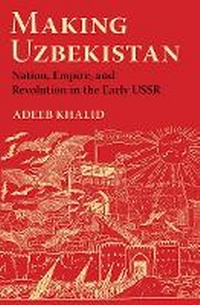
Making Uzbekistan
Nation, Empire, and Revolution in the Early USSR
Published on 21. December 2015
Book
Hardback
444 pages
978-0-8014-5409-7 (ISBN)
Description
In Making Uzbekistan, Adeeb Khalid chronicles the tumultuous history of Central Asia in the age of the Russian revolution. He explores the complex interaction between Uzbek intellectuals, local Bolsheviks, and Moscow to sketch out the flux of the situation in early-Soviet Central Asia. His focus on the Uzbek intelligentsia allows him to recast our understanding of Soviet nationalities policies. Uzbekistan, he argues, was not a creation of Soviet policies, but a project of the Muslim intelligentsia that emerged in the Soviet context through the interstices of the complex politics of the period. Making Uzbekistan introduces key texts from this period and argues that what the decade witnessed was nothing short of a cultural revolution.
Open Access edition funded by the National Endowment for the Humanities
Open Access edition funded by the National Endowment for the Humanities
Reviews / Votes
[T]his brilliant book demonstrates that modern Uzbekistan was unequivocally made by Uzbek intellectuals in Central Asia, and not by Bolshevik commissars in Moscow. Adeeb Khalid has offered invaluable evidence to argue that Central Asia's political fate remains equally in the hands of local leaders, and is not determined by obscure outside forces. It is in this sense that Making Uzbekistan will make a lasting contribution to Central Asian Studies.(Europe-Asia Studies) Khalid successfully compiles an impressive and outstanding account of the unfolding events in the making of Uzbekistan in the tumultuous epoch of the Russian Revolution as a result of his encyclopedic comprehension of the sociohistorical considerations of the period and his unique linguistic capabilities.
(Acta Via Serica) Adeeb Khalid's Making Uzbekistan is a careful reconstruction of Muslim reformist thought in Turkestan, which advances considerably our understanding of the reasons why sections of the local intelligentsia participated actively in the Soviet construction.
(American Historical Review)
More details
Language
English
Place of publication
Ithaca
United States
Target group
College/higher education
Professional and scholarly
Product notice
Paper over boards
Illustrations
8 halftones, 4 maps - 8 Halftones, black and white
Dimensions
Height: 235 mm
Width: 155 mm
Thickness: 35 mm
Weight
907 gr
ISBN-13
978-0-8014-5409-7 (9780801454097)
Copyright in bibliographic data and cover images is held by Nielsen Book Services Limited or by the publishers or by their respective licensors: all rights reserved.
Schweitzer Classification
Other editions
Additional editions
E-Book
12/2015
Cornell University Press
€4.49
Available for download
Person
Adeeb Khalid is Jane and Raphael Bernstein Professor of Asian Studies and History at Carleton College. He is the author of Islam after Communism and The Politics of Muslim Cultural Reform.
Content
Introduction
1. Intelligentsia and Reform in Tsarist Central Asia
2. The Moment of Opportunity
3. Nationalizing the Revolution
4. The Muslim Republic of Bukhara
5. The Long Road to Soviet Power
6. A Revolution of the Mind
7. Islam between Reform and Revolution
8. The Making of Uzbekistan
9. Tajik as a Residual Category
10. The Ideological Front
11. The Assault
12. Toward a Soviet Order
Epilogue
Glossary
Bibliography of Primary Sources
Index
1. Intelligentsia and Reform in Tsarist Central Asia
2. The Moment of Opportunity
3. Nationalizing the Revolution
4. The Muslim Republic of Bukhara
5. The Long Road to Soviet Power
6. A Revolution of the Mind
7. Islam between Reform and Revolution
8. The Making of Uzbekistan
9. Tajik as a Residual Category
10. The Ideological Front
11. The Assault
12. Toward a Soviet Order
Epilogue
Glossary
Bibliography of Primary Sources
Index