

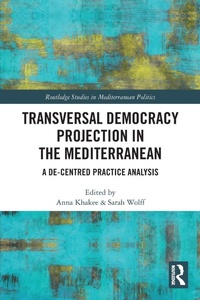
Transversal Democracy Projection in the Mediterranean
A De-Centred Practice Analysis
1st Edition
Will be published approx. on 26. December 2025
Book
Paperback/Softback
150 pages
978-1-032-79565-2 (ISBN)
Description
This book expands on the existing literature on the international dimension of democratization by introducing the concept of democracy projection. Democracy projection is defined as the projection of (democratic) norms through the every-day practice of interactions - beyond any donor-recipient relationship - between states and foreign civil society actors on issue areas where both sides have interests to defend.
The edited volume examines a variety of such issue areas, including trade, anti-corruption, applied research, gender and LGBTI, focusing on EU practices in its everyday dealings with civil society in the Southern Mediterranean. Based on comparative case studies relying on extensive interviews, direct observations and content analysis, the chapters in this book conclude that the extent to which democracy is projected varies according to four main factors: the EU's perceived interest, its ideational commitment to norms of dialogue and inclusion, the degree of institutional inertia, and dominant discourses/structures of meanings which preclude EU engagement on substance.
Transversal Democracy Projection in the Mediterranean will be of interest to students and scholars of Political Science, International Relations, and Democratisation studies. The chapters in this book were originally published as a special issue of Mediterranean Politics.
The edited volume examines a variety of such issue areas, including trade, anti-corruption, applied research, gender and LGBTI, focusing on EU practices in its everyday dealings with civil society in the Southern Mediterranean. Based on comparative case studies relying on extensive interviews, direct observations and content analysis, the chapters in this book conclude that the extent to which democracy is projected varies according to four main factors: the EU's perceived interest, its ideational commitment to norms of dialogue and inclusion, the degree of institutional inertia, and dominant discourses/structures of meanings which preclude EU engagement on substance.
Transversal Democracy Projection in the Mediterranean will be of interest to students and scholars of Political Science, International Relations, and Democratisation studies. The chapters in this book were originally published as a special issue of Mediterranean Politics.
More details
Series
Language
English
Place of publication
London
United Kingdom
Publishing group
Taylor & Francis Ltd
Target group
College/higher education
Professional and scholarly
Postgraduate, Undergraduate Advanced, and Undergraduate Core
Dimensions
Height: 234 mm
Width: 156 mm
Thickness: 9 mm
Weight
257 gr
ISBN-13
978-1-032-79565-2 (9781032795652)
Copyright in bibliographic data and cover images is held by Nielsen Book Services Limited or by the publishers or by their respective licensors: all rights reserved.
Schweitzer Classification
Other editions
Additional editions
Anna Khakee | Sarah Wolff
Transversal Democracy Projection in the Mediterranean
A De-Centred Practice Analysis
E-Book
08/2024
1st Edition
Routledge
€60.49
Available for download
Anna Khakee | Sarah Wolff
Transversal Democracy Projection in the Mediterranean
A De-Centred Practice Analysis
E-Book
08/2024
1st Edition
Routledge
€60.49
Available for download
Anna Khakee | Sarah Wolff
Transversal Democracy Projection in the Mediterranean
A De-Centred Practice Analysis
Book
08/2024
1st Edition
Routledge
€177.30
Shipment within 10-20 days
Persons
Anna Khakee is Associate Professor in International Relations at the University of Malta and EMA (European MA in Human Rights and Democratisation) Director. Prior to her appointment, she worked as a Senior Researcher at IHEID in Geneva and as a consultant to CSOs, think tanks and IOs, including FRIDE, Geneva Centre for the Democratic Control of Armed Forces (DCAF), the Norwegian Peacebuilding Centre, and the UNDP. She has been a consultant to several Swedish parliamentary and government committees and has served the Maltese Ministry of Foreign Affairs in various capacities. Prof. Khakee has published widely, including in Democratization, International Spectator, Journal of North African Studies, Mediterranean Politics, Communist and Post-Communist Studies, and East European Politics and Societies.
Sarah Wolff is Professor in International Studies and Global Politics at Leiden University. She previously was Professor in European Politics and International Relations at Queen Mary University of London (QMUL), where she also led the Centre for European Research (2017-2023). She has researched extensively EU-Middle East and North Africa, EU-Islam as well as the EU's policies on migration, gender and religion abroad. She is a member of the Editorial Board of the journal Mediterranean Politics. Before joining academia, she worked at the European Commission and the European Parliament. Her book Secular Power Europe and Islam: Identity and Foreign Policy (Michigan University Press, 2021) received the 2023 Best Book Award from the European Union Studies Association.
Sarah Wolff is Professor in International Studies and Global Politics at Leiden University. She previously was Professor in European Politics and International Relations at Queen Mary University of London (QMUL), where she also led the Centre for European Research (2017-2023). She has researched extensively EU-Middle East and North Africa, EU-Islam as well as the EU's policies on migration, gender and religion abroad. She is a member of the Editorial Board of the journal Mediterranean Politics. Before joining academia, she worked at the European Commission and the European Parliament. Her book Secular Power Europe and Islam: Identity and Foreign Policy (Michigan University Press, 2021) received the 2023 Best Book Award from the European Union Studies Association.
Content
Introduction - EU democracy projection in the Southern Mediterranean: A practice analysis 1. Gender equality in Tunisia: The EU's tripartite dialogue 2. Supporting democratic participation beyond democracy promotion? EU Relations with Moroccan and Tunisian civil society in the areas of trade and anti-corruption 3. EU democracy projection in Tunisia: The case of civil society consultations 4. The EU and LGBTI activism in the MENA - The case of Lebanon 5. Assessing dynamics of EU democracy projection through expert communities in the Mediterranean region Conclusion - EU democracy projection: Does the EU practice what it preaches?