

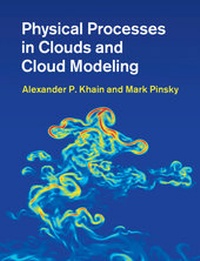
Physical Processes in Clouds and Cloud Modeling
Published on 5. July 2018
Book
Hardback
640 pages
978-0-521-76743-9 (ISBN)
Description
This book presents the most comprehensive and systematic description currently available of both classical and novel theories of cloud processes, providing a much-needed link between cloud theory, observation, experimental results, and cloud modeling. This volume shows why and how modern models serve as a major tool of investigation of cloud processes responsible for atmospheric phenomena, including climate change. It systematically describes classical as well as recent advancements in cloud physics, including cloud-aerosol interaction; collisions of particles in turbulent clouds; and the formation of multiphase cloud particles. As the first of its kind to serve as a practical guide for using state-of-the-art numerical cloud models, major emphasis is placed on explaining how microphysical processes are treated in modern numerical cloud resolving models. The book will be a valuable resource for advanced students, researchers and numerical model designers in cloud physics, atmospheric science, meteorology, and environmental science.
More details
Language
English
Place of publication
Cambridge
United Kingdom
Target group
Professional and scholarly
Product notice
sewn/stitched
Cloth over boards
Illustrations
213 Halftones, color; 8 Halftones, black and white; 248 Line drawings, black and white
Dimensions
Height: 287 mm
Width: 222 mm
Thickness: 38 mm
Weight
2017 gr
ISBN-13
978-0-521-76743-9 (9780521767439)
Copyright in bibliographic data and cover images is held by Nielsen Book Services Limited or by the publishers or by their respective licensors: all rights reserved.
Schweitzer Classification
Other editions
Additional editions
Alexander P. Khain | Mark Pinsky
Physical Processes in Clouds and Cloud Modeling
E-Book
08/2018
Cambridge University Press
€172.99
Available for download
Alexander P. Khain
Physical Processes in Clouds and Cloud Modeling
E-Book
07/2018
Cambridge University Press
€143.99
Available for download
Persons
Alexander P. Khain is a Professor in the Institute of Earth Sciences at the Hebrew University of Jerusalem. He is a renowned leading expert in developing cloud resolving models with precise microphysics in order to investigate the physics of clouds and precipitation. He has participated in several American, European and Asian international research projects where his advanced microphysical schemes were widely used to investigate natural and anthropogenic aerosol effects and relations between microphysics and atmospheric dynamics. He has published two books on tropical cyclones and their interaction with the ocean, and around 200 academic papers on cloud physics, cloud-aerosol interaction, and numerical modeling of clouds, storms and hurricanes. Mark Pinsky is a Professor in the Institute of Earth Sciences at the Hebrew University of Jerusalem. Dr Pinsky is a leading expert in the investigation and modeling of drop condensation/evaporation and turbulence impact on collision processes in clouds. The cloud models he has developed have enabled us - for the first time - to explain the impact of turbulence on precipitation formation as well as drizzle formation. Dr Pinsky has participated in several joint European and American research projects in the fields of cloud physics, precipitation enhancement, and satellite and radar meteorology. He has published over 100 academic papers on cloud physics, cloud modeling, radar meteorology, and estimation of symmetry measure in chemistry.
Content
Preface; List of abbreviations; List of symbols; 1. Clouds: definitions and significance; 2. Cloud particles and their representation in cloud models; 3. Basic equations; 4. Numerical methods used in cloud models; 5. Warm microphysical processes; 6. Microphysical processes in ice and mixed-phase clouds; 7. A powerful tool for cloud investigation; Appendix A. Tensors; Appendix B. Collision efficiency between drops and turbulent enhancement factor; Appendix C. Graupel-drop collision efficiency and kernel; Index.