

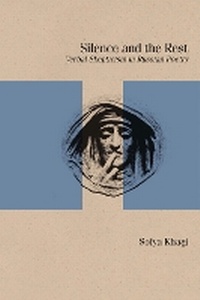
Silence and the Rest
Verbal Skepticism in Russian Poetry
Will be published approx. on 30. December 2020
Book
Paperback/Softback
312 pages
978-0-8101-4319-7 (ISBN)
Description
Scholars have long noted the deeply rooted veneration of the power of the word - both the expressive and communicative capacities of language - in Russian literature and culture. In her ambitious book Silence and the Rest, Sofya Khagi illuminates a consistent counternarrative, showing how, throughout its entire history, Russian poetry can be read as an argument for what she calls 'verbal skepticism.'
Although she deals with many poets from a two-century tradition, Khagi gives special emphasis to Osip Mandelstam, Joseph Brodsky, and Timur Kibirov, offering readings that add new layers of meaning to their work. She posits a long-running dialogue between the poets and the philosophers and theorists who have also been central to the antiverbal strain of Russian culture. Unlike its Western counterpart, the Russian philosophical and theological doubt of the efficacy of the word still grants the author, and literature itself, an ethical force, the inadequacies of language notwithstanding.
Although she deals with many poets from a two-century tradition, Khagi gives special emphasis to Osip Mandelstam, Joseph Brodsky, and Timur Kibirov, offering readings that add new layers of meaning to their work. She posits a long-running dialogue between the poets and the philosophers and theorists who have also been central to the antiverbal strain of Russian culture. Unlike its Western counterpart, the Russian philosophical and theological doubt of the efficacy of the word still grants the author, and literature itself, an ethical force, the inadequacies of language notwithstanding.
Reviews / Votes
"This is a conceptually rich and thought-provoking book, which features masterful close readings . . . It adds many valuable readings to the scholarship on the key figures explored in the volume: Mandelstam, Brodsky, and Kibirov." -Maria Khotimsky, Slavic and East European Journal"Khagi's readings are sensitive and detailed, making particularly adept use of philosophy: she uses important figures such as Theodor Adorno, Alain Badiou, and Wilhelm von Humboldt, along with . . . Bakhtin, Barthes, Boym, Culler, Foucault . . . to dig deeply into the poetry and elicit understanding." -Sibelan Forrester, The Russian Review
"This is a committed and challenging book, thankfully without a tincture of relativism, and boldly offering both close readings and generalizations that merit the attention of anyone seriously concerned with Russian poetry." -G.S. Smith, Slavonic and East European Review
More details
Series
Language
English
Place of publication
Evanston
United States
Dimensions
Height: 228 mm
Width: 152 mm
Thickness: 17 mm
Weight
412 gr
ISBN-13
978-0-8101-4319-7 (9780810143197)
Copyright in bibliographic data and cover images is held by Nielsen Book Services Limited or by the publishers or by their respective licensors: all rights reserved.
Schweitzer Classification
Person
Sofya Khagi is an associate professor in the Department of Slavic Languages & Literatures at the University of Michigan, Ann Arbor. She is the author of Pelevin and Unfreedom: Poetics, Politics, Metaphysics, forthcoming from Northwestern University Press.
Content
Introduction. Silence and the Rest
Verbal Skepticism and Existential Arguments
1. Theological Ineffability
2. (Pre)-Romantic Inexpressibility
3. Absurdist Logophobia
Russian Contributions to Verbal Skepticism
Western Philosophy versus Russian Philosophy versus Russian Poetry
Chapter 1. Initiating the Paradigm: The Inexpressible in Russian Romanticism
Romantic Inexpressibility
Batiushkov, Zhukovsky, Venevitinov: Inexpressible Ideality and Incommunicability
1. Batiushkov
2. Zhukovsky
3. Venevitinov
Tiutchev: Ontology of Otherness and the Operative Paradox
Baratynsky and Lermontov: Incommunicability, Silence, Nihilism
1. Baratynsky
2. Lermontov
Chapter 2. Osip Mandelstam's Many-Voiced Silentiums
(Pre)-Modernist Verbal Skepticism: Fet, Symbolism, and Post Symbolism
Silentium of "Silentium"
Other Shades of Silence
From Silver Silentium to Iron Silence
Chapter 3. A Figure that Leaves You Speechless: Joseph Brodsky on Death and Language
Residence Permit for Heaven: Divine Ineffability and Its Discontents
Linguistic Lunacy
A Slice of the Monotone of Infinity
The Condition We Call Exile and the Death of the Author
Chapter 4. "A Poet Is Less Than a Poet": Timur Kibirov's Merry Logophobia
L(aughing) O(ut) L(oud): The Conceptualist Lineage of Verbal Skepticism
Kibirov's Mechanics of Verbal Subversion
Like Rotten Fish: Beyond Laughter in Kibirov
Bad Infinity and Eternal Recurrence
Conclusion. Logophobia in the Land of Logos
Specificities of the Russian Paradigm
Dichten and Denken
Widening the Space of Ineffability
Notes
Notes to Introduction
Notes to Chapter 1
Notes to Chapter 2
Notes to Chapter 3
Notes to Chapter 4
Notes to Conclusion
Bibliography
Verbal Skepticism and Existential Arguments
1. Theological Ineffability
2. (Pre)-Romantic Inexpressibility
3. Absurdist Logophobia
Russian Contributions to Verbal Skepticism
Western Philosophy versus Russian Philosophy versus Russian Poetry
Chapter 1. Initiating the Paradigm: The Inexpressible in Russian Romanticism
Romantic Inexpressibility
Batiushkov, Zhukovsky, Venevitinov: Inexpressible Ideality and Incommunicability
1. Batiushkov
2. Zhukovsky
3. Venevitinov
Tiutchev: Ontology of Otherness and the Operative Paradox
Baratynsky and Lermontov: Incommunicability, Silence, Nihilism
1. Baratynsky
2. Lermontov
Chapter 2. Osip Mandelstam's Many-Voiced Silentiums
(Pre)-Modernist Verbal Skepticism: Fet, Symbolism, and Post Symbolism
Silentium of "Silentium"
Other Shades of Silence
From Silver Silentium to Iron Silence
Chapter 3. A Figure that Leaves You Speechless: Joseph Brodsky on Death and Language
Residence Permit for Heaven: Divine Ineffability and Its Discontents
Linguistic Lunacy
A Slice of the Monotone of Infinity
The Condition We Call Exile and the Death of the Author
Chapter 4. "A Poet Is Less Than a Poet": Timur Kibirov's Merry Logophobia
L(aughing) O(ut) L(oud): The Conceptualist Lineage of Verbal Skepticism
Kibirov's Mechanics of Verbal Subversion
Like Rotten Fish: Beyond Laughter in Kibirov
Bad Infinity and Eternal Recurrence
Conclusion. Logophobia in the Land of Logos
Specificities of the Russian Paradigm
Dichten and Denken
Widening the Space of Ineffability
Notes
Notes to Introduction
Notes to Chapter 1
Notes to Chapter 2
Notes to Chapter 3
Notes to Chapter 4
Notes to Conclusion
Bibliography