

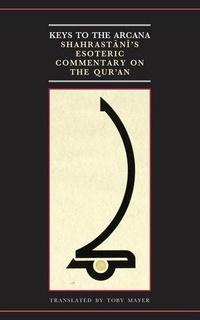
Keys to the Arcana
Shahrastani's Esoteric Commentary on the Qur'an
Oxford University Press
Published on 28. August 2020
Book
Paperback/Softback
418 pages
978-0-19-883306-2 (ISBN)
Description
Only preserved in a single manuscript in Tehran, this remarkable twelfth-century Qur'anic commentary by Muhammad b. 'Abd al-Karim al- Shahrastani marks the achievement of a lifelong, arduous quest for knowledge. Shahrastani began writing Mafatih al-asrar or Keys to the Arcana towards the end of his life and the work reflects the brilliant radicalism of his more private religious views. The introduction and opening chapter of this virtually unknown work is presented here in a bilingual edition, which also includes an introduction and contextual notes by Toby Mayer.
In Keys to the Arcana, Shahrastani breaks down the text of the Qur'an and analyses it from a linguistic point of view, with reference to the history of Qur'anic interpretation. The author's ultimate aim is to use an elaborate set of complimentary concepts - the 'keys' of the work's title - to unearth the esoteric meanings of the Qur'anic verses, which he calls the 'arcana' of the verses (asrar al-ayat). A historian of religious and philosophical doctrines, Shahrastani has generally been considered to be a spokesman for the Sunni religious establishment under the Seljuqs. The complimentary concepts in question, however, appear to derive from the Isma'ili Shi'i intellectual tradition, indicating that the author may have been secretly involved in the Isma'ili movement.
Shahrastani 's unusually esoteric and highly systematic exegesis of the Qur'an provides a vivid picture of the mature state of scriptural commentary in the twelfth-century CE. Dr Mayer's meticulous translation of Shahrastani 's Introduction and Commentary on Surat al-Fatiha, supplemented by the Arabic text, allows the reader and scholar access to this intriguing Muslim intellectual work for the first time.
In Keys to the Arcana, Shahrastani breaks down the text of the Qur'an and analyses it from a linguistic point of view, with reference to the history of Qur'anic interpretation. The author's ultimate aim is to use an elaborate set of complimentary concepts - the 'keys' of the work's title - to unearth the esoteric meanings of the Qur'anic verses, which he calls the 'arcana' of the verses (asrar al-ayat). A historian of religious and philosophical doctrines, Shahrastani has generally been considered to be a spokesman for the Sunni religious establishment under the Seljuqs. The complimentary concepts in question, however, appear to derive from the Isma'ili Shi'i intellectual tradition, indicating that the author may have been secretly involved in the Isma'ili movement.
Shahrastani 's unusually esoteric and highly systematic exegesis of the Qur'an provides a vivid picture of the mature state of scriptural commentary in the twelfth-century CE. Dr Mayer's meticulous translation of Shahrastani 's Introduction and Commentary on Surat al-Fatiha, supplemented by the Arabic text, allows the reader and scholar access to this intriguing Muslim intellectual work for the first time.
More details
Series
Language
English
Place of publication
Oxford
United Kingdom
Target group
College/higher education
Professional and scholarly
Product notice
Paperback (trade)
Unsewn / adhesive bound
Dimensions
Height: 216 mm
Width: 140 mm
Thickness: 23 mm
Weight
531 gr
ISBN-13
978-0-19-883306-2 (9780198833062)
Copyright in bibliographic data and cover images is held by Nielsen Book Services Limited or by the publishers or by their respective licensors: all rights reserved.
Schweitzer Classification
Other editions
Additional editions
Keys to the Arcana
Shahrastani's Esoteric Commentary on the Qur'an
Book
05/2009
Oxford University Press
€116.50
Shipment within 15-20 days
Person
Dr Toby Mayer is a Research Associate in the Quranic Studies Unit at The Institute of Ismaili Studies, London. After completing his undergraduate degree in Indian Studies at the University of Cambridge, he went on to study Medieval Arabic thought at the University of Oxford, where he wrote his doctoral thesis on the Book of Allusions (Isharat) by the major Persian philosopher Ibn Sina.
Content
- Translator's Introduction
- Translation of Shahrastani 's Introduction
- Translation of Shahrastani 's Commentary on Surat al-Fatiha
- Bibliography
- Index of Qur'anic Citations
- General Index
- The Arabic Text of Shahrastani 's Introduction and Commentary on Surat al-Fatiha