

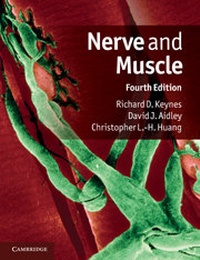
Nerve and Muscle
4th Edition
Published on 6. January 2011
Book
Paperback/Softback
191 pages
978-0-521-73742-5 (ISBN)
Description
Written with undergraduate students in mind, the new edition of this classic textbook provides a compact introduction to the physiology of nerve and muscle. It gives a straightforward account of the fundamentals accompanied by some of the experimental evidence upon which this understanding is based. It first explores the nature of nerve impulses, clarifying their mechanisms in terms of ion flow through molecular channels in cell membranes. There then follows an account of the synaptic transmission processes by which one excitable cell influences activity in another. Finally, the emphasis turns to the consequences of excitable activity in the activation of contraction in skeletal, cardiac and smooth muscle, highlighting the relationships between cellular structure and function. This fourth edition includes new material on the molecular nature of ion channels, the activation of skeletal muscle and the function of cardiac and smooth muscle, reflecting exciting new developments in these rapidly growing fields.
Reviews / Votes
'Huang has taken on the mammoth task of bringing the book up to date and has succeeded in maintaining the enthusiastic and eminently readable approach of Keynes and Aidley who created one of the greatest physiology books covering the crucial areas of nerve and muscle. The fascinating historical perspective on the discovery of membrane potentials, the transmission of nerve impulses and their molecular basis is essential reading for students of medicine and physiology with a curiosity about scientific methods, and progress. ... The new edition shows how the important discoveries in the twentieth century remain central today, and the book provides the groundwork for the enormous and exciting task that still lies ahead, namely the understanding of how nerve transmission in the central nervous system is integrated to achieve the higher functions of the human brain, memory, learning and consciousness.' Michael A. Ferenczi, Imperial College London 'This book is a beautifully written gem. It is clearly illustrated, and it makes one of the most difficult areas of biology completely accessible. It should find its way onto the bookshelves of electrophysiologists everywhere and any students who aspire to master one of the most exciting areas of modern biology.' Denis Noble, University of OxfordMore details
Edition
4th Revised edition
Language
English
Place of publication
Cambridge
United Kingdom
Target group
College/higher education
Professional and scholarly
Edition type
Revised edition
Product notice
Paperback (trade)
Illustrations
5 Tables, black and white; 11 Halftones, unspecified; 130 Line drawings, unspecified
Dimensions
Height: 245 mm
Width: 189 mm
Thickness: 11 mm
Weight
440 gr
ISBN-13
978-0-521-73742-5 (9780521737425)
Copyright in bibliographic data and cover images is held by Nielsen Book Services Limited or by the publishers or by their respective licensors: all rights reserved.
Schweitzer Classification
Other editions
New editions
Christopher L.-H. Huang
Keynes & Aidley's Nerve and Muscle
Book
11/2020
5th Edition
Cambridge University Press
€83.80
Shipment within 15-20 days
Additional editions
Richard D. Keynes
Nerve and Muscle
E-Book
01/2011
1st Edition
Cambridge University Press
€31.99
Available for download
Previous edition
R. D. Keynes | D. J. Aidley
Nerve and Muscle
Book
03/2001
3rd Edition
Cambridge University Press
€32.23
Article exhausted; check for reprint
Persons
Richard D. Keynes is Emeritus Professor of Physiology at the University of Cambridge. David J. Aidley was Senior Fellow in the School of Biological Sciences at the University of East Anglia, Norwich. Christopher Huang is Professor of Cell Physiology at the University of Cambridge.
Content
Preface; 1. Structural organization of the nervous system; 2. Resting and action potentials; 3. The ionic permeability of the nerve membrane; 4. Membrane permeability changes during excitation; 5. Voltage-gated ion channels; 6. Cable theory and saltatory conduction; 7. Neuromuscular transmission; 8. Synaptic transmission in the nervous system; 9. The mechanism of contraction in skeletal muscle; 10. The activation of skeletal muscle; 11. Contractile function in skeletal muscle; 12. Cardiac muscle; 13. Smooth muscle; Further reading; References; Index.