

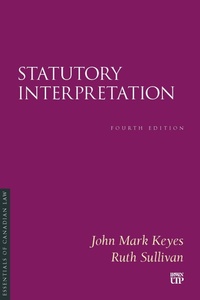
Statutory Interpretation
4th Edition
Will be published approx. on 6. October 2026
Book
Paperback/Softback
560 pages
978-1-0498-0177-3 (ISBN)
Description
Statutory Interpretation provides a clear and authoritative account of how legislation is interpreted and applied in Canada. Grounded in constitutional principles, including the rule of law, democracy, and constitutional supremacy, it traces the evolution of interpretive methodology as developed by the courts and synthesized in Elmer Driedger's Modern Principle of Interpretation.
Legal experts Ruth Sullivan and John Mark Keyes explain how contemporary statutory interpretation hinges on three interrelated aspects of legislation: text, context, and purpose. The book draws attention to these three aspects - exploring in detail how each of these shapes legislative meaning - and integrates recent jurisprudence, particularly that of the Supreme Court of Canada. This updated edition retains the strengths of earlier editions while introducing a revised structure reorganized around the three core dimensions of interpretive analysis so that readers can see how they operate in practice and how they work together in the interpretation of statutes and other legislation.
Frequently cited by Canadian courts and tribunals, the fourth edition of this essential legal text provides an authoritative and up-to-date account of the methodology for interpreting legislation in Canada.
Legal experts Ruth Sullivan and John Mark Keyes explain how contemporary statutory interpretation hinges on three interrelated aspects of legislation: text, context, and purpose. The book draws attention to these three aspects - exploring in detail how each of these shapes legislative meaning - and integrates recent jurisprudence, particularly that of the Supreme Court of Canada. This updated edition retains the strengths of earlier editions while introducing a revised structure reorganized around the three core dimensions of interpretive analysis so that readers can see how they operate in practice and how they work together in the interpretation of statutes and other legislation.
Frequently cited by Canadian courts and tribunals, the fourth edition of this essential legal text provides an authoritative and up-to-date account of the methodology for interpreting legislation in Canada.
More details
Series
Edition
Fourth Edition
Language
English
Place of publication
Toronto
Canada
Target group
College/higher education
Professional and scholarly
Edition type
New edition
Product notice
Paperback (trade)
Dimensions
Height: 229 mm
Width: 152 mm
Thickness: 25 mm
Weight
1 gr
ISBN-13
978-1-0498-0177-3 (9781049801773)
Copyright in bibliographic data and cover images is held by Nielsen Book Services Limited or by the publishers or by their respective licensors: all rights reserved.
Schweitzer Classification
Persons
John Mark Keyes is a sessional professor in the Faculty of Law, University of Ottawa, and an instructor in the Legislative Drafting Program of Athabasca University; he previously worked in the Legislative Services Branch of the Department of Justice Canada and was the Chief Legislative Counsel from 2005 until 2013.
Ruth Sullivan was a professor in the Faculty of Law, University of Ottawa, for twenty-seven years, before joining the Legislative Services Branch of the Department of Justice Canada.
Ruth Sullivan was a professor in the Faculty of Law, University of Ottawa, for twenty-seven years, before joining the Legislative Services Branch of the Department of Justice Canada.
Content
Acknowledgments
Part 1: Introduction
Chapter 1: Introduction to Statutory and Other Legislation
Chapter 2: Interpreting Statutes and Other Legislation - The Big Picture
Chapter 3: Interpretive Methodology in Yet Another Nutshell
Part 2: First Impression Textual Meaning
Chapter 4: Ordinary Meaning
Chapter 5: Technical Meaning and Meanings Fixed by Law
Chapter 6: Original Meaning
Part 3: Text and Its Legislative Context
Chapter 7: Textual Analysis
Chapter 8: Legislative Context
Chapter 9: Multiple Language Versions
Chapter 10: Reliance on Components
Chapter 11: Overlap and Conflict
Part 4: Purposes and Consequences
Chapter 12: Purposive Analysis
Chapter 13: Consequential Analysis
Chapter 14: Plausibility, Mistakes, and Gaps
Part 5: External Context and Aids
Chapter 15: External Context
Chapter 16: Extrinsic Aids
Part 6: Interpretive Harmony with the Larger Legal Context
Chapter 17: Legal Policy Analysis
Chapter 18: Constitutional and Quasi-constitutional Law
Chapter 19: International Law
Chapter 20: Common Law and Civil Law
Chapter 21: Law and Legislation Relating to Indigenous Peoples
Part 7: Legislation and Time
Chapter 22: Operation Application of Legislation in Time
Table of Cases
Index
About the Authors
Part 1: Introduction
Chapter 1: Introduction to Statutory and Other Legislation
Chapter 2: Interpreting Statutes and Other Legislation - The Big Picture
Chapter 3: Interpretive Methodology in Yet Another Nutshell
Part 2: First Impression Textual Meaning
Chapter 4: Ordinary Meaning
Chapter 5: Technical Meaning and Meanings Fixed by Law
Chapter 6: Original Meaning
Part 3: Text and Its Legislative Context
Chapter 7: Textual Analysis
Chapter 8: Legislative Context
Chapter 9: Multiple Language Versions
Chapter 10: Reliance on Components
Chapter 11: Overlap and Conflict
Part 4: Purposes and Consequences
Chapter 12: Purposive Analysis
Chapter 13: Consequential Analysis
Chapter 14: Plausibility, Mistakes, and Gaps
Part 5: External Context and Aids
Chapter 15: External Context
Chapter 16: Extrinsic Aids
Part 6: Interpretive Harmony with the Larger Legal Context
Chapter 17: Legal Policy Analysis
Chapter 18: Constitutional and Quasi-constitutional Law
Chapter 19: International Law
Chapter 20: Common Law and Civil Law
Chapter 21: Law and Legislation Relating to Indigenous Peoples
Part 7: Legislation and Time
Chapter 22: Operation Application of Legislation in Time
Table of Cases
Index
About the Authors