

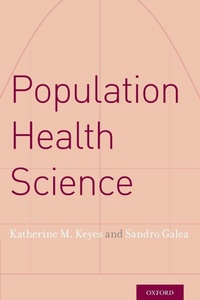
Population Health Science
Published on 15. September 2016
Book
Paperback/Softback
224 pages
978-0-19-045937-6 (ISBN)
Description
Population Health Science formalizes an emerging discipline at the crossroads of social and medical sciences, demography, and economicsan emerging approach to population studies that represents a seismic shift in how traditional health sciences measure and observe health events.
Bringing together theories and methods from diverse fields, this text provides grounding in the factors that shape population health. The overall approach is one of consequentialist science: designing creative studies that identify causal factors in health with multidisciplinary rigor.
Distilled into nine foundational principles, this book guides readers through population science studies that strategically incorporate:
? macrosocial factors
? multilevel, lifecourse, and systems theories
? prevention science fundamentals
? return on investment
? equity and efficiency
Harnessing the power of scientific inquiry and codifying the knowledge base for a burgeoning field, Population Health Science arms readers with tools to shift the curve of population health.
Bringing together theories and methods from diverse fields, this text provides grounding in the factors that shape population health. The overall approach is one of consequentialist science: designing creative studies that identify causal factors in health with multidisciplinary rigor.
Distilled into nine foundational principles, this book guides readers through population science studies that strategically incorporate:
? macrosocial factors
? multilevel, lifecourse, and systems theories
? prevention science fundamentals
? return on investment
? equity and efficiency
Harnessing the power of scientific inquiry and codifying the knowledge base for a burgeoning field, Population Health Science arms readers with tools to shift the curve of population health.
Reviews / Votes
This book's great strength derives from a clear and cohesive narrative dealing with the complex, messy and dynamic way in which the social context of our lives interacts with our individual biological make-up and behaviours - in the here and now, and even preceding conception. [...] The authors seek to embolden the next generation of epidemiologists not to be deterred by political and practical constraints and to embrace ubiquitous factors - those macrosocial variables which might seem out of reach, almost impenetrable. * Glenn Salkeld, International Journal of Epidemiology *More details
Language
English
Place of publication
New York
United States
Target group
Professional and scholarly
Dimensions
Height: 234 mm
Width: 156 mm
Thickness: 13 mm
Weight
386 gr
ISBN-13
978-0-19-045937-6 (9780190459376)
Copyright in bibliographic data and cover images is held by Nielsen Book Services Limited or by the publishers or by their respective licensors: all rights reserved.
Schweitzer Classification
Other editions
Additional editions
Katherine M. Keyes | Sandro Galea
Population Health Science
E-Book
07/2016
1st Edition
OUP eBook
€47.49
Available for download
Katherine M. Keyes | Sandro Galea
Population Health Science
E-Book
07/2016
1st Edition
OUP eBook
€47.49
Available for download
Persons
Katherine M. Keyes, PhD, is an Assistant Professor of Epidemiology at Columbia University. Her research focuses on life course epidemiology with particular attention to psychiatric disorders, including cross-generational cohort effects on substance use, mental health, and chronic disease. She has particular expertise in the development and application of novel epidemiological methods, and in the development of epidemiological theory to measure and elucidate the drivers of population health.
Sandro Galea, MD, DrPH, is the Robert A. Knox Professor and Dean at the School of Public Health at Boston University. A physician and epidemiologist interested in the social production of health of urban populations, his work explores innovative cells-to-society approaches to population health questions, with an overall aim of advancing a consequentialist approach to population health scholarship. He is a past president of the Society for Epidemiologic Research and an elected member of the National Academy of Medicine.
Together Keyes and Galea have taught introductory epidemiology across various institutions for more than 15 years.
Sandro Galea, MD, DrPH, is the Robert A. Knox Professor and Dean at the School of Public Health at Boston University. A physician and epidemiologist interested in the social production of health of urban populations, his work explores innovative cells-to-society approaches to population health questions, with an overall aim of advancing a consequentialist approach to population health scholarship. He is a past president of the Society for Epidemiologic Research and an elected member of the National Academy of Medicine.
Together Keyes and Galea have taught introductory epidemiology across various institutions for more than 15 years.
Content
1. An introduction to population health science
2. Conceptualizing and evaluating causes for population health science
3. The causes of cases versus causes of incidence
4. Population health across levels, systems, and the lifecourse
5. Ubiquity and the macrosocial determinants of population health
6. Causal architecture to understand what matters most: theory
7. Causal architecture and what matters most: quantitative examples
8. Valuing population health interventions, measuring return on investment
9. Equity and efficiency in population health science
10. Prediction in population health science
11. Case study: Can we reduce obesity by encouraging people to eat better?
12. Case study: Simulating the impact of high-risk and population intervention strategies for the prevention of disease
13. Tensions in population health science
2. Conceptualizing and evaluating causes for population health science
3. The causes of cases versus causes of incidence
4. Population health across levels, systems, and the lifecourse
5. Ubiquity and the macrosocial determinants of population health
6. Causal architecture to understand what matters most: theory
7. Causal architecture and what matters most: quantitative examples
8. Valuing population health interventions, measuring return on investment
9. Equity and efficiency in population health science
10. Prediction in population health science
11. Case study: Can we reduce obesity by encouraging people to eat better?
12. Case study: Simulating the impact of high-risk and population intervention strategies for the prevention of disease
13. Tensions in population health science