

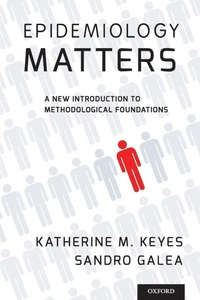
Epidemiology Matters
A New Introduction to Methodological Foundations
Published on 7. August 2014
Book
Paperback/Softback
256 pages
978-0-19-933124-6 (ISBN)
Description
Epidemiology Matters offers a new approach to understanding and identifying the causes of disease -- and with it, how to prevent disease and improve human health. Utilizing visual explanations and examples, this text provides an accessible, step-by-step introduction to the fundamentals of epidemiologic study, from design to analysis.
Across fourteen chapters, Epidemiology Matters teaches the individual competencies that underlie the conduct of an epidemiologic study: identifying populations; measuring exposures and health indicators; taking a sample; estimating associations between exposures and health indicators; assessing evidence for causes working together; assessing internal and external validity of results.
With its consequentialist approach -- designing epidemiologic studies that aim to inform our understanding, and therefore improve public health -- Epidemiology Matters is an introductory text for the next generation of students in medicine and public health.
Across fourteen chapters, Epidemiology Matters teaches the individual competencies that underlie the conduct of an epidemiologic study: identifying populations; measuring exposures and health indicators; taking a sample; estimating associations between exposures and health indicators; assessing evidence for causes working together; assessing internal and external validity of results.
With its consequentialist approach -- designing epidemiologic studies that aim to inform our understanding, and therefore improve public health -- Epidemiology Matters is an introductory text for the next generation of students in medicine and public health.
Reviews / Votes
Epidemiology Matters makes a nice addition to the existing roster of introductory epidemiology texts. The authors provide a clear introduction to central epidemiologic concepts, including causality, internal validity, external validity, study design, and measures of association using a step-bystep approach. Their well-designed website provides useful supplementary materials... The book will be useful to students who take only one course in epidemiology, as well as to scholars who decide to pursue epidemiology in more depth. * American Journal of Epidemiology * This is a unique addition to the ever-expanding library of introductory epidemiology books. The material is easily accessible to beginners, and the consequentialist approach brethes new life into the field.More details
Language
English
Place of publication
New York
United States
Target group
College/higher education
Professional and scholarly
Dimensions
Height: 234 mm
Width: 156 mm
Thickness: 15 mm
Weight
395 gr
ISBN-13
978-0-19-933124-6 (9780199331246)
Copyright in bibliographic data and cover images is held by Nielsen Book Services Limited or by the publishers or by their respective licensors: all rights reserved.
Schweitzer Classification
Other editions
Additional editions
Katherine M. Keyes | Sandro Galea
Epidemiology Matters
A New Introduction to Methodological Foundations
E-Book
10/2014
1st Edition
OUP eBook
€49.99
Available for download
Katherine M. Keyes | Sandro Galea
Epidemiology Matters
A New Introduction to Methodological Foundations
E-Book
06/2014
OUP eBook
€49.99
Available for download
Persons
Katherine M. Keyes, PhD, is Assistant Professor of Epidemiology at Columbia University. Her research focuses on life course epidemiology with particular attention to psychiatric disorders, including cross-generational cohort effects on substance use, mental health, and chronic disease. She has particular expertise in the development and application of novel epidemiological methods, and in the development of epidemiological theory to measure and elucidate the drivers of population health.
Sandro Galea, MD, DrPH, is Chair of the Department of Epidemiology at Columbia University. His work focuses on the social production of health of urban populations, innovative cells-to-society approaches to population health, and advancing a consequentialist approach to epidemiology in the service of population health. He is a past president of the Society for Epidemiologic Research and an elected member of the Institute of Medicine of the National Academies of Science.
Sandro Galea, MD, DrPH, is Chair of the Department of Epidemiology at Columbia University. His work focuses on the social production of health of urban populations, innovative cells-to-society approaches to population health, and advancing a consequentialist approach to epidemiology in the service of population health. He is a past president of the Society for Epidemiologic Research and an elected member of the Institute of Medicine of the National Academies of Science.
Content
1. An introduction ; 2. What is a population and what is population health? ; 3. What is an exposure, what is a disease, and how do we measure them? ; 4. What is a sample? ; 5. Watching a sample, counting cases ; 6. Are exposures associated with health indicators? ; 7. What is a cause? ; 8. Is the association causal, or are there alternative explanations? ; 9. How do non-causal associations arise? ; 10. How can we mitigate against non-causal associations in design and analysis? ; 11. When do causes work together? ; 12. Do the results matter beyond the study sample? ; 13. How do we identify disease early to minimize its consequences? ; 14. Conclusion: Epidemiology and what matters most