

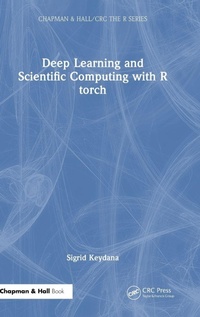
Deep Learning and Scientific Computing with R torch
1st Edition
Published on 5. April 2023
Book
Hardback
394 pages
978-1-032-23138-9 (ISBN)
Description
torch is an R port of PyTorch, one of the two most-employed deep learning frameworks in industry and research. It is also an excellent tool to use in scientific computations. It is written entirely in R and C/C++.
Though still "young" as a project, R torch already has a vibrant community of users and developers. Experience shows that torch users come from a broad range of different backgrounds. This book aims to be useful to (almost) everyone. Globally speaking, its purposes are threefold:
Provide a thorough introduction to torch basics - both by carefully explaining underlying concepts and ideas, and showing enough examples for the reader to become "fluent" in torch
Again with a focus on conceptual explanation, show how to use torch in deep-learning applications, ranging from image recognition over time series prediction to audio classification
Provide a concepts-first, reader-friendly introduction to selected scientific-computation topics (namely, matrix computations, the Discrete Fourier Transform, and wavelets), all accompanied by torch code you can play with.
Deep Learning and Scientific Computing with R torch is written with first-hand technical expertise and in an engaging, fun-to-read way.
Though still "young" as a project, R torch already has a vibrant community of users and developers. Experience shows that torch users come from a broad range of different backgrounds. This book aims to be useful to (almost) everyone. Globally speaking, its purposes are threefold:
Provide a thorough introduction to torch basics - both by carefully explaining underlying concepts and ideas, and showing enough examples for the reader to become "fluent" in torch
Again with a focus on conceptual explanation, show how to use torch in deep-learning applications, ranging from image recognition over time series prediction to audio classification
Provide a concepts-first, reader-friendly introduction to selected scientific-computation topics (namely, matrix computations, the Discrete Fourier Transform, and wavelets), all accompanied by torch code you can play with.
Deep Learning and Scientific Computing with R torch is written with first-hand technical expertise and in an engaging, fun-to-read way.
Reviews / Votes
"The book is very well written and easy to follow with plenty of illustrations and explanations via examples and codes. I have learned a lot from the book and believe that many R users can greatly benefit from it as well even without an extensive machine learning background."- Yang Ni, Texa A&M University, U.S.A, The MAerican Statistician, April 2024
More details
Series
Language
English
Place of publication
United Kingdom
Publishing group
Taylor & Francis Ltd
Target group
Professional and scholarly
Illustrations
91 s/w Abbildungen, 32 s/w Photographien bzw. Rasterbilder, 59 s/w Zeichnungen, 6 s/w Tabellen
6 Tables, black and white; 59 Line drawings, black and white; 32 Halftones, black and white; 91 Illustrations, black and white
Dimensions
Height: 240 mm
Width: 161 mm
Thickness: 27 mm
Weight
784 gr
ISBN-13
978-1-032-23138-9 (9781032231389)
Copyright in bibliographic data and cover images is held by Nielsen Book Services Limited or by the publishers or by their respective licensors: all rights reserved.
Schweitzer Classification
Other editions
Additional editions
Sigrid Keydana
Deep Learning and Scientific Computing with R torch
E-Book
04/2023
1st Edition
Chapman & Hall/CRC
€76.49
Available for download
Sigrid Keydana
Deep Learning and Scientific Computing with R torch
Book
04/2023
1st Edition
Chapman & Hall/CRC
€81.10
Shipment within 10-20 days
Sigrid Keydana
Deep Learning and Scientific Computing with R torch
E-Book
04/2023
1st Edition
Chapman & Hall/CRC
€76.49
Available for download
Person
Sigrid Keydana is an Applied Researcher at Posit (formerly RStudio, PBC). She has a background in the humanities, psychology, and information technology, and is passionate about explaining complex concepts in a concepts-first, comprehensible way.
Content
Part 1. Getting familiar with torch 1. Overview 2. On torch, and how to get it 3. Tensors 4. Autograd 5. Function minimization with autograd 6. A neural network from scratch 7. Modules 8. Optimizers 9. Loss functions 10. Function minimization with L-BFGS 11. Modularizing the neural network Part 2. Deep learning with torch 12. Overview 13. Loading data 14. Training with luz 15. A first go at image classification 16. Making models generalize 17. Speeding up training 18. Image classification, take two: Improving performance 19. Image segmentation 20. Tabular data 21. Time series 22. Audio classification Part 3. Other things to do with torch: Matrices, Fourier Transform, and Wavelets 23. Overview 24. Matrix computations: Least-squares problems 25. Matrix computations: Convolution 26. Exploring the Discrete Fourier Transform (DFT) 27. The Fast Fourier Transform (FFT) 28. Wavelets