

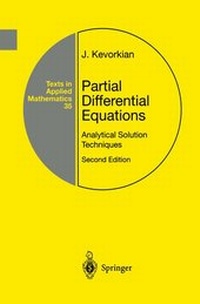
Partial Differential Equations
Analytical Solution Techniques
2nd Edition
Published on 5. December 2010
Book
Paperback/Softback
XI, 637 pages
978-1-4419-3139-9 (ISBN)
Description
Mathematics is playing an ever more important role in the physical and biological sciences, provoking a blurring of boundaries between scientific disciplines and a resurgence of interest in the modem as weil as the classical techniques of applied mathematics. This renewal of interest, both in research and teaching, has led to the establishment of the series: Texts in Applied Mathematics (TAM). The development of new courses is a natural consequence of a high level of excitement on the research frontier as newer techniques, such as numerical and symbolic computer systems, dynamical systems, and chaos, mix with and rein force the traditional methods of applied mathematics. Thus, the purpose of this textbook series is to meet the current and future needs of these advances and en courage the teaching of new courses. TAM will publish textbooks suitable for use in advanced undergraduate and beginning graduate courses, and will complement the Applied Mathematical Sci ences (AMS) series, which will focus on advanced textbooks and research level monographs. Preface This is a text for a two-semester or three-quarter sequence of courses in partial differential equations. It is assumed that the student has a good background in vector calculus and ordinary differential equations and has been introduced to such elementary aspects of partial differential equations as separation of variables, and eigenfunction expansions.
Reviews / Votes
From the reviews of the second edition:"The book provides a well chosen collection of analytical solution techniques by applications to a wide class of problems of mathematical physics. It will be useful for the researchers in PDE-s, physicists, engineers and also for students with basic knowledge in vector calculus, ODE-s and PDE-s." (Jeno Hegedus, Acta Scientiarum Mathematicarum, Vol. 71, 2005)"This is the revised and enlarged second edition of a text book on partial differential equations. . the book gives a good overview of a large number of analytic solution techniques for both linear and nonlinear partial differential equations .. In addition, the author always tries to include information on the applications that lead to a particular equation and to use an intuitive approach explaining the mechanisms behind the observed phenomena. . it is definitely an interesting source for both students and teachers." (G. Teschl, Monatshefte für Mathematik, Vol. 133 (4), 2001)"The text presents the classical, analytical techniques used by applied mathematicians, scientist, and engineers to solve problems. . The Kevorkian text is an outstanding treatment of classical PDEs and applications suitable for beginning graduate students in mathematics and applied science. It represents what 'everyone should know' about PDE methods .. If I had to recommend a single book to a research engineer who wanted to learn the basic, analytical tools of PDEs . I might select this book." (J. David Logan, SIAM Review, Vol. 42 (3), 2000)More details
Series
Edition
2., Softcover reprint of hardcover 2nd ed. 2000
Language
English
Place of publication
New York
United States
Target group
Professional and scholarly
Research
Edition type
Revised edition
Product notice
Paperback (trade)
Illustrations
8 s/w Tabellen
8 black & white tables, biography
Dimensions
Height: 23.5 cm
Width: 15.5 cm
Thickness: 33 mm
Weight
985 gr
ISBN-13
978-1-4419-3139-9 (9781441931399)
DOI
10.1007/978-1-4757-3266-5
Schweitzer Classification
Other editions
Additional editions
Book
01/2000
2nd Edition
Springer
€86.62
Article exhausted; check different version
Content
1. The Diffusion Equation.- 2. Laplace's Equation.- 3. The Wave Equation.- 4. Linear Second-Order Equations with Two Independent Variables.- 5. The Scalar Quasilinear First-Order Equation.- 6. Nonlinear First-Order Equations.- 7. Quasilinear Hyperbolic Systems.- 8. Approximate Solutions by Perturbation Methods.- A.1. Review of Green's Function for ODEs Using the Dirac Delta Function.- A.2. Review of Fourier and Laplace Transforms.- A.3. Review of Asymptotic Expansions.- References.