

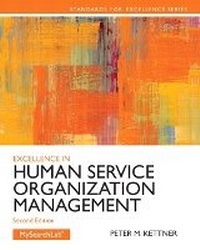
Excellence in Human Service Organization Management
2nd Edition
Published on 5. September 2013
Book
Paperback/Softback
384 pages
978-0-205-08815-7 (ISBN)
Description
An integrated model for management and administrative practice.
Excellence in Human Service Organization Management, 2/e provides guidelines to insure internal consistency within Human Service Organizations. Integrated in management theory, the model presented in the text is adapted to human service organizations generally and social work issues specifically. The text first identifies problems in organizational functioning as well as proposes what managers need to do to put their organizations back on track toward excellence. Then it guides managers through a plan to bring employees on board and continuously nurture them so they identify their success with that of the organization. Standards for Excellence Series -- Designed to help students advance their knowledge, values, and skills, the Standards for Excellence Series assists students in associated CSHSE's National Standards to all levels of human service practice.
Learning Goals
Upon completing this book, readers will be able to:
Identify problems in organizational functioning.
Recognize what managers need to do to get organizations on the track for excellence.
Understand what employees need to do to help the overall well-being of an organization.
Excellence in Human Service Organization Management, 2/e provides guidelines to insure internal consistency within Human Service Organizations. Integrated in management theory, the model presented in the text is adapted to human service organizations generally and social work issues specifically. The text first identifies problems in organizational functioning as well as proposes what managers need to do to put their organizations back on track toward excellence. Then it guides managers through a plan to bring employees on board and continuously nurture them so they identify their success with that of the organization. Standards for Excellence Series -- Designed to help students advance their knowledge, values, and skills, the Standards for Excellence Series assists students in associated CSHSE's National Standards to all levels of human service practice.
Learning Goals
Upon completing this book, readers will be able to:
Identify problems in organizational functioning.
Recognize what managers need to do to get organizations on the track for excellence.
Understand what employees need to do to help the overall well-being of an organization.
More details
Other editions
Previous edition
Book
11/2001
Pearson
€75.70
Article exhausted; check for reprint
Person
Peter M. Kettner is Professor Emeritus at Arizona State University School of Social Work. He is author or co-author of six books, four of which have been translated into multiple languages. He has also authored over 50 articles, monographs, and book chapters on the topics of program planning, macro practice in social work, human services administration, purchase-of-service contracting, and privatization,. Over his 30 year career in academia he served as consultant to five different state human service agencies and dozens of local nonprofit agencies on their design and implementation of effectiveness-based planning systems and purchase of service contracting practices. In retirement he has continued his writing and consultation with local government and nonprofit agencies.
Content
In this Section:
1. Brief Table of Contents
2. Full Table of Contents
BRIEF TABLE OF CONTENTS:
Chapter 1: Developing a Theory and Philosophy of Management
Chapter 2: Understanding the Organization from a Systems Perspective
Chapter 3: Using Structure to Facilitate and Support Achievement of the Agency's Mission
Chapter 4: Job Analysis and Job Design
Chapter 5: Maximizing Organizational Performance through Human Resources Planning
Chapter 6: Strengthening the Organization throughExcellent Recruitment, Selection, and Hiring Practices
Chapter 7: Maximizing Employee Potential through Staff Training and Development
Chapter 8: Promoting Excellence through Well-Designed Motivation and Reward Systems
Chapter 9: Supervision, Performance Appraisal, Rewards, and Termination
Chapter 10: Using Data and Information to Achieve Excellence
Chapter 11: Managing Resources to Support Excellence
Chapter 12: Monitoring and Evaluating Organizational Efforts and Accomplishments
FULL TABLE OF CONTENTS:
Chapter 1: Developing a Theory and Philosophy of Management
Understanding the Manager's Role
Defining Management and Administration
Creating a Positive Work Environment
Establishing Criteria for Organizational Excellence
Excellence as Defined by Accreditation Standards
The Opinions of Managers
Some Themes Emerging from a Study of Organizational Excellence
The Usefulness of Early Management Theory
Scientific Management &nb
1. Brief Table of Contents
2. Full Table of Contents
BRIEF TABLE OF CONTENTS:
Chapter 1: Developing a Theory and Philosophy of Management
Chapter 2: Understanding the Organization from a Systems Perspective
Chapter 3: Using Structure to Facilitate and Support Achievement of the Agency's Mission
Chapter 4: Job Analysis and Job Design
Chapter 5: Maximizing Organizational Performance through Human Resources Planning
Chapter 6: Strengthening the Organization throughExcellent Recruitment, Selection, and Hiring Practices
Chapter 7: Maximizing Employee Potential through Staff Training and Development
Chapter 8: Promoting Excellence through Well-Designed Motivation and Reward Systems
Chapter 9: Supervision, Performance Appraisal, Rewards, and Termination
Chapter 10: Using Data and Information to Achieve Excellence
Chapter 11: Managing Resources to Support Excellence
Chapter 12: Monitoring and Evaluating Organizational Efforts and Accomplishments
FULL TABLE OF CONTENTS:
Chapter 1: Developing a Theory and Philosophy of Management
Understanding the Manager's Role
Defining Management and Administration
Creating a Positive Work Environment
Establishing Criteria for Organizational Excellence
Excellence as Defined by Accreditation Standards
The Opinions of Managers
Some Themes Emerging from a Study of Organizational Excellence
The Usefulness of Early Management Theory
Scientific Management &nb